The Safest and Most Dangerous Cities in Mississippi
 |
November 10, 2026
Mississippi Security Solutions
The following is a list of cities that provide home security solutions in the state of Mississippi
Mississippi’s overall violent crime rate is below the national figure, but its murder rate is 73% higher. That contrast makes the individual offenses especially important here. A favorable overall ranking does not erase the violence experienced by families and neighborhoods.
Mississippi’s violent crime rate is 226.9 offenses per 100,000 residents, 31% below the national rate. Its property crime rate of 1,263.8 is 18% below the national benchmark. The state has the 15th-lowest violent crime rate and the 16th-lowest property crime rate among all states in 2025.
Mississippi Cities With the Highest and Lowest Crime Rates
The following tables compare places with populations of at least 10,000. All rates represent reported offenses per 100,000 residents in 2025.
Cities with the highest property crime rates
| City or town | Property crime rate |
|---|---|
| D'Iberville | 4,389.8 |
| Pascagoula | 4,294.1 |
| Vicksburg | 3,961.4 |
Cities with the highest violent crime rates
| City or town | Violent crime rate |
|---|---|
| Clarksdale | 989.7 |
| Gulfport | 784.6 |
| Laurel | 745.8 |
Cities with the lowest property crime rates
| City or town | Property crime rate |
|---|---|
| Brandon | 299.3 |
| Hernando | 323.2 |
| Madison | 377.8 |
Cities with the lowest violent crime rates
| City or town | Violent crime rate |
|---|---|
| Madison | 21.2 |
| Petal | 25.7 |
| Long Beach | 46.2 |
Source: 2025 FBI Crime in the United States, Table 8. Rankings include places with at least 10,000 residents. Zero reported crime rates and ties at the cutoff are included; rankings use unrounded values.
Mississippi Communities With the Lowest and Highest Crime
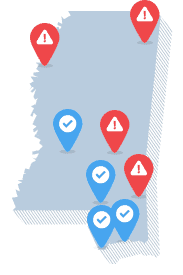
Madison has the lowest violent crime rate among Mississippi’s 31 qualifying cities, at 21.2 offenses per 100,000 residents. Petal follows at 25.7, and Long Beach ranks third at 46.2.
Brandon has the lowest property crime rate at 299.3, followed by Hernando at 323.2 and Madison at 377.8. Madison appears in both low-rate groups.
Clarksdale has the highest violent crime rate among qualifying cities at 989.7, followed by Gulfport at 784.6 and Laurel at 745.8. Each is above the state and national benchmarks.
D’Iberville has the highest property crime rate at 4,389.8, followed by Pascagoula at 4,294.1 and Vicksburg at 3,961.4. None of these cities appears in the three highest violent crime rates, underscoring how the two local comparisons differ.
How Does Crime in Mississippi Compare to Other States
Mississippi’s property crime rate is 18% below the national benchmark. Motor vehicle theft is 30% lower and larceny-theft 22% lower, while burglary is 20% higher. Property crime counts declined 27% between 2022 and 2025.
Property crime rates
Offenses per 100,000 residents, 2025
| Crime type | Mississippi | National |
|---|---|---|
| Property crime overall | 1,263.8 | 1,534.8 |
| Burglary | 231.5 | 193.6 |
| Larceny-theft | 894.0 | 1,144.1 |
| Motor vehicle theft | 138.3 | 197.0 |
The number of property crimes in Mississippi decreased 27% between 2022 and 2025.
The state’s overall violent crime rate is 31% below the national rate, the 15th-lowest among states. Robbery is 59% lower, aggravated assault 28% lower, and rape 22% lower. Murder and nonnegligent manslaughter stands out in the other direction, at 73% above the national rate. Overall violent crime counts fell 7% from 2022 to 2025.
February 2026 reporting on Jackson’s falling 2025 homicide total captured two experiences of the same city. Community organizer Geno Womack described less conflict and fewer deaths, while south Jackson pastor Terry Williams remained concerned after recent shootings in his neighborhood. A decline in killings is real progress, but residents may still feel unsafe where violence continues close to home.
Violent crime rates
Offenses per 100,000 residents, 2025
| Crime type | Mississippi | National |
|---|---|---|
| Violent crime overall | 226.9 | 327.6 |
| Murder and nonnegligent manslaughter | 7.1 | 4.1 |
| Aggravated assault | 171.1 | 238.0 |
| Robbery | 20.5 | 49.4 |
| Rape | 28.2 | 36.1 |
The number of violent crimes in Mississippi decreased 7% between 2022 and 2025.
Percentage changes reflect offense counts, rather than population-adjusted crime rates.
Is Mississippi a Safe Place to Live
Mississippi’s low overall violent crime rate should not overshadow its elevated murder rate. Madison appears in both low-rate groups, while Brandon leads for property crime. The experiences described in Jackson show why residents may welcome falling homicides and still want a stronger response to violence in their neighborhoods.
Where Our Crime Data Comes From
Unless specified otherwise, the information in this article is based on the FBI’s Crime in the United States tables. Statewide offense counts and published crime rates come from Table 5, national benchmarks come from Table 1, and city-level figures come from Table 8.
The state and national rate comparisons use 2025 data. Changes in Mississippi’s violent and property crime counts compare 2022 with 2025. The trend percentages reflect changes in offense counts, rather than population-adjusted rates.
For the local rankings, we calculated violent and property crime rates per 100,000 residents using the populations and offense counts in the 2025 dataset. Only places with at least 10,000 residents were eligible. We included zero reported rates and all places tied at the cutoff for the three lowest-rate selections. Missing values were not treated as zero. State rankings compare the 50 states and exclude the District of Columbia.
Percentages are rounded to whole numbers, and crime rates are rounded to one decimal place. Calculations and rankings use unrounded values. Rankings describe the jurisdictions included in the dataset rather than every community in the state.
Important note: Crime statistics offer valuable insights, but they aren’t the only way to evaluate a community’s safety. Local context, law enforcement participation, reporting practices, population estimates, and geographic boundaries can influence the figures. A zero reported rate does not guarantee that no crime occurred. These comparisons do not establish why crime is higher or lower in a particular place.