LifeLock is a solid identity theft protection service on its own. Depending on your plan, you get up to $3 million in coverage per adult spread across three categories, a one-click TransUnion credit freeze, and three-bureau credit monitoring on its higher tiers.
You can also get LifeLock bundled with Norton 360, which raises the monthly price, especially once you start comparing it to services like Aura that build device protection into every plan by default. So is LifeLock worth buying on its own, or with the Norton 360 bundle attached? Let’s look at the plans and features to help you figure out what fits.
Key Features
Up to $3 million in coverage per adult spread across three categories of coverage
Unique fictitious identity monitoring we rarely see with competitors
One click to freeze your TransUnion credit file
Credit monitoring in all plans with three-bureau credit monitoring in the premium plan
High-quality apps that let you use all the features your plan comes with
Plans and Prices for LifeLock
LifeLock gives you a lot of plans to choose from, and while we like having the options, we can see how it gets overwhelming. There isn’t one clean page on LifeLock’s site that lays out every plan side by side. You’ll find the Norton 360 bundles on one page and the standalone LifeLock plans on another.
Here’s a breakdown of LifeLock’s individual pricing across all three tiers. Note that annual pricing reflects the first-year rate.
Core
Advanced
Total
Monthly price
$12.49
$19.99
$34.99
Annual price
$124.99
$199.99
$349.99
Savings if you go with annual billing
$24.89
$39.89
$69.89
If you’re covering more than one person, LifeLock’s couple and family pricing is both built on the Advanced tier, there’s no couple or family option on Core or Total. Still, we found the family plan one of the best family identity theft protection plans in the industry.
Couple (2 adults)
Family (2 adults + up to 10 kids)
Monthly price
$35.99
$47.99
Annual price
$359.99 (~$30 per month)
$479.99 (~$40 per month)
If you’re not ready to commit to a year upfront, expect monthly billing to run noticeably higher than the annual rate across every tier. And keep in mind that these prices reflect your first term only. LifeLock doesn’t publish its exact renewal pricing, so we’d recommend checking your specific rate directly with LifeLock before your first year is up, rather than assuming what you sign up for is what you’ll keep paying long-term.
FYI: Norton 360 is a bundle of device protection services that includes antivirus software and a VPN. Unlike LifeLock’s core tiers, Norton 360 only comes bundled with two specific plans, LifeLock Select (roughly matching Core’s features, $14.99 per month) and LifeLock Ultimate Plus (roughly matching Total’s features, $34.99 per month). There’s no Norton 360 bundle at the Advanced level, and bundling is only available on individual plans, not couple or family plans.
LifeLock’s Free Trial
LifeLock offers a 30-day free trial, available across all three tiers, Core, Advanced, and Total. We tested this ourselves on Total and didn’t run into any hoops to jump through to access it.
We liked that the trial isn’t limited to the entry-level plan. A lot of companies only let you trial their cheapest tier, which means you’re stuck guessing whether the pricier plans are worth it. LifeLock lets you try whichever tier you’re actually considering, so you can see the real feature set before committing.
Beyond the trial itself, LifeLock backs annual subscriptions with a 60-day money-back guarantee, giving you extra runway to decide if you need more time than the trial alone offers.
Get 30 Days of LifeLock Free
LifeLock’s 30-day free trial lets you try the full service risk-free. Plus, LifeLock has a 60-day money-back guarantee if you need more time to decide.
SecureScore™:
9.7/10This rating is derived from our editorial team's research, hands-on product testing, and customer surveys.
What Each LifeLock Plan Offers (And Our Recommendations)
Each LifeLock plan builds on the one below it, so moving up a tier means layering on more coverage and monitoring, not switching to a different feature set entirely.
Here’s how the three tiers compare feature by feature.
Features
Core
Advanced
Total
Identity and SSN alerts
Yes
Yes
Yes
Credit monitoring
2-bureau
3-bureau
3-bureau
Insurance for lawyers and experts
$1 million
$1 million
$1 million
Personal expense compensation
$25,000
$100,000
$1 million
Stolen funds reimbursement
$25,000
$100,000
$1 million
Dark web monitoring
Yes
Yes
Yes
Synthetic identity theft monitoring
Yes
Yes
Yes
Social media monitoring
Yes
Yes
Yes
Bank and credit card activity alerts
Yes
Yes
Yes
TransUnion credit lock
No
Yes
Yes
401(k) and investment account alerts
No
No
Yes
Bank account takeover alerts
No
No
Yes
Home title monitoring
No
No
Yes
Phone takeover monitoring
No
No
Yes
Since we tested the Total plan ourselves, we got hands-on with LifeLock’s full feature set. We’ll walk through what each tier actually adds below, with screenshots from our own testing so you can see what you’d be signing up for.
LifeLock Core
Core is LifeLock’s entry-level plan, and it covers the basics well. You get identity and Social Security number monitoring, dark web monitoring going, and two-bureau credit monitoring. On the insurance side, Core includes up to $1.05 million in total identity theft coverage, split across stolen funds, personal expenses, and legal fees.
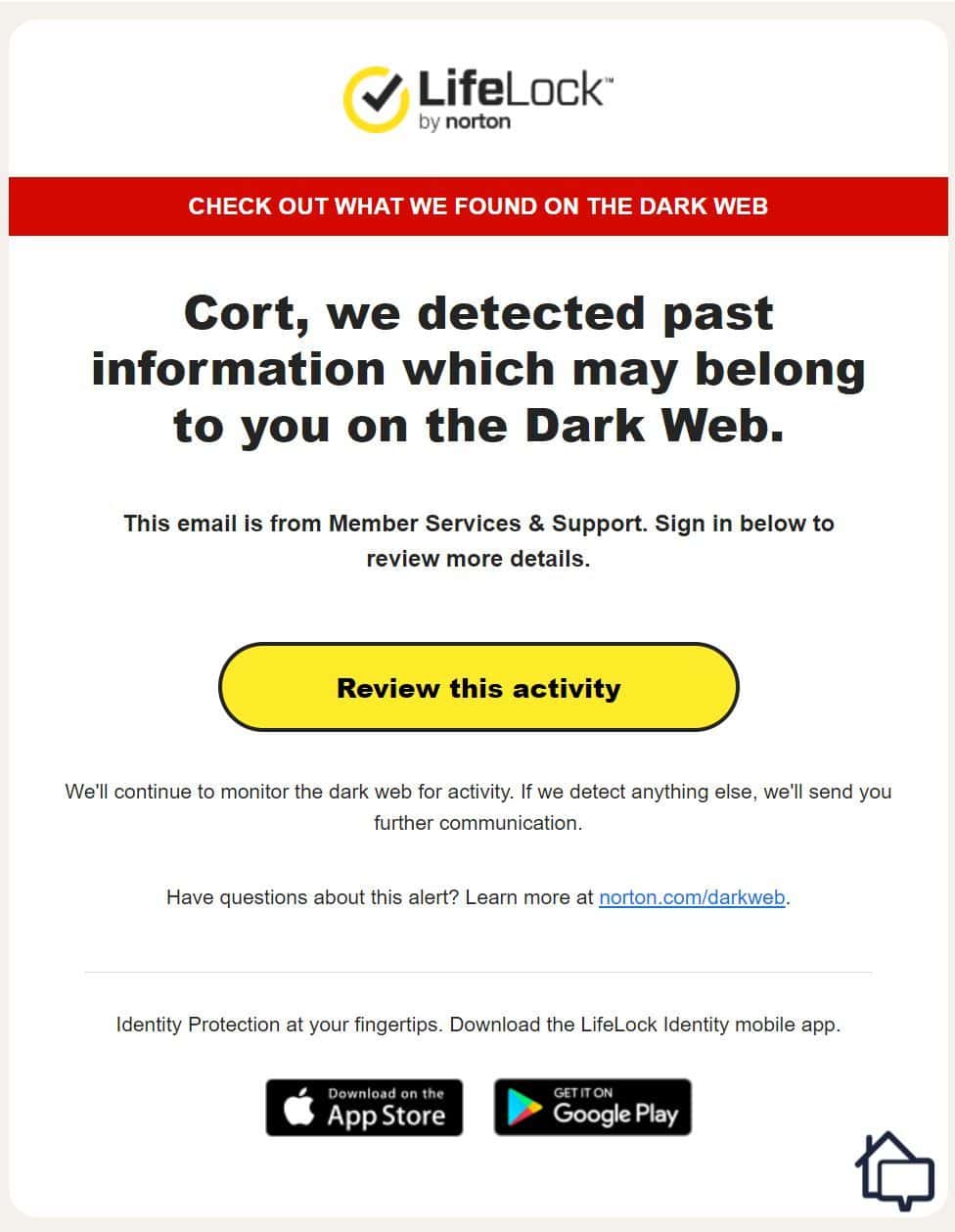
That dark web monitoring is worth calling out specifically. During our testing, it was the one alert we actually received, and it’s included even at this lowest tier. If your information has been exposed in a past breach, this is the feature most likely to catch it and walk you through what to do next.
Did You Know? Some identity thieves don’t use your identity themselves. Instead, they sell it on the dark web for someone else to use. Dark web monitoring keeps an eye on these anonymous marketplaces so you can act before your identity actually gets sold.
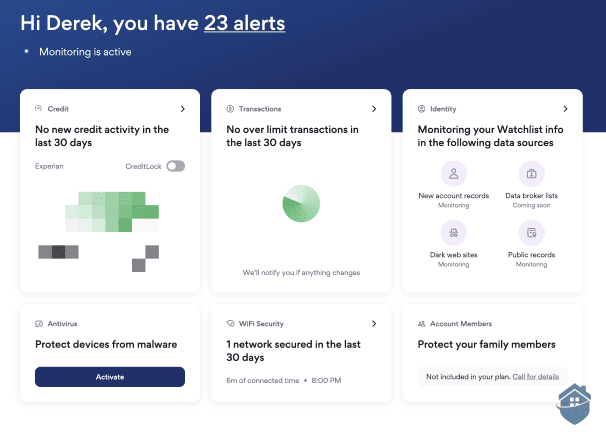
Here’s what our LifeLock dark web monitoring alert looked like.
Core is a solid fit if you want real protection without paying for features you’re less likely to need, like three-bureau monitoring or investment account alerts. It’s a good starting point for anyone without significant financial complexity to protect yet.
FYI: LifeLock Core and LifeLock Select are the same plan. Select is simply what Core is called when bundled with Norton 360.
LifeLock Advanced
Advanced sits in the middle of LifeLock’s lineup, and the biggest upgrades here are the TransUnion Credit Lock and a jump to three-bureau credit monitoring.
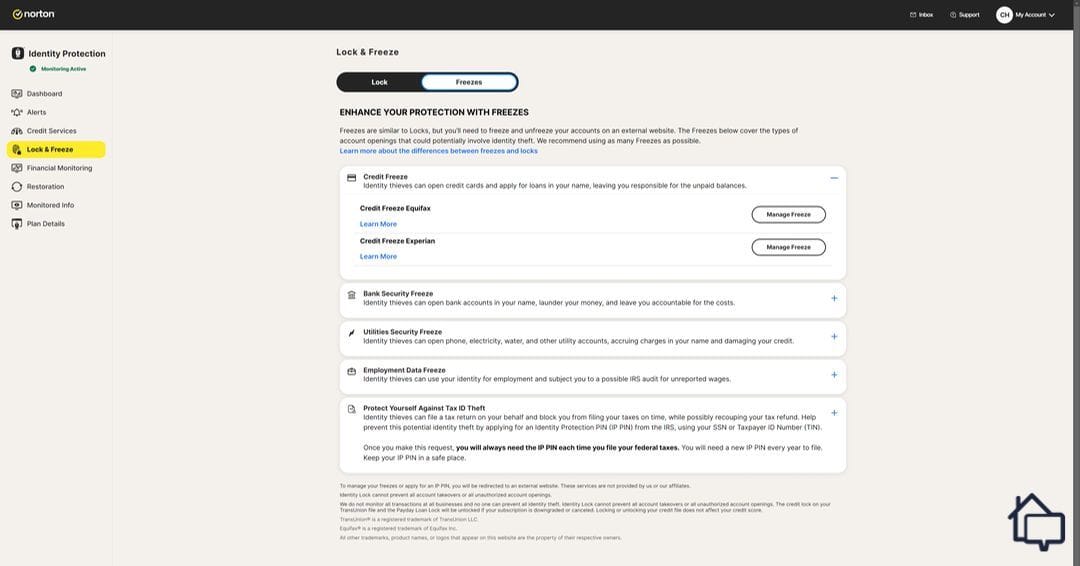
Credit Lock is one of LifeLock’s more distinctive features. Instead of the usual freeze and unfreeze process, which can take time to process with the bureau, Credit Lock lets you toggle your TransUnion file on and off instantly. That matters if you ever need to apply for new credit on short notice, you can unlock it, get approved, and lock it back down right after, rather than waiting on a freeze to lift.
Freezing our credit files was easy with LifeLock’s help.
Advanced also adds fictitious identity monitoring, which watches for synthetic identity theft, a growing scheme where someone combines pieces of your real information with fake details to build a new identity. On top of that, you get insurance coverage up to $1.2 million total, and expense and stolen funds reimbursement both increase to $100,000 per adult.
For most people who want more than baseline protection but don’t need Total’s full financial account monitoring, Advanced is where the value tends to land best.
The biggest reason to go with Total is the insurance coverage. You get up to $1 million each for stolen funds, personal expenses, and legal fees, for up to $3 million in total protection per adult, the highest coverage of any plan LifeLock offers, and among the highest we’ve seen industry-wide. By comparison, Aura’s plans caps out at $1 million per adult on every tier. We break down the full differences in our Aura vs. LifeLock comparison.
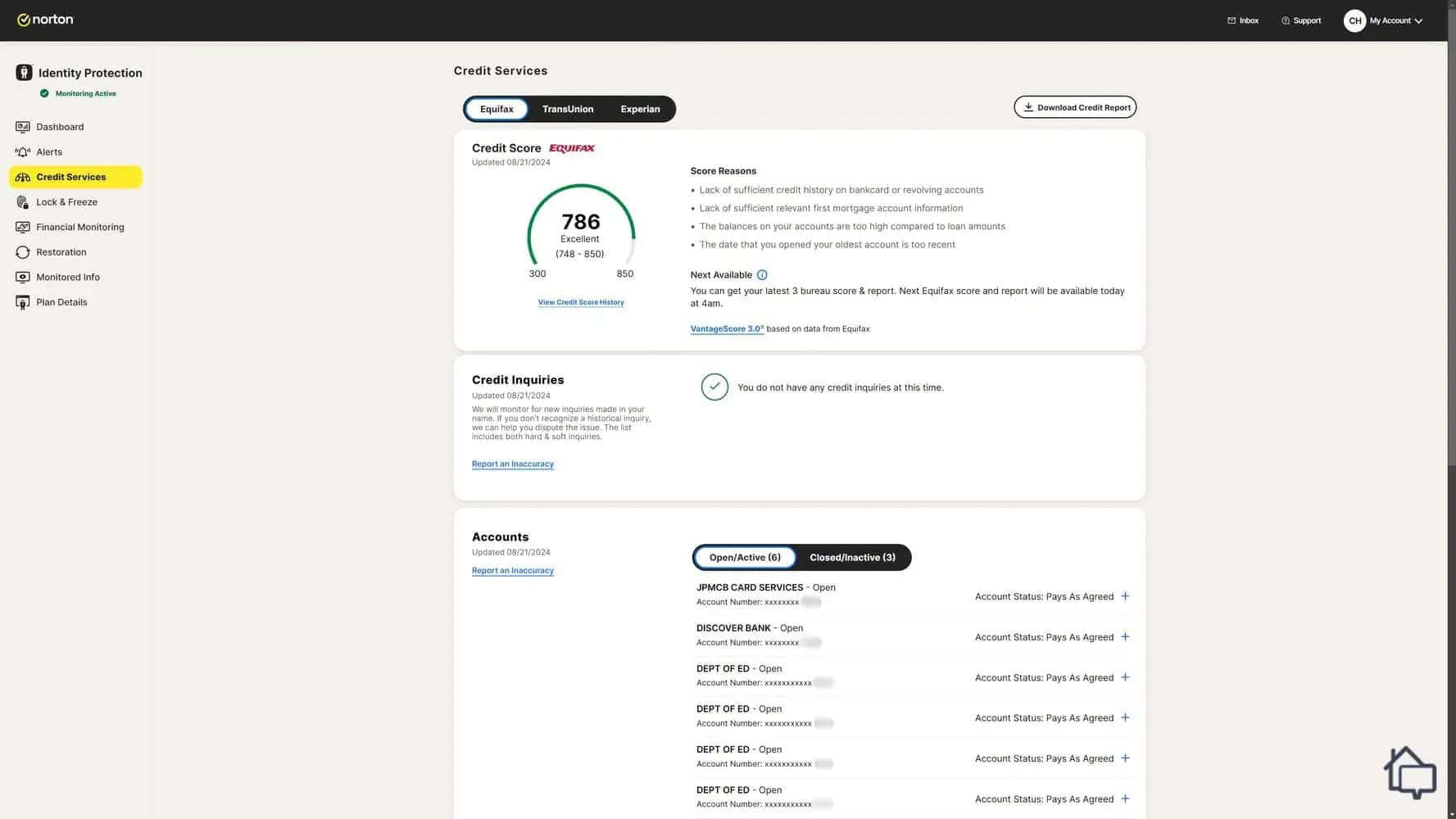
LifeLock’s Credit Services gave us tips to improve our credit score.
That’s the headline, but it’s not the only upgrade. Total is also the only tier that includes home title monitoring and phone takeover monitoring, two protections that don’t show up on Core or Advanced at all. You also get full financial account monitoring, including 401(k) and investment activity alerts and bank account takeover alerts, plus unlimited financial account coverage rather than the capped account limits on the lower tiers.
Three-bureau credit monitoring comes standard on both Advanced and Total, so that’s not a Total-exclusive perk, but paired with everything above, Total is built for people with real financial complexity to protect: investment accounts, larger savings, or a mortgage, where both the monitoring depth and the insurance ceiling actually matter.
LifeLock’s Norton 360 bundle isn’t available across every tier. There are only two bundle options, LifeLock Select (Core’s feature set plus Norton 360) and LifeLock Ultimate Plus (Total’s feature set plus Norton 360). There’s no bundled option at the Advanced level, and bundling is only available on individual plans, not couple or family plans.
Device coverage differs between the two.
LifeLock Select with Norton 360 supports up to 5 devices
LifeLock Ultimate Plus with Norton 360 supports unlimited devices
One thing worth knowing going in: device limits are tied to the bundle tier, not the number of people on your plan. Since bundling is individual-only anyway, this mostly comes into play if you’re deciding between Select and Ultimate Plus based on how many of your own devices you actually need covered.
LifeLock Deals: Where To Find Them
LifeLock’s promotional pricing changes fairly often, and the discount tends to be more meaningful on annual plans than monthly ones. Rather than guess at what’s live right now, your best bet is checking LifeLock’s current offers directly before you sign up, since first-year discounts can vary by plan and by season.
LifeLock has also run seasonal promotions in the past, including discounts during Black Friday and Cyber Monday. If you’re not in a rush to sign up, timing your purchase around one of those periods can be worth watching for.
Is LifeLock Still a Leader in the Identity Theft Protection Industry?
Yes, LifeLock remains a leader in the identity theft protection space. Its services make up over 15 percent of the entire industry’s revenue,1 though being the biggest player doesn’t automatically mean staying ahead on technology or service. In LifeLock’s case, it largely does, and the cost reflects that.
On the technology side, LifeLock offers a few genuinely distinctive features. Its fictitious identity monitoring tackles synthetic identity theft, one of the more recent and harder-to-catch fraud methods, and its Credit Lock feature lets you freeze and unfreeze your TransUnion credit file instantly, without the delay that comes with a standard credit freeze.
On the service side, LifeLock remains the only major provider we’ve reviewed offering up to $3 million in total identity theft coverage per adult.
FYI: LifeLock’s family plans extend protection to children too, though with a narrower feature set than adults get. Kids on the plan are covered by credit file detection, dark web monitoring, and file-sharing network searches, protections aimed at catching child identity theft early, even without the full insurance coverage adults have. We rounded up five child identity theft statistics every parent should know if you want more context on the risks.
Final Thoughts
Looking at LifeLock as a whole, we think it offers solid value for what you’re paying. It’s a top-tier service at a top-tier price. We haven’t found another provider that matches its $3 million coverage ceiling, and it monitors a few areas that don’t show up much elsewhere, like fictitious identities and 401(k) activity.
If you’re working with a tighter budget, you’ll likely get more for your money with a service like Identity Guard, which tends to undercut LifeLock’s pricing at the entry level while still covering the essentials. See our LifeLock vs. Identity Guard comparison for a closer look at how the two stack up feature by feature.
For anyone who wants top-tier protection and has the budget for one of LifeLock’s premium plans, we don’t think you’ll find better coverage elsewhere.
Norton 360 keeps your devices, like smartphones and laptops, free of viruses and malware. It also includes a VPN, ad blocker, anonymous browsing tool, PC SafeCam, and a cloud backup system for PCs.
It depends on which LifeLock bundle you choose. LifeLock Select with Norton 360 covers up to 5 devices, while LifeLock Ultimate Plus with Norton 360 covers an unlimited number. There’s no bundle option between those two tiers.
Every LifeLock plan includes up to $1 million in coverage for lawyers and experts used during identity theft recovery. Each plan also covers personal expenses and stolen funds, starting at $25,000 each on Core, increasing to $100,000 each on Advanced, and reaching $1 million each on Total, for up to $3 million in total coverage per adult on LifeLock’s top plan.
No. LifeLock is built to keep you aware of potential threats and alert you when fraud happens, not to stop it from happening in the first place. You can lower your own risk by doing things like using strong, unique passwords and shredding sensitive documents before throwing them out.
Technically, you don’t need any credit monitoring at all, but we’d recommend having it. Monitoring your credit helps you catch fraud quickly. Most of the time, all three bureaus report the same activity, but it’s possible for something to show up on just one or two of them. That’s why we lean toward recommending three-bureau monitoring where it’s available, for the extra coverage and peace of mind.
With a decade of experience as a journalist, Derek Prall has been covering home security for over three years. He has spent more than 1,000 hours researching security solutions and has covered almost 100 topics related to home safety. Previously, Derek has covered tech issues at American City & County magazine, where he won numerous national awards for his coverage. Derek graduated with dual bachelor’s degrees in English and Communications from Furman University and now lives in Atlanta, Georgia, with his wife and two cats.

 Updated July 16, 2026
copied!
Updated July 16, 2026
copied!