The USAA is a membership for the military community with exclusive insurance, banking, and retirement services. For example, it has credit cards with unique perks, auto loans with low interest rates, and health plans with low out-of-pocket expenses. USAA also offers identity theft protection.
USAA has partnered with Blink by Chubb to keep you and your family safe from online threats. But how does USAA’s identity theft protection service compare to top brands like Aura and Identity Guard? We decided to find out. Here’s what we learned.
USAA only offers its membership to members of the military and their families. To be eligible, you must be one of the following:
Active duty military
National Guard and Reservist
Veteran
Contracted ROTC cadets and midshipmen
Officer and warrant officer candidate
Military spouse
Children of USAA member
Service academy appointee
If you qualify for a membership, you can take out personal cyber insurance, which is what USAA refers to as its identity theft protection service. As we mentioned earlier, the policy comes from Blink by Chubb. But the USAA insurance is an exclusive offering for its members.
FYI: USAA also includes identity theft protection as part of its homeowner’s insurance plan. The standard policy pays up to $5,000 for services that can help recover your identity. It also comes with personal liability insurance and loss of use coverage, which helps out if an event leaves your home unlivable.
What Does USAA Identity Theft Protection Cover?
Blink by Chubb tries to keep insurance as simple as possible so everyone can understand what’s included and what’s not. The cyber insurance with USAA includes three options – coverage for $10,000, $25,000, or $50,000. You won’t have to pay a deductible for identity theft, but there is a charge of $250 for other services. Here’s what is included:
Ransomware attacks: If your device is hacked and you can’t access it unless you pay someone to unlock it for you.
Financial fraud: When money is stolen from your bank account, or fraudulent charges appear on your debit card.
Deceptive transfer fraud: If you pay a fake invoice to someone you thought was a person or company you deal with.
Breach of privacy: Compensation for when your reputation is damaged online through false information.
Smart home disruption: If someone hacks your smart home system and forces you to vacate your home.
Cyberbullying: If someone harasses you or your children online, USAA will help pay for psychiatric services and lost wages.
Electronic data restoration: When you accidentally download malware, it corrupts your data or deletes files.
Device replacement: If someone fixes your device but installs the wrong apps, which makes it unusable, USAA will pay for a replacement.
Identity theft: When someone steals your identity, takes out loans in your name, or applies for services using your personally identifiable information.
USAA also points out several exclusions. For example, if you have prior knowledge of losses before taking out a policy. The coverage also excludes losses for digital currencies, gambling, and widespread events that impact a range of unrelated people or businesses.
FYI: The cost of USAA identity theft protection can vary based on the amount of coverage you need. When we spoke to a consultant, they told us prices start from $5.28 per month for $10,000 of coverage. But you’ll need to speak to them directly for a personalized quote.
Considerations for USAA Identity Theft Protection
While USAA cyber insurance can help you get back on your feet after an identity theft incident, it’s missing some critical features included in some of our favorite identity theft protection services, such as:
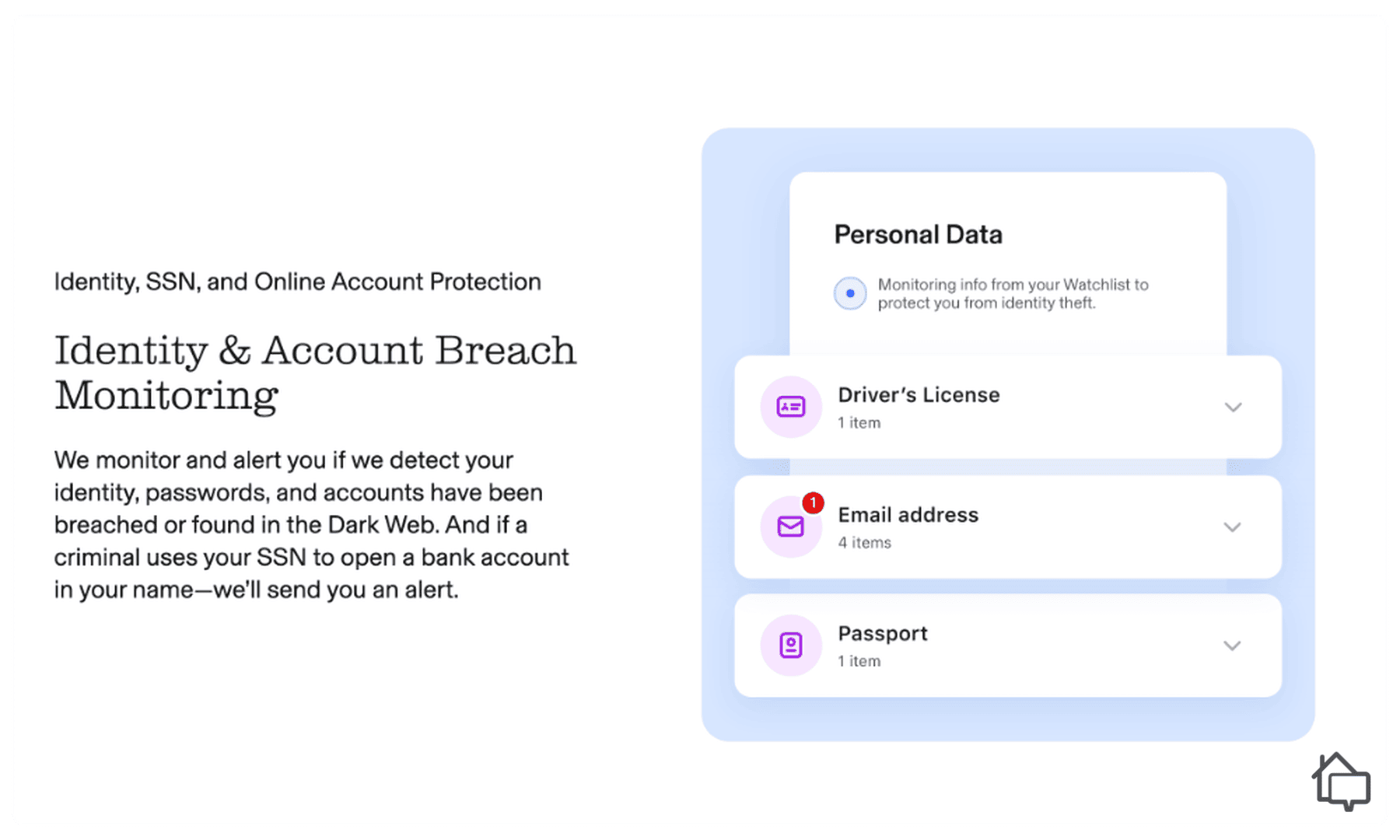
Social Security Number monitoring: This feature scans public databases and records to see if anyone is using your Social Security Number.
Dark web monitoring: Many identity theft protection services can scan the dark web to see if any of your data is available for sale.
Address change monitoring: An identity theft protection service can scan the U.S.P.S databases to see if anyone has changed your address to go along with their fake identity.
Court record monitoring: Monitoring court records lets you know if any crimes are committed in your name.
Credit monitoring: Even the cheapest IdentityIQ plans include at least one bureau credit report monitoring, which ensures that no one is applying for loans in your name or affecting your credit score.
Comprehensive Protection Without Breaking the Bank
Unlike USAA, LifeLock offers Social Security Number monitoring, dark web monitoring, three-bureau credit monitoring, and device protection from $11 a month
SecureScore™:
9.7/10This rating is derived from our editorial team's research, hands-on product testing, and customer surveys.
We’ve spent hundreds of hours researching, testing, and comparing identity theft protection services so you don’t have to. Here are our top four recommended alternatives to USAA identity theft protection. Each offers the kind of proactive monitoring and recovery tools that a standalone cyber insurance policy simply can’t match.
Aura’s dashboard lets you manage all alerts and monitor your records.
Aura
Aura has plans that can protect the whole family. It even comes with monitoring features and security tools exclusively designed to keep kids safe online. The adults can access three-bureau credit monitoring, retirement and investment account monitoring, and spam list removals, among other services.
For the children, there are cyberbullying and safe gaming alerts, as well as SSN monitoring. It might seem premature to include SSN and credit monitoring, but Aura knows that protecting these vital records now will pay dividends in the long run. Learn more about all the features available in our Aura review.
Identity Guard uses AI to monitor millions of data points to keep your identity safe.
Identity Guard
Identity Guard relies on artificial intelligence to monitor for potential identity theft issues. It leverages IBM’s Watson AI to continuously scan the internet and dark web for your personal information. Once a match is found, Identity Guard will send you a mobile app and email alert so you can respond quickly.
Identity Guard offers three plans that start at $7.50 per month (billed annually) and go up to $25 per month (billed annually). Monthly billing is available but costs a bit more. With Identity Guard you get comprehensive identity theft protection that includes $1 million in identity theft insurance with a stolen funds reimbursement feature included.
You also get a U.S.-based dedicated case manager and a wide variety of identity theft monitoring services, and more. If you would like more information, you can read our full Identity Guard guide here.
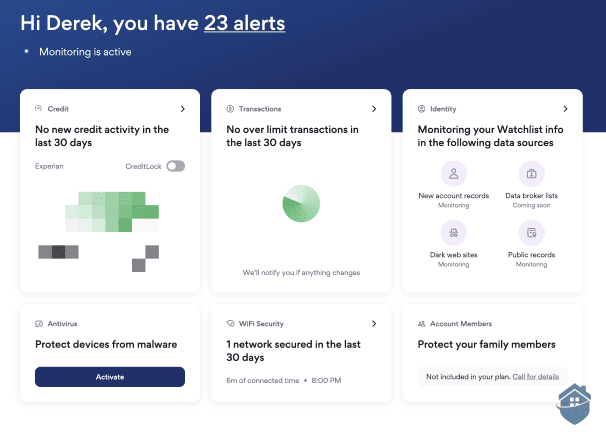
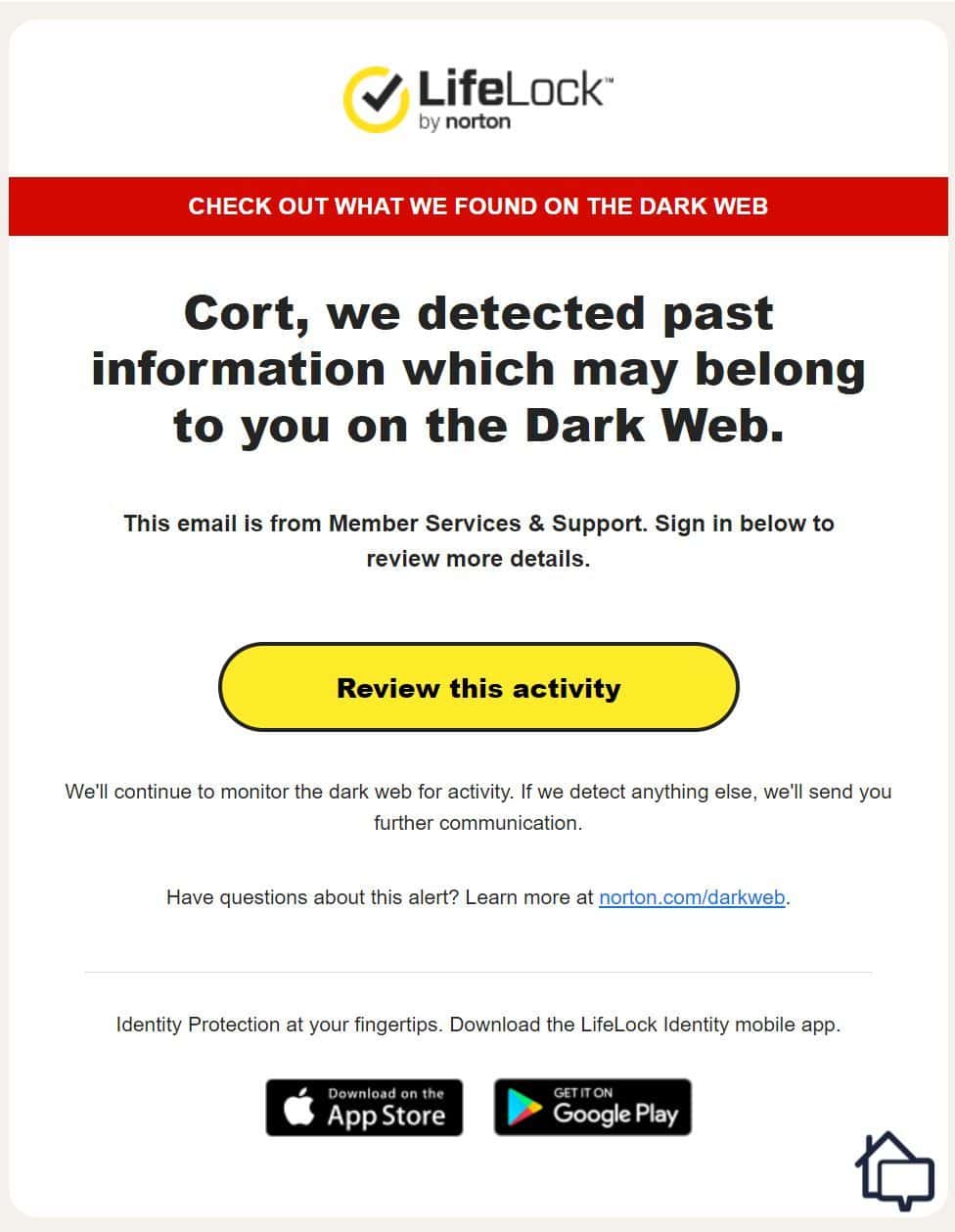
LifeLock will alert you the second it finds your information on the dark web.
LifeLock
LifeLock is probably the most widely known identity theft protection service. They offer a variety of full coverage services along with Norton 360 internet protection. So you get an all-in-one identity theft protection service that offers several plans from which you can choose. LifeLock’s services come with a million-dollar protection package, reimbursement of stolen funds, personal expense compensation, and coverage for lawyers and identity theft experts.
LifeLock’s standalone plans range from $10.42 to $34.99 a month, each offering its own set of protections depending on the plan you choose. You can also bundle LifeLock with Norton 360 for extra features like antivirus protection, a VPN, and a password manager. Of course, these bundles cost extra. If you would like more information, you can read our full LifeLock Review here.
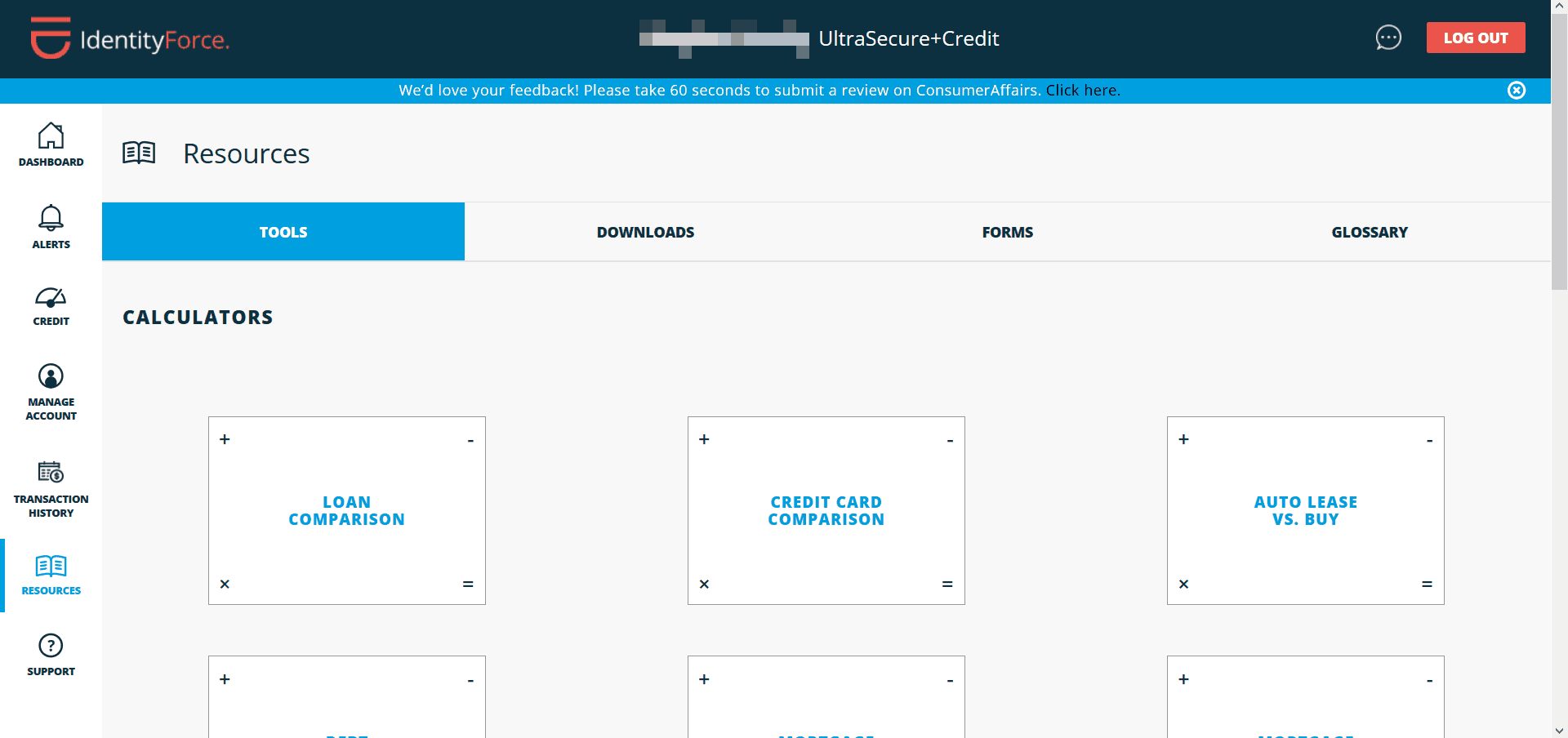
IdentityForce has an excellent selection of resources that can keep you safe online.
IdentityForce
IdentityForce’s services are used by millions of people, and they are also a GSA Tier One provider for U.S. government agencies. So they must be doing something right.
IdentityForce has a $1 million identity theft insurance policy. They will monitor your personal information and if anything suspicious is found, they will alert you to it. If your identity has been compromised, they offer comprehensive 24/7 recovery services. IdentityForce will complete all the paperwork and make all the necessary calls for you while handling every intricate detail until your issues have all been resolved. IdentityForce has protection plans that are as little as $17.95 a month up to $35.90 a month. And, if you pay annually, IdentityForce will give you a break on the price.
Is USAA Identity Theft Protection Worth It?
The USAA has some excellent services for the military personnel and their families. But the USAA’s identity theft protection service only takes a reactive approach to cybersecurity. Backed by Blink by Chubb, you’ll be taken care of if someone hacks your devices, makes fraudulent financial transactions, or steals your identity.
That said, USAA identity theft protection is missing many of the proactive, preventative tools you’ll find with dedicated services like Aura and Identity Guard. For instance, it doesn’t offer real-time dark web monitoring, credit lock features, or three-bureau credit monitoring. A strong identity theft protection service should strike a balance between prevention and recovery. So if we were going to pay for a service to keep your financial and personal data safe, we’d pick one from our list of best identity theft protection services.
With a decade of experience as a journalist, Derek Prall has been covering home security for over three years. He has spent more than 1,000 hours researching security solutions and has covered almost 100 topics related to home safety. Previously, Derek has covered tech issues at American City & County magazine, where he won numerous national awards for his coverage. Derek graduated with dual bachelor’s degrees in English and Communications from Furman University and now lives in Atlanta, Georgia, with his wife and two cats.