SafeHome.org may receive compensation from some providers listed on this page. Learn More
We may receive compensation from some providers listed on this page. Learn More
SafeHome.org may receive compensation from some providers listed on this page. Learn More
We may receive compensation from some providers listed on this page. Learn More
LifeLock is our top pick for identity theft restoration, backed by a 100% restoration guarantee, U.S.-based case managers, and up to $3 million in coverage per adult.
 Updated September 8, 2026
copied!
Updated September 8, 2026
copied!

LifeLock backs its identity restoration with a guarantee: if its U.S.-based specialists can’t fix your case, you get your money back. Combined with up to $3 million in coverage per adult, it’s the most confident restoration promise we’ve tested.
Best Restoration Case Manager

Coveron assigns a dedicated identity restoration case manager through insurance partner HSB as soon as you file a claim, with coverage active from the moment you subscribe. Its $2 million policy is itemized separately from cyber extortion, home title fraud, and online fraud coverage, rather than one blended pool.

Since launching in 2019, Aura has built a reputation for white-glove, all-in-one support. Its restoration specialists and 24/7 customer service consistently rank among the most responsive we’ve encountered.
Best Restoration Case Manager
If you ever find yourself in the unfortunate situation where your identity is stolen, you probably want everything resolved as quickly as possible. You could try doing this yourself, but it requires a lot of time and paperwork just to get the ball rolling on reclaiming your identity and repairing your financial situation.
A better strategy is to invest in identity theft protection services. Not only do they monitor your credit files and personal information, but they have the resources to work around the clock to resolve fraud incidents before they become a major problem.
When we tested identity theft protection services, LifeLock stood out for the strength of its restoration guarantee and the size of its insurance coverage. Coveron, Aura, and Identity Guard also have excellent resources to help you get things back on track, each with a different edge worth knowing about. We'll break down all four so you can choose the right one for your needs.
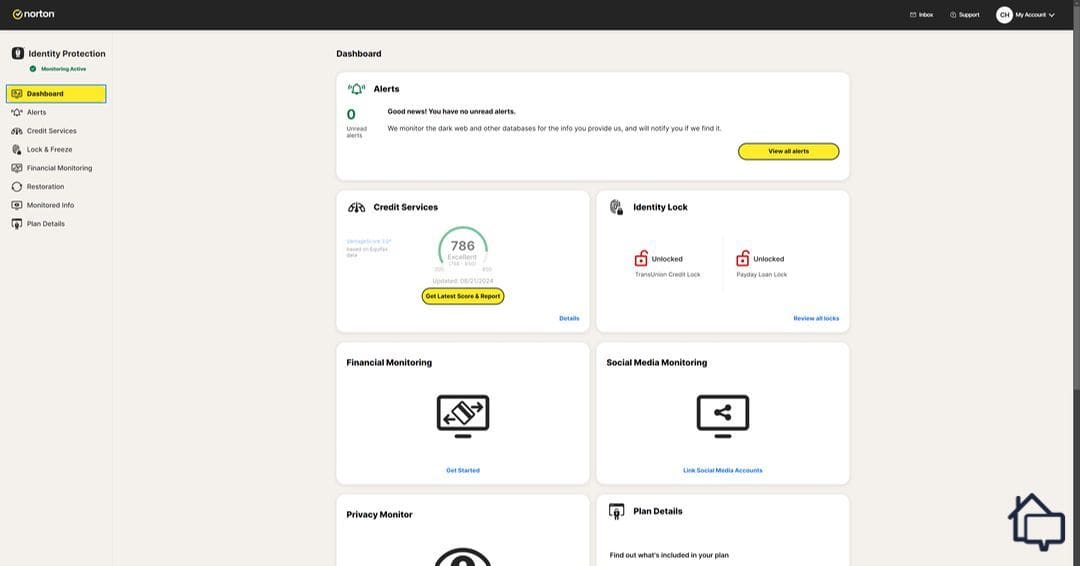
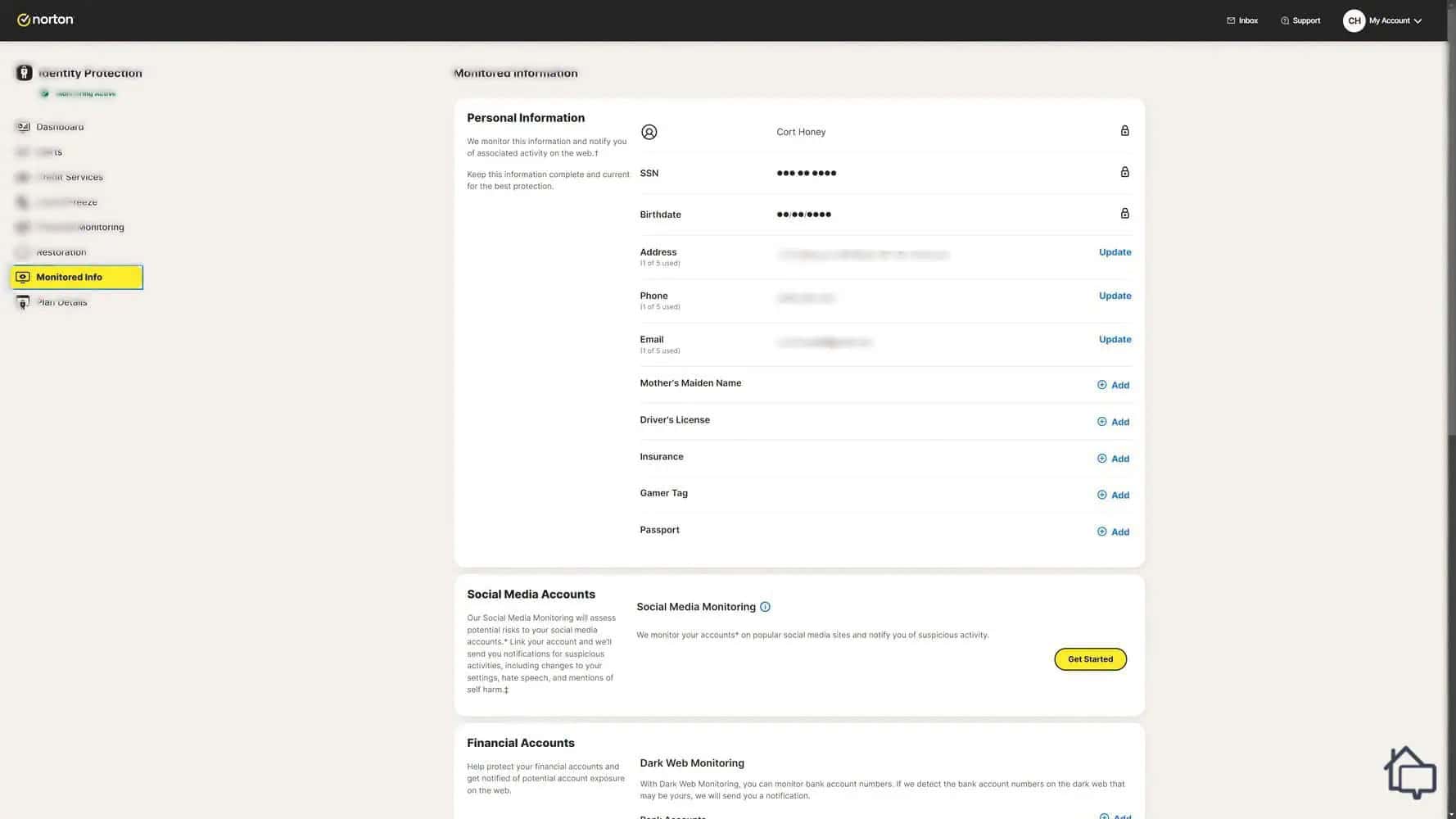
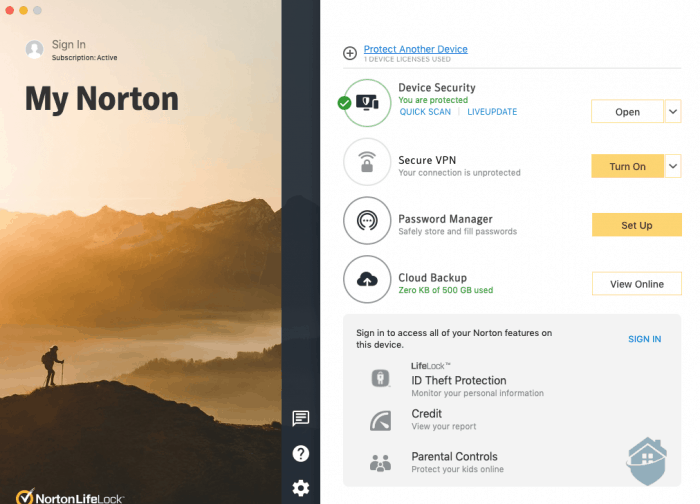
LifeLock’s dashboard made it easy for us to monitor our personal information.
LifeLock builds its entire restoration case around one promise: if its specialists can't fix your identity theft, you get your money back. That's a rare thing to see in writing in this industry, and it's backed by real substance, up to $3 million in identity theft insurance coverage per adult, 24/7 U.S.-based restoration specialists, and a Million Dollar Protection Package that covers legal and expert fees. LifeLock also layers on multi-device cybersecurity protections to try to keep you from needing restoration in the first place.
During our testing of LifeLock, the restoration guarantee is what set it apart from everyone else we tried. Most competitors will help you clean up after identity theft. LifeLock puts its money where its mouth is: if its specialists can’t restore your identity, they refund your subscription. That’s a meaningfully different level of accountability.
Did You Know? LifeLock’s restoration guarantee only applies to memberships you pay for yourself. Plans provided through an employer or a data breach settlement aren’t eligible, so it’s worth checking how you signed up before you rely on this benefit.
Once you’re assigned a case, a dedicated U.S.-based restoration specialist takes the lead from start to finish, filing police reports and fraud affidavits, disputing unauthorized transactions with your bank, and working directly with the three major credit bureaus to remove fraudulent inquiries. LifeLock is also one of the few services in the industry to offer up to $1 million in stolen fund reimbursement, $1 million in personal expense compensation, and $1 million to cover lawyers and other experts, scaling up to $3 million per adult on its top plan.
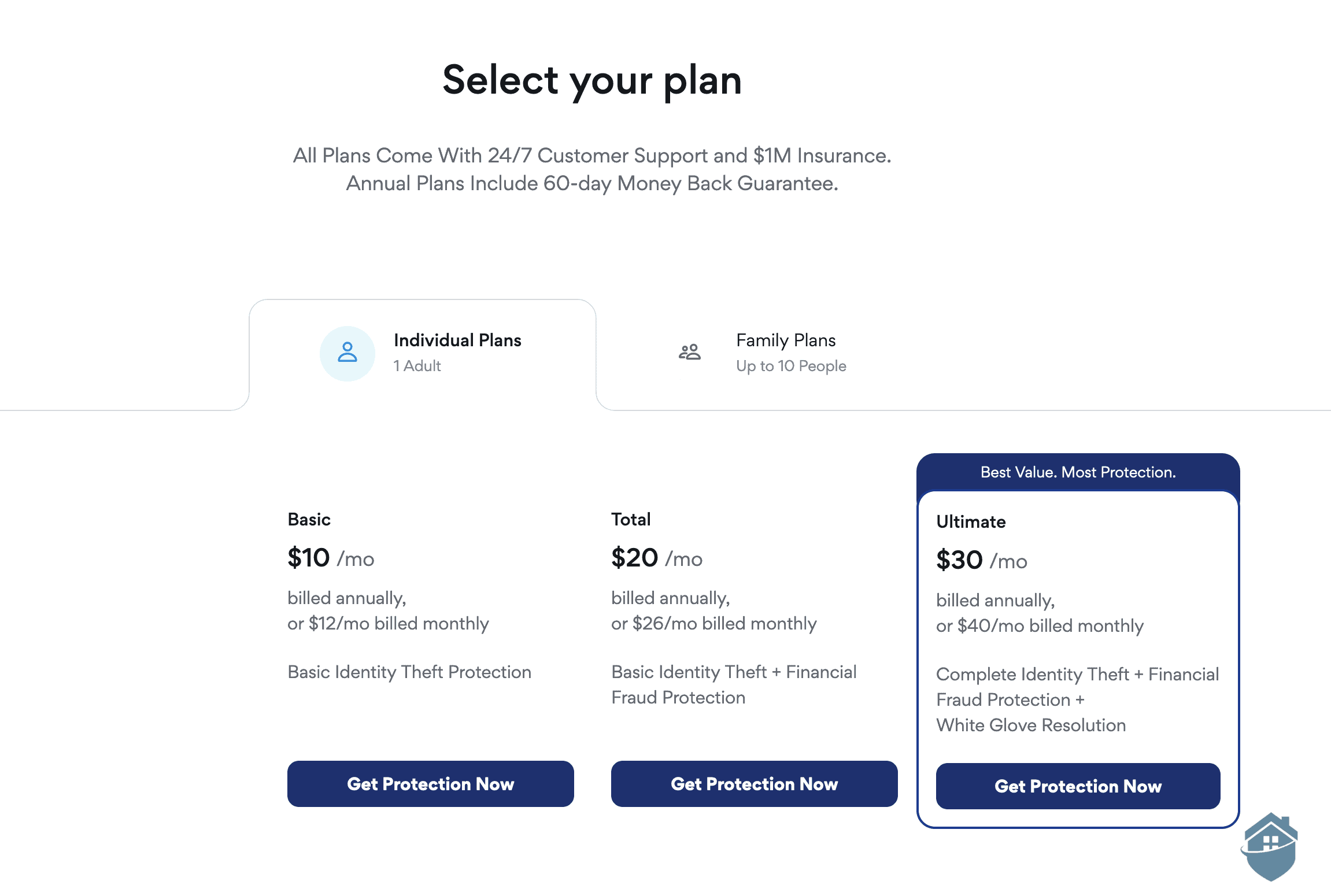
LifeLock has multiple plans, and they’re not always easy to compare side by side on the website. We’ve done that legwork for you in our breakdown of every LifeLock package. Pricing and plan details change from time to time, so for the most current rates and offers, check LifeLock’s website directly.
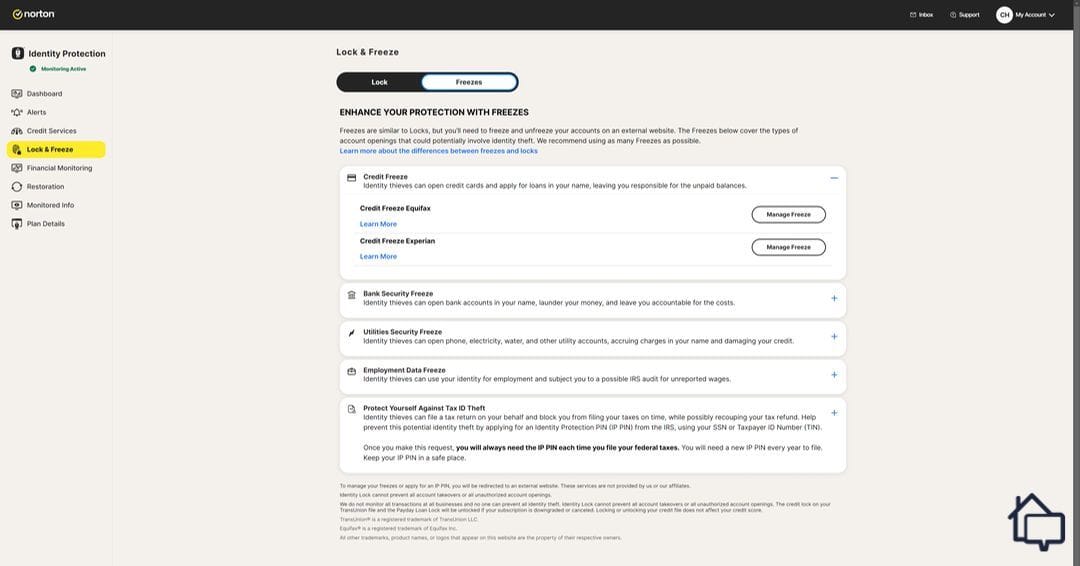
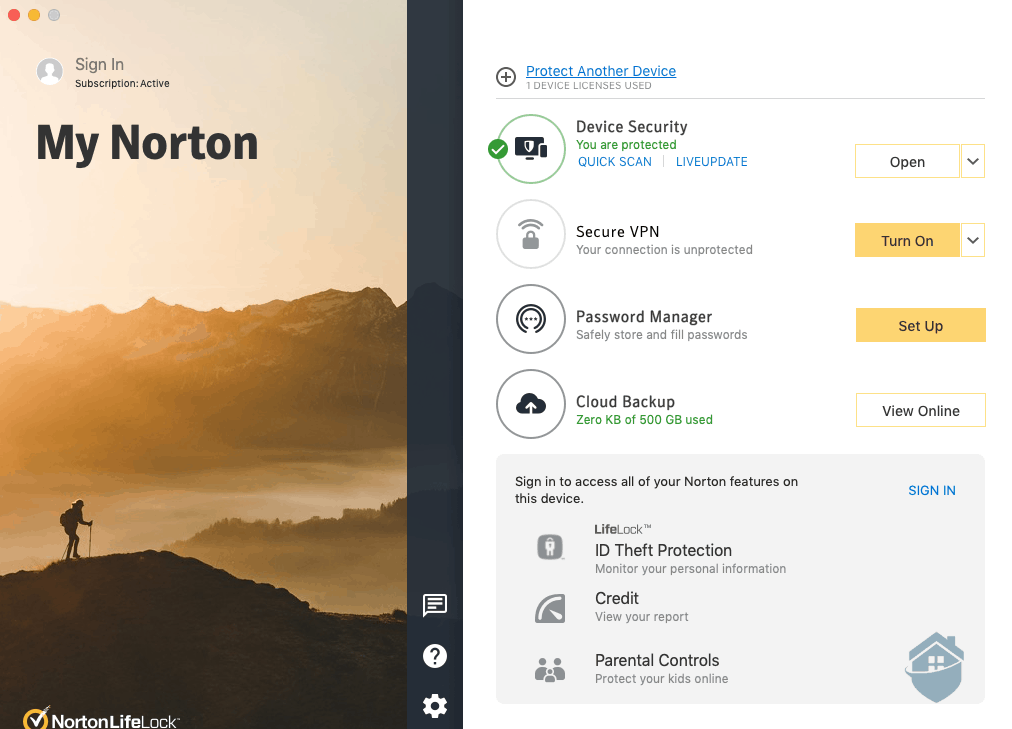
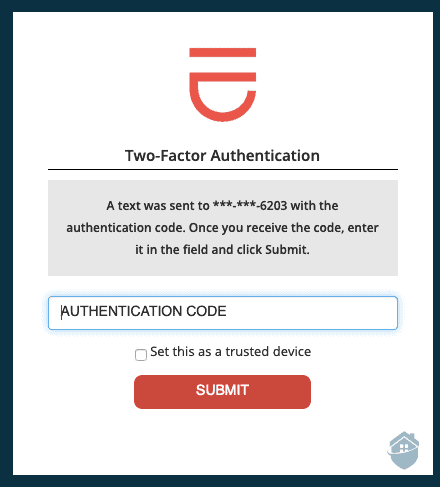
We could freeze our Equifax or Experian credit file from LifeLock’s dashboard.
| Identity monitoring | Yes |
|---|---|
| Credit monitoring | 2-bureau (Core) or 3-bureau (Advanced/Total) |
| Insurance | Up to $3 million per adult |
| Restoration guarantee | Yes, or your subscription is refunded |
| Free trial | 30 days |
| Money-back guarantee | 60 days (annual plans) |
Coveron provides a dedicated identity restoration case manager through its insurance partner HSB as soon as a claim is filed, backed by up to $2 million in identity theft recovery coverage that activates immediately upon subscribing, with no waiting period. Its coverage is itemized rather than blended: cyber extortion ($50,000), online fraud ($10,000), and home title fraud ($25,000) are each covered separately and don't draw down the $2 million identity recovery amount.
Coveron’s claims process is built around its dashboard: a dedicated section under ID protection benefits lets you select a claim category, which routes directly to a claim form managed by HSB, one of the largest cyber insurance writers in the U.S. From there, HSB assigns a case manager to guide the recovery process, similar in structure to how LifeLock and Aura assign dedicated specialists regardless of plan tier.
Coverage-wise, Coveron’s $2 million identity theft recovery policy activates the moment you subscribe rather than after a waiting period. That coverage is also itemized: cyber extortion, home title fraud, and online fraud are each covered under separate limits that don’t reduce the $2 million recovery amount, a structure LifeLock, Aura, and Identity Guard don’t replicate in quite the same way, since their headline insurance figures are typically blended across stolen funds, personal expenses, and legal fees. Coveron does apply a $100 deductible per incident, and individual coverage categories (such as lost wages) carry their own internal caps below the full $2 million figure.
| Identity monitoring | Yes |
|---|---|
| Credit monitoring | 1-bureau (Identity Theft Protection) or 3-bureau (Full Protection) |
| Insurance | Up to $2 million, itemized separately from cyber extortion, home title, and online fraud coverage |
| Restoration guarantee | No |
| Free trial | None |
| Money-back guarantee | 30 days |
Aura's all-in-one digital approach makes it a strong pick for everyday identity protection, but it's the human side of the service that stands out most. Aura pairs 24/7 support with white-glove restoration specialists who stay with you through the entire recovery process, which is exactly what you want to hear from when you're already stressed about fraud.
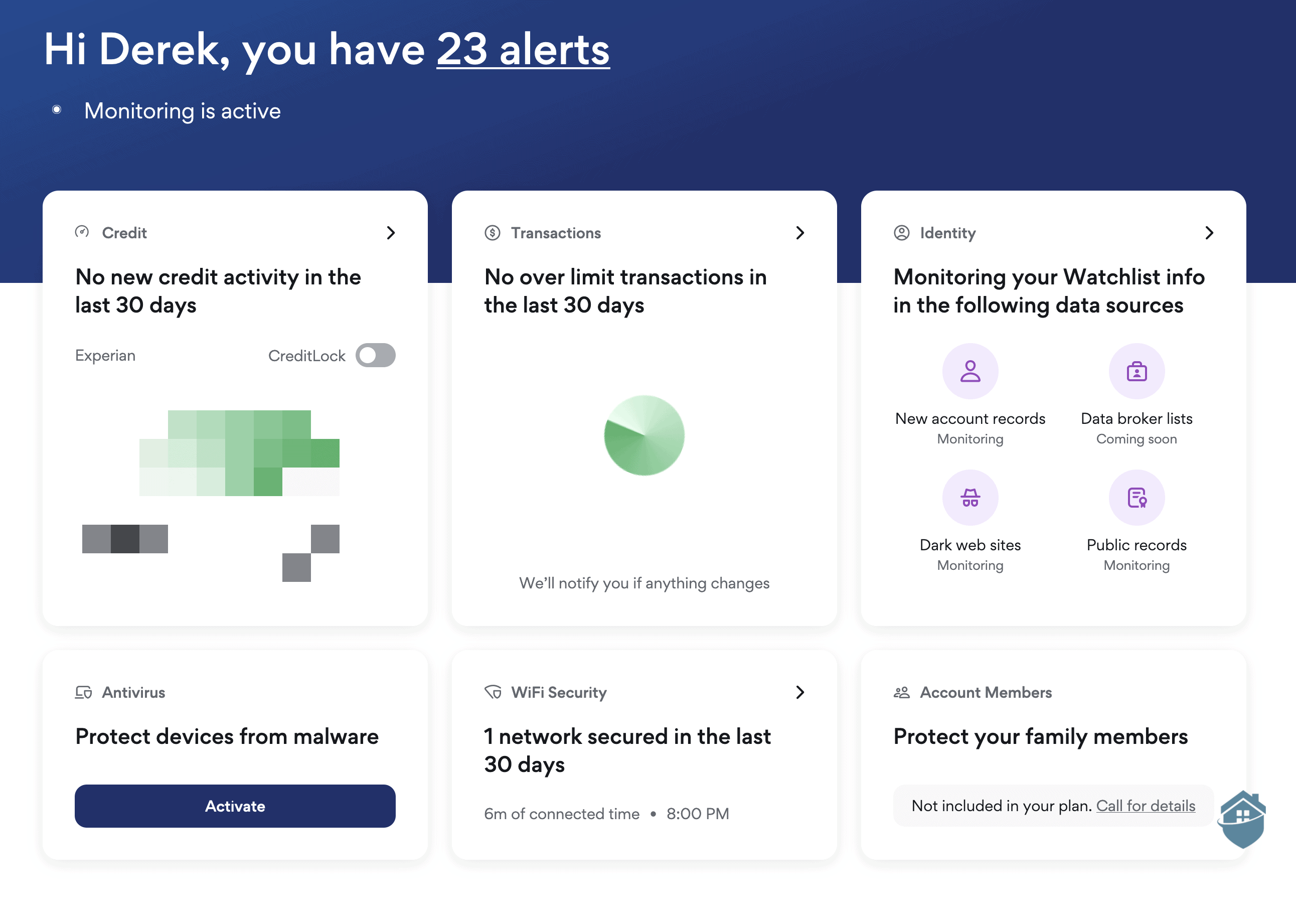
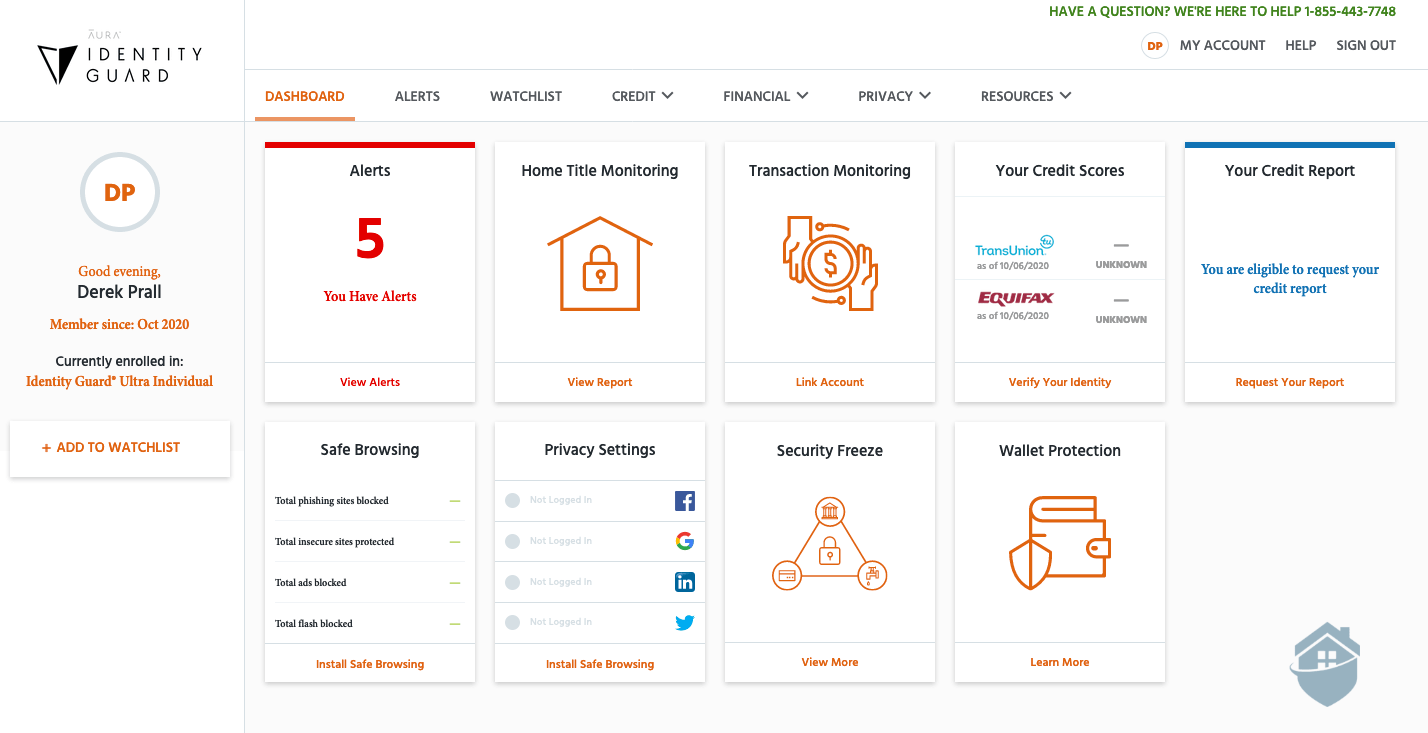
We found Aura’s dashboard easy to navigate and to add family members.
The problem with identity theft is you never know when it’s going to strike. About once every few seconds, according to the FTC. So having spending alerts and a credit lock in your back pocket is great, but if a thief makes off with your SSN, you want a team that’s willing to step up. We found Aura’s customer support consistently easy to reach, and once you’re connected, its white-glove specialists take over the recovery process instead of just pointing you toward a checklist.
Did You Know? Aura doesn’t just protect adults from identity theft. It includes parental control apps to help keep kids safe on social media and gaming platforms.
You can set financial thresholds so Aura doesn’t spam you with alerts every time your card is swiped. We’ve reported extensively on Aura’s full battery of features in our complete Aura review. Enough to say Aura is no lightweight. A premium Aura package is stacked with protections, including a free VPN and malware blocker, two pieces of tech you don’t want to leave the house without these days. That explains why, when you’re comparing top-of-the-line ID monitoring services, Aura packages tend to run a little pricier than average.
That slightly higher price tag pays itself off if you ever need to actually use the service. Aura’s insurance covers a wide range of recovery-related costs, from lost wages and refiling fees to legal expenses and other out-of-pocket costs tied to restoring your identity. In our book, the amount of attention Aura pays to the fine points of recovery, from a consumer’s perspective, says a lot about the quality of its support team.
| Identity monitoring | Yes |
|---|---|
| Credit monitoring | Three bureaus |
| Insurance | Up to $1 million per adult ($5 million family total) |
| Free trial | 14 days |
| Money-back guarantee | 60 days (annual plans) |

Identity Guard proves you don't need to pay top dollar to get solid restoration support. Every plan, including the cheapest one, comes with $1 million in identity theft insurance, and its AI-powered monitoring does a good job flagging trouble before it snowballs. Step up to the Ultra plan and you'll also get a dedicated case manager, making it one of the more complete restoration packages for the price.
When we tested Identity Guard, we quickly learned not to judge a book by its cover. The app doesn’t have the flashiest design of the services we tested, but underneath it packs real value. Identity Guard’s preventative monitoring is powered by AI, which means it can analyze billions of data points while continuously learning about emerging threats.
Pro Tip: Add as much personal information to your Identity Guard watchlist as possible. We added credit card numbers, passport details, and even health insurance numbers on the Ultra plan. The more you include, the less you have to monitor on your own.
But restoration is what we’re here to talk about, and Identity Guard delivers solid coverage without the premium price tag. You’re insured up to $1 million regardless of which plan you choose, and Identity Guard can freeze your credit if someone tries opening accounts in your name. On the Ultra plan specifically, the White Glove Fraud service is the real differentiator: you’re assigned an expert who builds a personalized mitigation and remediation plan to stop further damage and help recover losses.
That top-tier experience comes at a higher cost than Identity Guard’s budget-friendly reputation might suggest, with Total and Ultra family plans running $29.99 and $39.99 per month. Pricing changes periodically, so confirm current rates on Identity Guard’s official site before you sign up. Even so, getting $1 million in insurance on the entry-level plan is hard to beat for the price.
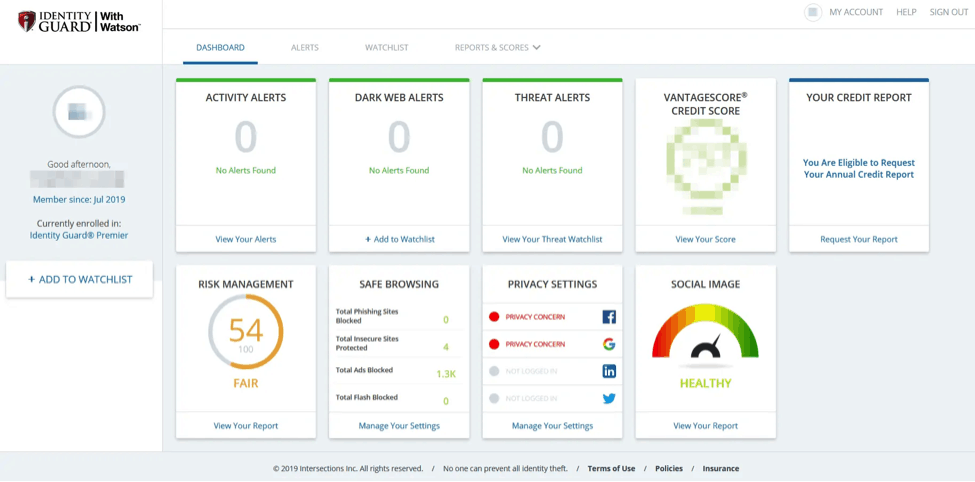
We like that all of Identity Guard’s important information is easy to access from the home screen.
| Identity monitoring | Yes |
|---|---|
| Credit monitoring | Up to 3-bureau (except Value plan) |
| Insurance | Up to $1 million (all plans) |
| Free trial | 7 days |
| Money-back guarantee | 60 days (long-term plans) |
“Restoration” gets used loosely in this industry, so it's worth breaking down what you're actually paying for. Most restoration services bundle together a few distinct pieces:
LifeLock, Coveron, Aura, and Identity Guard all include versions of this, but the depth varies. LifeLock, Coveron, and Aura assign a dedicated specialist regardless of plan tier, while Identity Guard reserves its case-manager service for the Ultra plan. Coverage limits also differ significantly, from $1 million on Identity Guard and Aura's standard plans up to $3 million per adult on LifeLock's top tier. Coveron sits in the middle at up to $2 million per adult. Before you compare prices, compare what's actually inside the box.
If you're weighing options beyond our top three, IdentityForce and Zander Insurance also offer restoration-focused plans worth a look, particularly if family size or budget matters more to you than guarantee terms.
These two terms get used interchangeably, but they're not the same thing, and the difference matters when you're deciding what to pay for.
Identity theft insurance reimburses specific losses, stolen funds, lost wages, legal fees, up to a stated dollar limit. It's a payout mechanism, not a promise of outcome. If your case isn't fully resolved, the insurance doesn't change that; it just helps cover what the fraud cost you.
A restoration guarantee is a commitment to the outcome itself. LifeLock's version says its specialists will restore your identity, or you get your subscription refunded. That's a different kind of accountability than a coverage limit. It doesn't replace insurance (you'll still want the reimbursement for actual losses), but it does mean the company has skin in the game on whether your case actually gets fixed, not just whether you get a check.
When you're comparing services, ask which one you're actually getting. A big insurance number looks great on a comparison table, but a guarantee tells you what happens if things don't go smoothly. If you're weighing a guarantee-backed plan against a purely insurance-driven one, our LifeLock vs. Zander comparison walks through exactly how those two approaches play out in practice.
There's no single answer here, and any service that promises a fixed timeline is oversimplifying. According to research from Security.org, the average identity theft victim spends around 100 hours over the course of a year resolving their case. Simpler incidents, like a single fraudulent credit card charge, can often be resolved in days. Cases involving your Social Security number are a different story; those can drag on for months or, in the worst instances, years, especially if the thief used your SSN to file a fraudulent tax return or open long-term accounts.
FYI: Nearly half of the identity theft victims tracked by the Identity Theft Resource Center in its most recent Consumer Impact Report said their case was still unresolved at the time they were surveyed.1
This is where a dedicated restoration specialist earns their keep. Handling disputes, paperwork, and follow-up calls yourself is what eats up those hundred-plus hours. A specialist who already knows the process, and who's motivated to close your case quickly, won't make identity theft painless, but it can meaningfully cut down the time and stress involved.
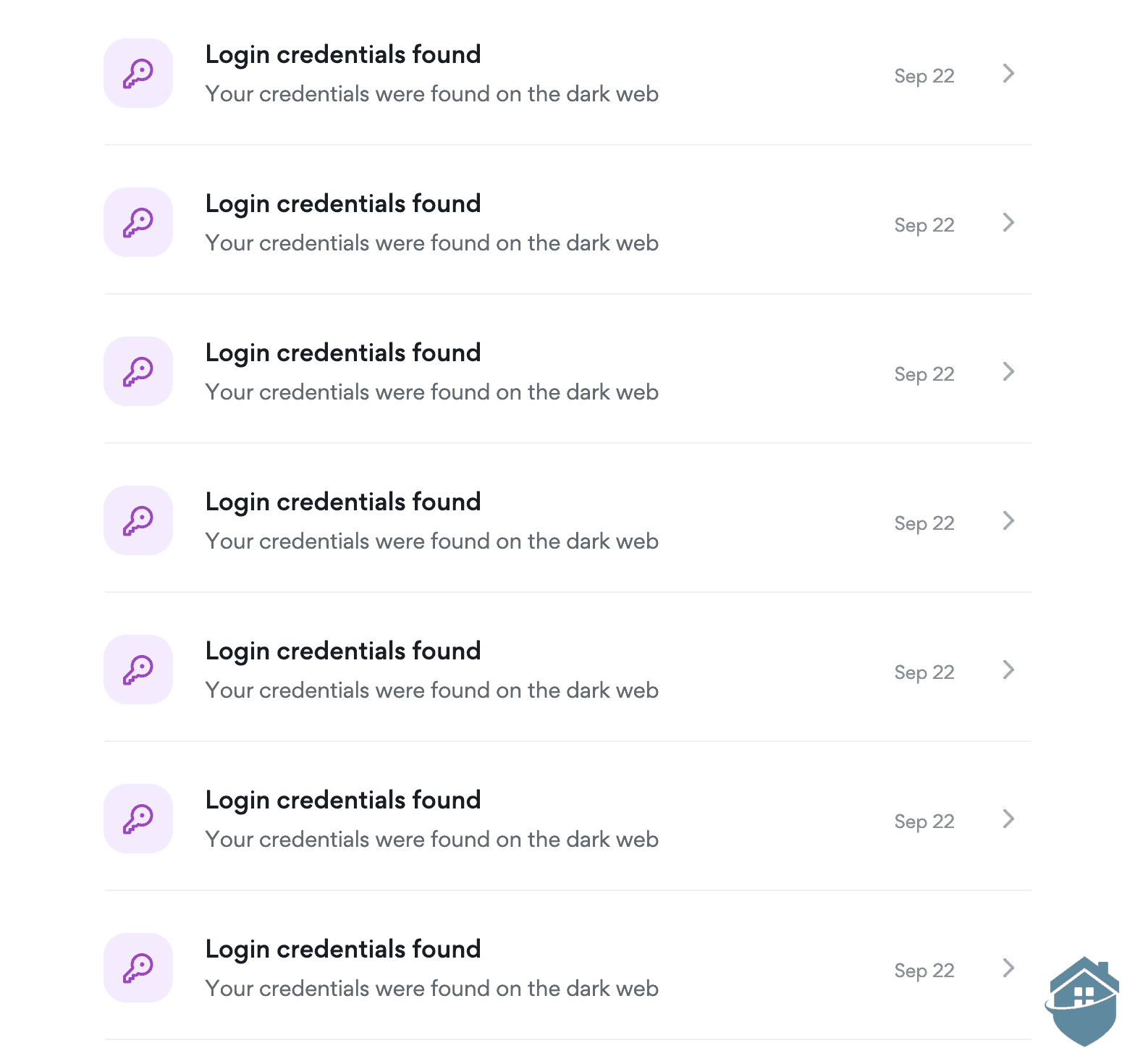
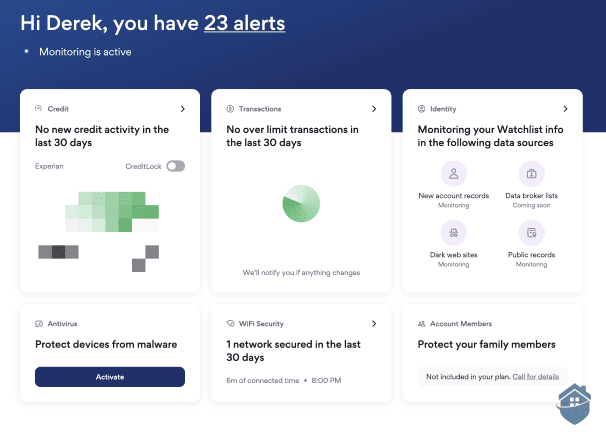
Some of the alerts we received from Aura during our testing that made us take action before needing to use restoration services.
Identity theft can happen to anyone, and if you suspect you're a victim, you need to act fast. The longer fraud is allowed to continue, the worse the potential damage. Here's what to do, in order.
Did You Know? 2.6 million cases of fraud were reported to the FTC in 2023, totaling more than $10 billion in losses, up roughly $1 billion from 2022.2
Did You Know? Credit card fraud was the most common type of identity theft reported in the first three quarters of 2024.3 It's one more reason to invest in a service with strong credit monitoring alongside restoration support.
Our team built a fair, objective scoring system to evaluate identity theft restoration services. We used it to test each service firsthand and grade it across the restoration service, insurance coverage, and monitoring and alerts. Here's specifically what we looked for in every identity protection service we tested:
Using these metrics, we arrived at our top picks. Each one carries a SecureScore™ above 9.0 out of 10.
Identity theft is a huge headache, but it isn't insurmountable, especially if you have help from a service built to handle recovery. In our testing, LifeLock offered the strongest overall restoration experience thanks to its money-back guarantee, its U.S.-based specialists, and coverage that scales up to $3 million per adult. It's the pick we'd trust first if things go wrong.
If you’re after a dedicated identity restoration case manager, we recommend Coveron. For a service known for standout customer support along the way, Aura is an excellent alternative. And if you're watching your budget without wanting to skimp on insurance coverage, Identity Guard delivers real value, especially on its Ultra plan.
LifeLock is the best identity theft restoration service overall, thanks to its 100% restoration guarantee, U.S.-based case managers, and up to $3 million in coverage per adult. Coveron offers the best restoration case managers, Aura is a strong runner-up for its customer service, and Identity Guard offers solid restoration coverage at a lower price point.
Identity theft restoration services assign you a specialist who investigates the fraud, contacts affected institutions on your behalf, files necessary paperwork, and helps dispute fraudulent charges or accounts. Most plans also include insurance to reimburse stolen funds, lost wages, and legal fees incurred during recovery.
Yes, for most people. LifeLock's guarantee means that if its specialists can't restore your identity, you get your subscription refunded, a commitment few competitors match. Just note the guarantee only applies to memberships you pay for directly, not plans provided through an employer or data breach settlement.
Restoration coverage typically comes bundled into an identity theft protection subscription rather than sold separately. Prices for the services in this roundup range from budget-friendly entry plans to premium tiers with higher insurance limits, and rates change periodically, so check each provider's official site for current pricing.
File a fraud alert with the three credit bureaus and report the incident to the FTC through its online portal. From there, contact any company directly affected, freeze impacted accounts, and use your FTC Identity Theft Report to guide next steps with your bank, credit bureaus, and, if needed, local authorities.
Identity Theft Resource Center. (2025). 2025 Consumer Impact Report.
https://www.idtheftcenter.org/publication/itrc-2025-consumer-impact-report/
FTC. (2024). Facts about fraud from the FTC – and what it means for your business.
https://www.ftc.gov/business-guidance/blog/2024/02/facts-about-fraud-ftc-what-it-means-your-business
Motley Fool. (2024). Identity Theft and Credit Card Fraud Statistics for 2024.
https://www.fool.com/money/research/identity-theft-credit-card-fraud-statistics/