
Stealing Strangers' Stuff
According to the Department of Justice, property crimes remain a significant concern for Americans. In 2023, they reported that 13.6 million instances of property crime occurred. That’s over 190 households out of 1,000 experiencing property crime in urban areas.
These crimes carry a heavy financial toll. In 2020, when there were fewer property crimes, losses still totaled over $17 billion. That means the average victim lost about $1,250.
To understand how these statistics impact everyday Americans, we analyzed the latest FBI crime data to identify the items thieves most commonly target, the states experiencing the highest rates of various property crimes, and seasonal patterns that affect theft rates. Here's what we discovered about protecting your valuables in today's environment.
Stolen Items Across the U.S.
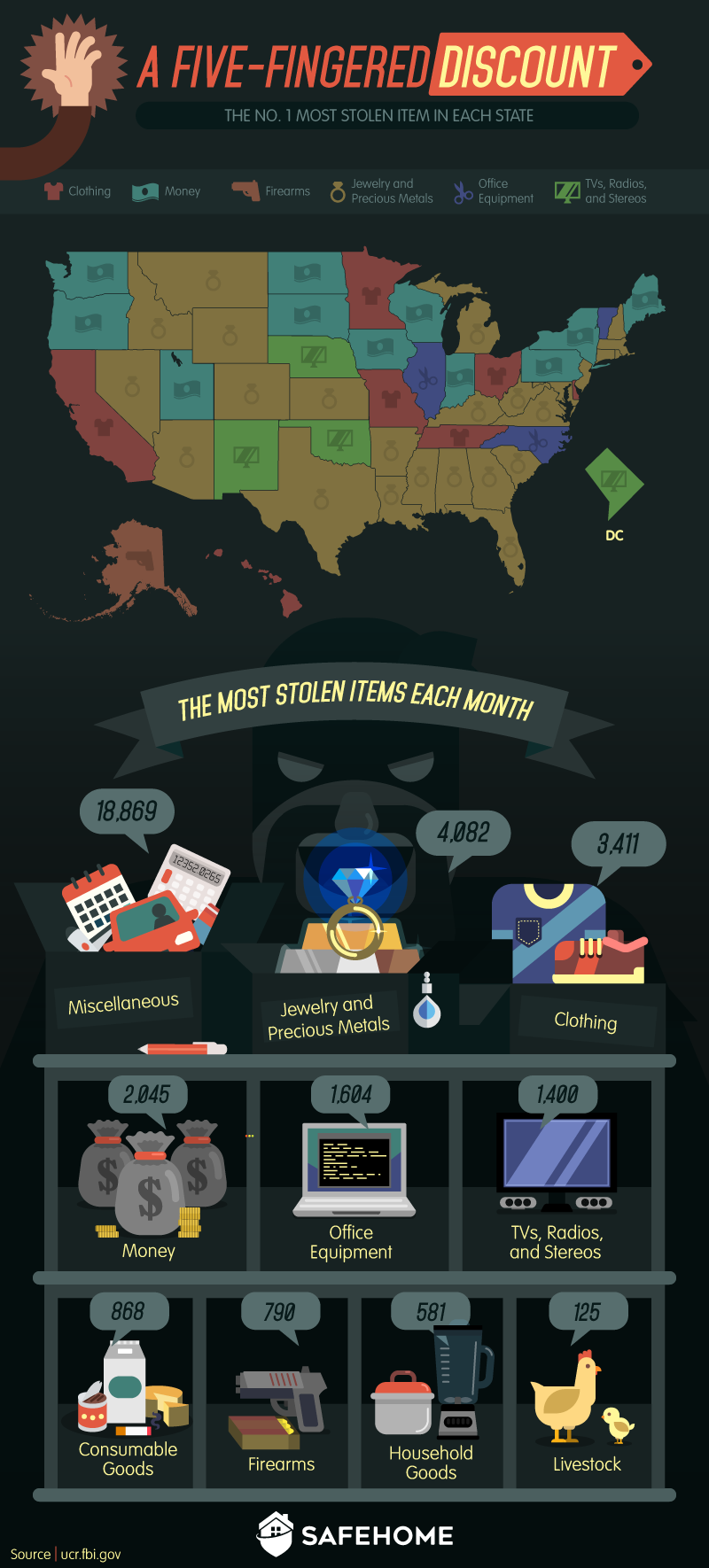
According to FBI data, the most stolen items were classified as miscellaneous. Like pregnancy tests – which one Walmart loss prevention report identified as among the most commonly stolen items from their stores.
Besides miscellaneous valuables, the most common stolen items across 26 states were jewelry and precious metals. In states like Florida, Texas, Massachusetts, and Colorado, thieves targeted diamonds, gold, silver, and other jewelry more than almost anything else. The rise of organized retail crime has particularly impacted jewelry retailers, with the Jewelers' Security Alliance warning of a recent string of violent jewelry shop robberies.
Clothing was the most stolen item in seven states, including California and Tennessee. In fact, actor and comedian Kevin Hart’s California home was burglarized in 2016, with thieves taking his clothing and other personal items.
Other frequently stolen items across the U.S. include currency (most prevalent in 11 states), office equipment, and electronics. While pets can sometimes be the target of thieves and robbers, livestock was the least common category of stolen items, according to the UCR data.
State Rankings for Larceny
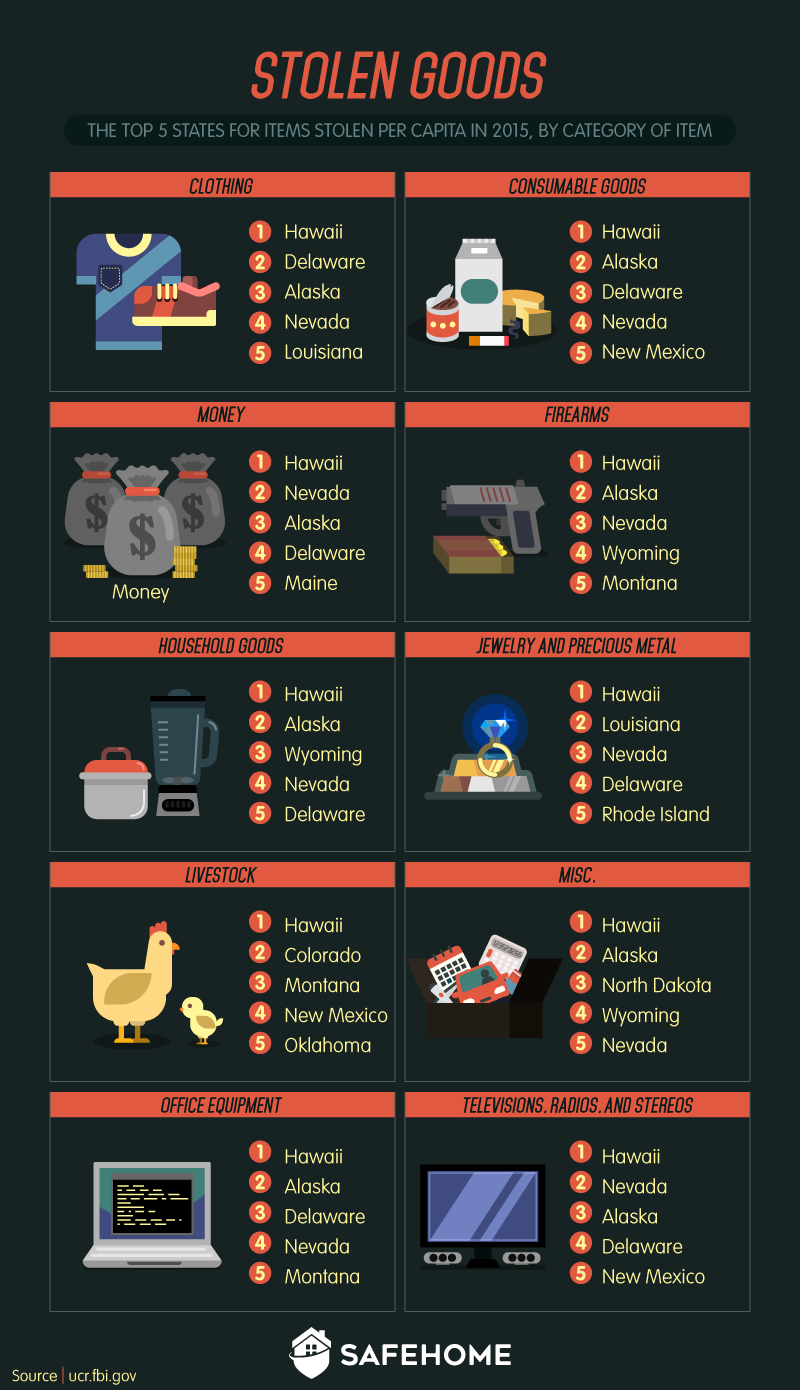
As seen above, we ranked each state by the number of items stolen per capita. While firearms ranked relatively low, according to the UCR data, they were more commonly stolen in Hawaii than anywhere else in the country – like when two thieves in Ewa stole a handgun (along with police gear) from a local police officer and were later arrested on those charges. Alaska and Nevada also had higher reported instances of stolen firearms.
>> Also see: How To Recover Lost or Stolen Items
Livestock was also most commonly stolen in Hawaii, but Colorado and Montana had high rates of stolen livestock, as well. Office equipment, which includes electronics like computers, were most commonly stolen in Hawaii, Alaska, and Delaware – based on the number of stolen goods per capita in each state.
It All Adds Up
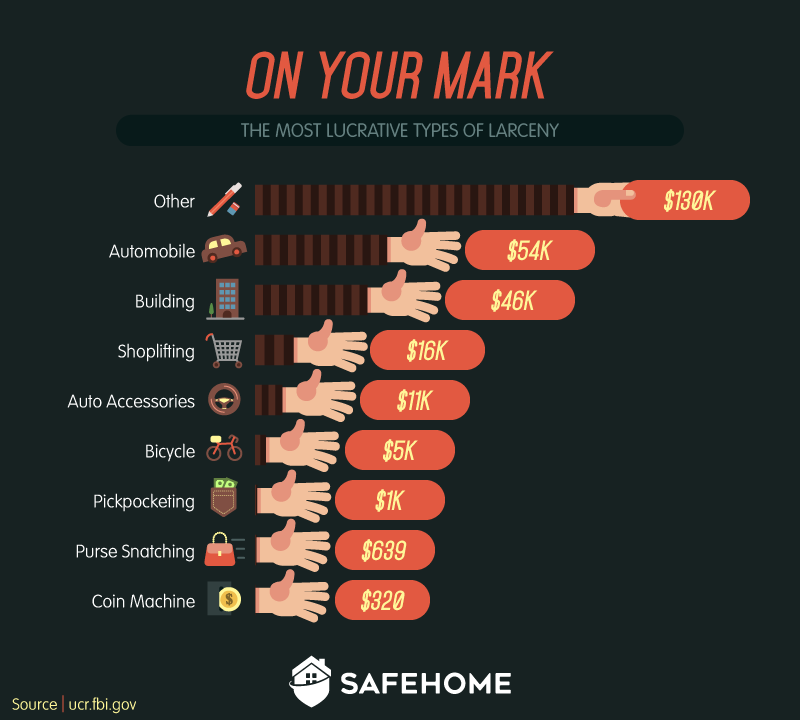
Items stolen from vehicles remain one of the most costly categories of larceny. Worth over $54,000 annually on average, commonly stolen items from cars include catalytic converters, which have seen a dramatic surge in thefts. Even with car insurance, having the full value of these items replaced isn't guaranteed. You also have to take your deductible into account if your coverage does extend to break-ins and subsequent damage.
Crimes from buildings – including homes and office spaces – accounted for nearly $46,000 in stolen property every month. When it comes to professional spaces, even politicians have been targeted. Even congressional offices have been broken into, with thieves primarily targeting electronic equipment and data storage devices.
Shoplifting (nearly $16,000) and auto accessories (more than $11,000) were both highly ranked for the cost of damages every month, on average, while bicycles added up to more than $4,500 a month in stolen property.
Instances of Theft
Larceny-theft differs from traditional theft in that it is “the unlawful taking, carrying, leading, or riding away of property from the possession or constructive possession of another,” according to the FBI. This can include bicycles, motor vehicles, accessories from motor vehicles, shoplifting, and pickpocketing.
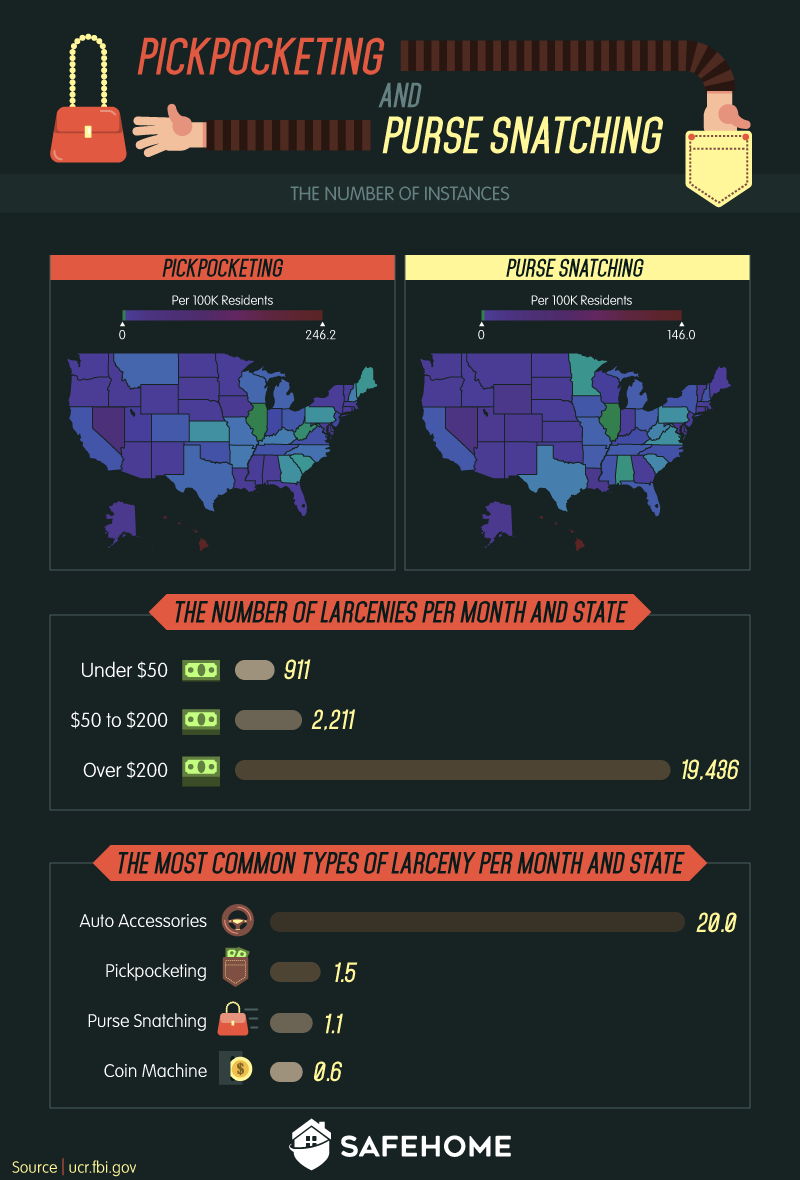
According to recent FBI data, pickpocketing incidents have evolved with technology. While traditional pickpocketing still occurs, digital pickpocketing through RFID skimming has become increasingly common. Major cities like New York, San Francisco, and Washington D.C. report the highest rates of these crimes, particularly in tourist-heavy areas and public transportation hubs. With thieves occasionally working in pairs, being aware of your surroundings, keeping your hand on your wallet, and keeping your purse close can help you avoid being a victim.
Purse snatching (which can lead to identity theft) was less common, according to the UCR data, but the highest number of these crimes on a per-capita basis occurred in Hawaii and Washington, D.C.
Vehicle-related thefts have surged dramatically. Electrical items like navigation systems are often the most common things stolen from cars, and experts recommend making sure these items are out of sight when you leave your car unattended.
Expensive Heists
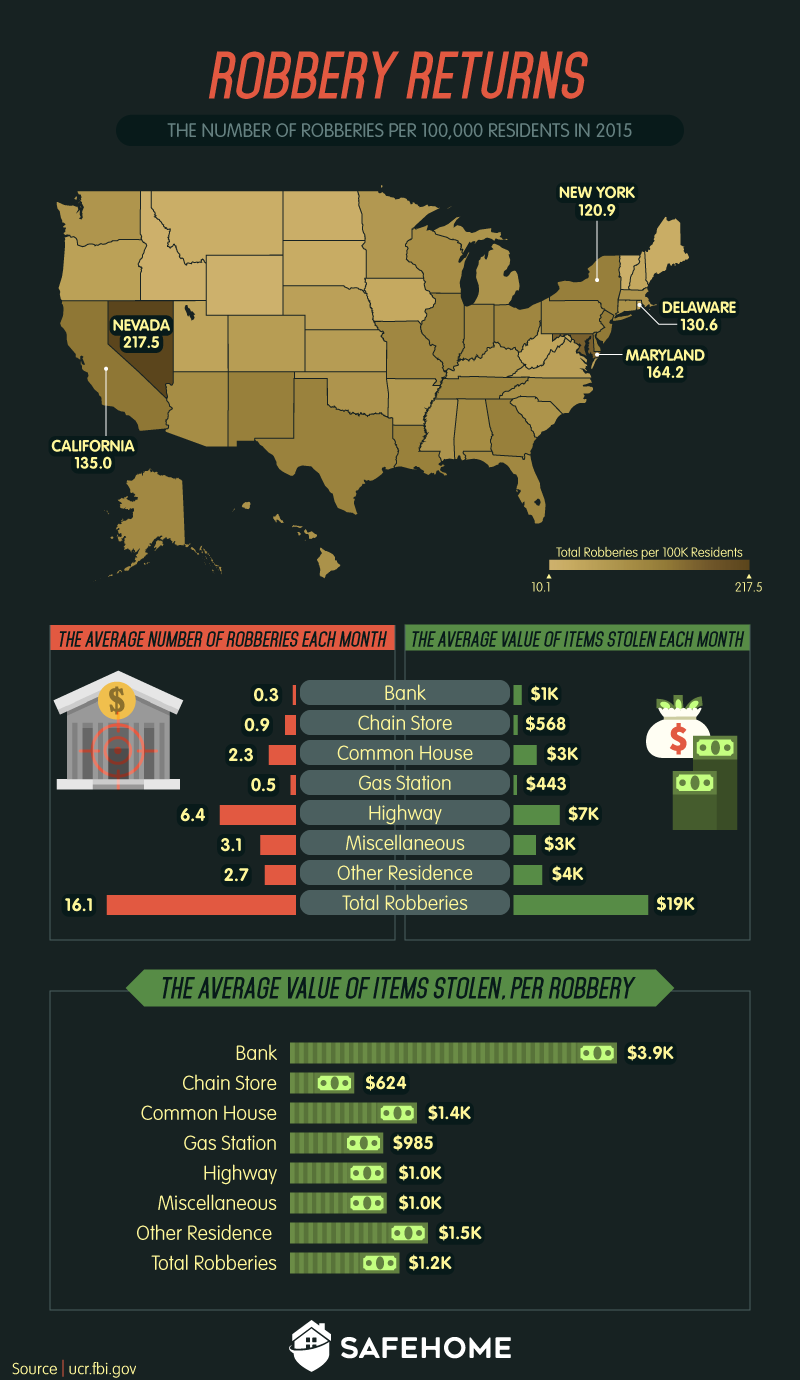
The FBI defines a robbery as “the taking or attempting to take anything of value from the care, custody, or control of a person or persons by force or threat of force or violence and/or by putting the victim in fear.”
Nevada continues to experience elevated robbery rates, with Las Vegas Metropolitan Police reporting significant organized retail crime activity. In 2023, coordinated robbery crews targeted multiple high-end retailers on the Las Vegas Strip, with single incidents sometimes resulting in losses exceeding $100,000. When it comes to bank robberies, California experiences the most with 192 out of 1,263 robberies nationwide in 2023.
Residential robberies remain a serious concern, with home invasions becoming more sophisticated. Criminals increasingly use social media to identify targets, monitoring posts about vacations, expensive purchases, or daily routines. The average loss from a residential robbery now exceeds $1,000, with incidents often targeting homes without visible security systems.
Breaking and Entering
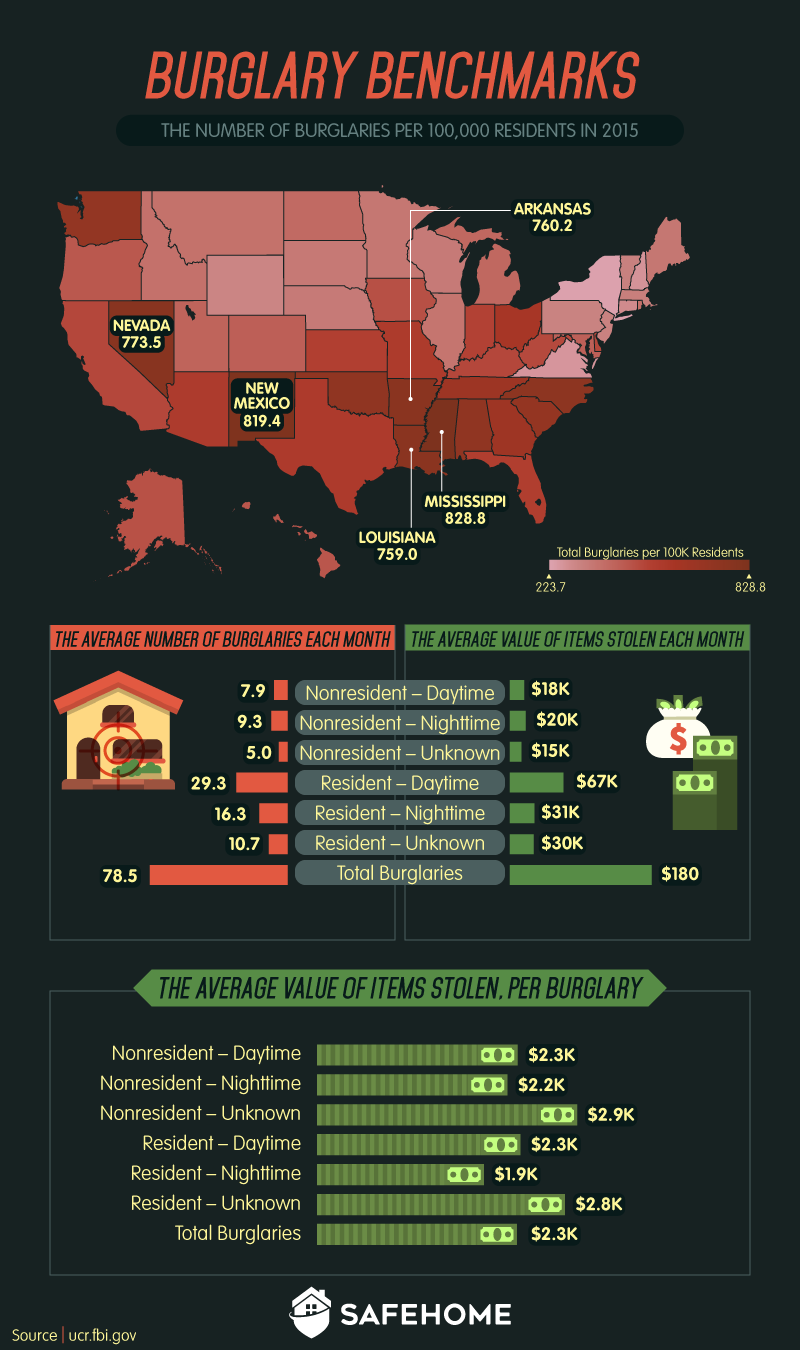
Burglary – which is specifically defined as including unlawful entry – can include thieves gaining access to your home or office through forcible entry, unlawful entry, or attempted forcible entry.
In Hawaii, there were more than 11,000 total burglaries for every 100,000 residents. Nevada and Alaska each had over 1,000, and New Mexico, Arizona, and Wyoming each had between 384 and 574 burglaries for every 100,000 residents. While residences were the most targeted location for these crimes, there were more than 78 burglaries each month for every 100,000 residents, adding up to over $180,000 in stolen valuables, on average.
The most costly burglaries occurred at an unknown time of day, according to UCR data, implying whether the assailants broke in during daytime hours or evening hours was indiscernible. For burglaries that targeted both resident and nonresident buildings, those that occurred during daytime hours resulted in a higher loss than those that occurred at night. It does not hurt to invest in some security cameras to deter criminals from choosing your home or business.
Your Security, Now
Property crimes affect every state, with burglaries, robberies, and larceny impacting millions of Americans annually. From high-value electronics and catalytic converters to jewelry and cash, thieves adapt their targets based on market values and opportunity. In some states like Nevada, Maryland, Rhode Island, and Delaware, these crimes were reported at a higher rate, according to the FBI Uniform Crime Reporting data.
When it comes to protecting your family and possessions, don’t take any chances. Break-ins don’t just happen at night, and a home security system can help ensure your home or office is protected, regardless of who’s home.
Methodology
We pulled the FBI 2015 Uniform Crime Reporting data from the National Archive of Criminal Justice Data and looked at what property was stolen and the value of that property across the United States.
Fair Use Statement
Help keep your readers safe and up-to-date on crime trends by sharing the results of our findings on your site for any noncommercial use. We only ask you ensure a link back to this page so our contributors earn credit for their work.