

Identity theft protection insurance reimburses victims for costs tied to recovering a stolen identity. This includes stolen funds, legal fees, and personal expenses like lost wages or travel. However, we found that coverage varies widely across the industry. The phrase “up to $1 million” is often used, but it means different things to different providers depending on how a policy structures its categories and limits. In our experience, understanding the structure and not just the top-line figure is the best way to judge whether a plan’s insurance is worth relying on.
Below, we explain how this insurance actually works, what it typically covers, and what separates a strong policy from a weak one. We’ll also look at how it works in practice for three of the best identity theft protection providers.

LifeLock has a dedicated page to submit claims and stay updated on the recovery process
How Identity Theft Insurance Works
Identity theft insurance isn’t something you buy on its own. It’s bundled into most identity theft protection subscriptions. If your identity is stolen while you’re an active subscriber, the insurance reimburses you for qualifying losses and expenses. There are terms and conditions, though. For example:
- Identity theft insurance doesn’t reimburse losses that occurred before you subscribed
- It requires proof of loss and documentation before paying out a claim
- The coverage is typically underwritten by a third-party insurer, not the identity theft protection company itself
In practice, that last point is the one people overlook the most. The insurer, not the provider you’re paying monthly, ultimately decides whether a claim gets paid.
Pro Tip: We recommend reading the “Summary of Benefits” document for any plan you’re considering. You’ll find all the details on exclusions, filing deadlines, and documentation requirements. This is the information we use when evaluating a provider’s coverage claims.
What’s Typically Covered
Most identity theft insurance policies divide coverage into a few core categories. We’ve found that the exact list varies by provider, but here are some of the most common ones:
- Stolen funds reimbursement. Money taken directly from your bank, credit, or retirement accounts due to identity theft
- Personal expense compensation. Out-of-pocket costs like lost wages, childcare, travel, and notary fees incurred while resolving the theft
- Lawyers and expert fees. Legal costs if you need an attorney or specialist to help clear your name or dispute fraudulent debt
- Cyber extortion or ransomware costs. This covers expenses tied to ransom demands or data-hostage situations
- Online fraud reimbursement. Losses from scams like phishing or fake payment requests
It’s worth noting that not every provider includes every category. The ones that do often set separate dollar limits for each. Speaking of limits, let’s look at how most identity protection services structure their coverage limits.
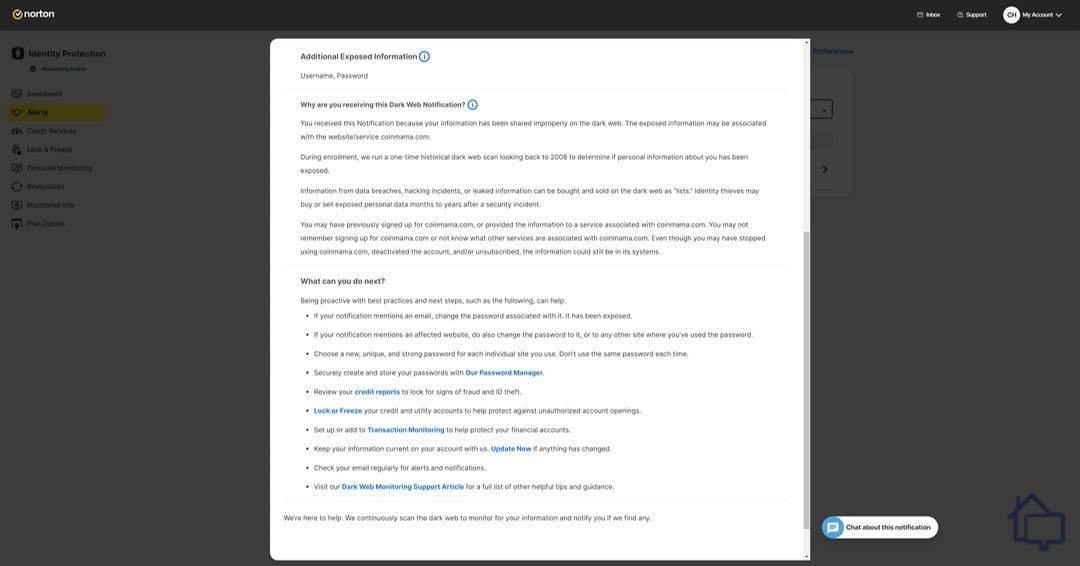
We appreciated LifeLock including instructions on how to protect ourselves when receiving a monitoring alert.
Why Coverage Limits Matter
Many services advertise “up to $1 million in coverage” as if it’s a flexible pool of money. In reality, that $1 million is often split across the several categories listed above. Your actual reimbursement for stolen funds will likely be capped. We recommend asking a few questions about a policy before you assume you know what it covers. For example:
- Is the advertised total a single shared pool, or separate limits per category?
- Does coverage scale with the plan tier, or is it the same across every plan?
- Is there a deductible per claim?
- Does coverage start immediately, or is there a waiting period after enrollment?
The answers aren’t always easy to find. From what we’ve seen across the industry, providers hide the details in the fine print.
FYI: A policy with a lower headline number but no deductible and immediate activation is sometimes more useful in practice than a higher number with more restrictions attached.
What Good Identity Theft Insurance Looks Like
Based on our testing, we consider an identity theft insurance policy to be strong when it does three things. First, it sets substantial dollar limits in each major category rather than relying on one shared pool. Second, it keeps those limits transparent and easy to find. Third, it scales coverage to match what a real identity theft case actually costs. Here are three examples from LifeLock, Aura, and Coveron.
| Provider | Total (Advertised) | Recovery / Stolen Funds | Legal Fees | Other Coverage |
|---|---|---|---|---|
| LifeLock (Total plan) | Up to $3,000,000 | Up to $1,000,000 | Up to $1,000,000 | Up to $1,000,000 for personal expenses |
| Aura | Up to $1,000,000 per adult | Included in the $1M | Included in the $1M | Included in the $1M |
| Coveron | Up to $2,310,000 | Up to $2,000,000 (identity theft recovery) | Included in the $2M | $100,000 for cyber extortion; $100,000 for online fraud; $100,000 for home title fraud; $10,000 for cyberattacks |
A few things stood out to us when we compared these plans side by side:
- LifeLock’s Total plan is the only one of the three that dedicates a full $1 million separately to each of three categories (stolen funds, personal expenses, and legal fees). That structure gives it the highest total advertised coverage of the three. It’s also the clearest example of the “separate limits per category” approach we consider the gold standard. Keep in mind that lower tiers offer less coverage for stolen funds and personal expenses.
- Aura takes the simplest approach. It offers a single $1 million policy per adult that covers eligible losses without subdividing into categories. While it’s easier to understand, it also means a large legal bill and a large stolen-funds loss in the same incident would draw from the same $1 million pool.
- Coveron sits in between LifeLock and Aura. Its core identity theft recovery benefit is $2 million, and it’s the only one of the three to offer cyber extortion ($100,000), online fraud ($100,000), home title fraud ($100,000), and cyberattacks ($10,000) as separate benefits. That’s an advantage for anyone worried about ransomware or scam-related losses.
The best one for you depends on what you’re trying to protect against. If you want the highest combined ceiling with dedicated, non-overlapping limits across stolen funds, personal expenses, and legal fees, LifeLock’s Total plan is the one we’d recommend.
>> Compare: LifeLock vs. Aura
LifeLock’s Insurance Coverage by Plan
LifeLock’s dashboard makes it easy to navigate between the various monitoring tools.
Given that it offers the highest insurance coverage among the three we compared above, let’s take a closer look at LifeLock’s offerings. Again, that $3 million figure only applies to the Total plan. Let’s see how its lower tiers, Core and Advanced, stack up.
| Plan | Stolen Funds | Personal Expenses | Legal Fees | Total Coverage |
|---|---|---|---|---|
| Core | Up to $25,000 | Up to $25,000 | Up to $1,000,000 | Up to $1,050,000 |
| Advanced | Up to $100,000 | Up to $100,000 | Up to $1,000,000 | Up to $1,200,000 |
| Total | Up to $1,000,000 | Up to $1,000,000 | Up to $1,000,000 | Up to $3,000,000 |
Legal fee coverage is the one category that stays flat at up to $1 million across all three LifeLock tiers. It’s the stolen funds and personal expense limits that scale up as you move to a higher plan.
We think it makes sense that LifeLock offers $1 million flat for legal expenses across all plans. Stolen funds are often partly recoverable through your bank. Federal protections like Regulation E require banks to reimburse many types of fraudulent transactions directly. That gives stolen-funds insurance a role as a backup rather than the primary source of recovery.
Legal and expert fees don’t have that same safety net. If identity theft escalates to disputing fraudulent debt, clearing a criminal record filed under your name, or fighting a contested title claim, you’re paying an attorney out of pocket with no bank protection to lean on. Keeping that coverage at $1 million regardless of plan means the risk that’s hardest to absorb on your own is covered the same way whether you’re on Core or Total. We go into more detail about each option in our LifeLock review.
Matching Coverage to Your Actual Risk
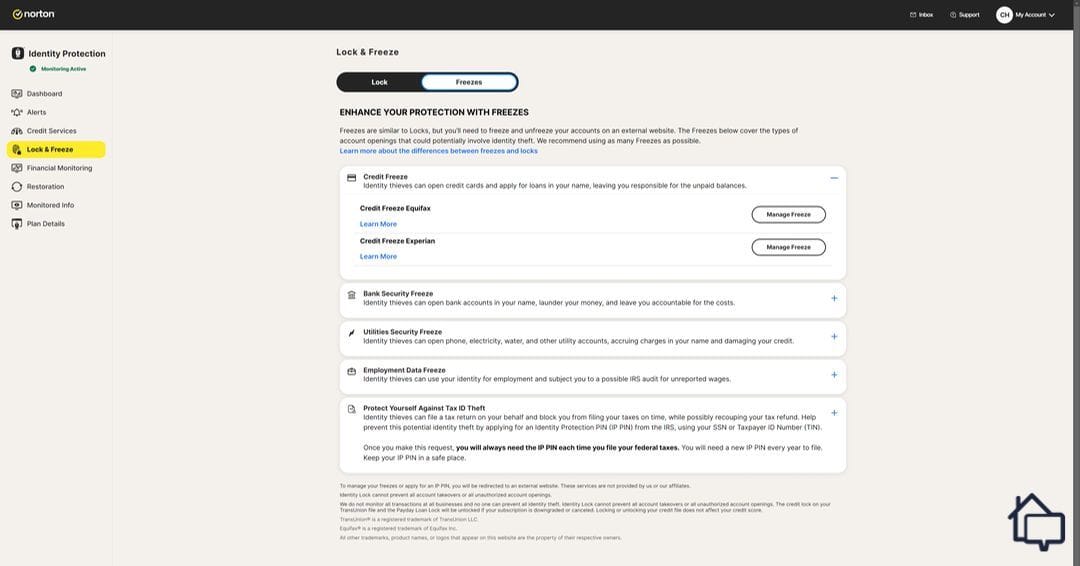
LifeLock makes it easy to freeze your credit fast if you’re impacted by identity theft.
Rather than choosing the identity theft protection service with the highest number on the page, take a minute to consider what you’re actually protecting. It might be safeguarding investments and savings or protecting yourself from ransomware and cyber extortion.
We recommend looking at our identity theft protection services recommendations. In our opinion, LifeLock offers the strongest coverage, thanks to its dedicated, non-overlapping limits across stolen funds, personal expenses, and legal fees. The right fit for you, though, depends on your own financial exposure and what kind of incident concerns you most.
Identity Theft Insurance FAQs
- What does identity theft insurance actually cover?
Identity theft insurance typically covers three categories of loss: stolen funds taken from your accounts, personal expenses like lost wages or travel costs tied to resolving the theft, and legal fees if you need an attorney or specialist. Limits and exclusions vary by provider.
- Is $1 million in identity theft insurance enough?
For most people, $1 million is enough to cover realistic losses. Identity theft cases rarely result in six- or seven-figure losses. If that $1 million is split across multiple coverage categories rather than dedicated to each one, though, your protection could be much lower than it appears.
- How does LifeLock's insurance compare to Aura and Coveron?
LifeLock’s Total plan offers the highest combined coverage of the three at up to $3 million, split into three separate $1 million categories. Aura offers a $1 million policy per adult that isn’t subdivided. Coveron offers up to $2 million in identity theft recovery, plus separate benefits of $100,000 for cyber extortion, $100,000 for online fraud, $100,000 for home title fraud, and $10,000 for cyberattacks.
- Does every LifeLock plan include $3 million in coverage?
No, coverage scales by plan. Core includes up to $1,050,000 total, Advanced includes up to $1,200,000, and Total includes up to $3,000,000. Legal fee coverage stays at up to $1 million across all three tiers.
- How do I file a claim on identity theft insurance?
You’ll need to report the theft to your provider, document your losses (bank statements, receipts, legal invoices), and submit a claim through the insurer named in your plan’s Summary of Benefits. Processing times and documentation requirements vary by provider and policy.