Key Findings
- More than half of all Americans believe it’s reasonable to trade privacy for safety, but only 1 in 5 feel significantly safer due to modern surveillance technology.
- Most people feel their personal data is completely out of their control: 86% of Americans do not feel they have control over how data about them is used, and 84% do not feel able to control who can gather and use data about them.
- 4 in 5 Americans are at least somewhat concerned about government surveillance, and almost 9 in 10 believe surveillance will be taken too far or already has been.
The Rise of Modern Surveillance
Artificial intelligence is everywhere and is continually evolving. Most people interact with artificial intelligence every day, as it enables computers, robots, and machines to mimic the capabilities of the human mind. The global AI market was estimated at $279 billion in 2024 and is projected to grow at 31.5 percent annually through 2033.1 Privacy remains a concern, as personal data collection is necessary for AI systems to operate and improve how they function.
From advanced facial recognition systems that can identify individuals in crowds to AI-powered predictive policing algorithms and autonomous security drones, surveillance technology continues to evolve rapidly. Law enforcement agencies now use real-time crime centers that integrate multiple data streams. Even retail stores use AI-driven loss prevention systems to instantly detect suspicious behavior patterns. We see AI being used in communities across the country and around the world by everyone from governments and law enforcement to individuals looking for a more efficient way of doing things.
As the balance between safety and privacy seems to be at a tipping point in our society, we wanted to put our finger on the pulse of Americans to see how they feel about surveillance. Where do most people stand on the issue of security versus privacy?
Security and Privacy Concerns
As heightened security measures become the new norm, we felt compelled to examine how it’s affecting Americans. Are they willing to trade their privacy for increased safety? Are they concerned about the amount of surveillance they’re under? Here’s a look at their responses.
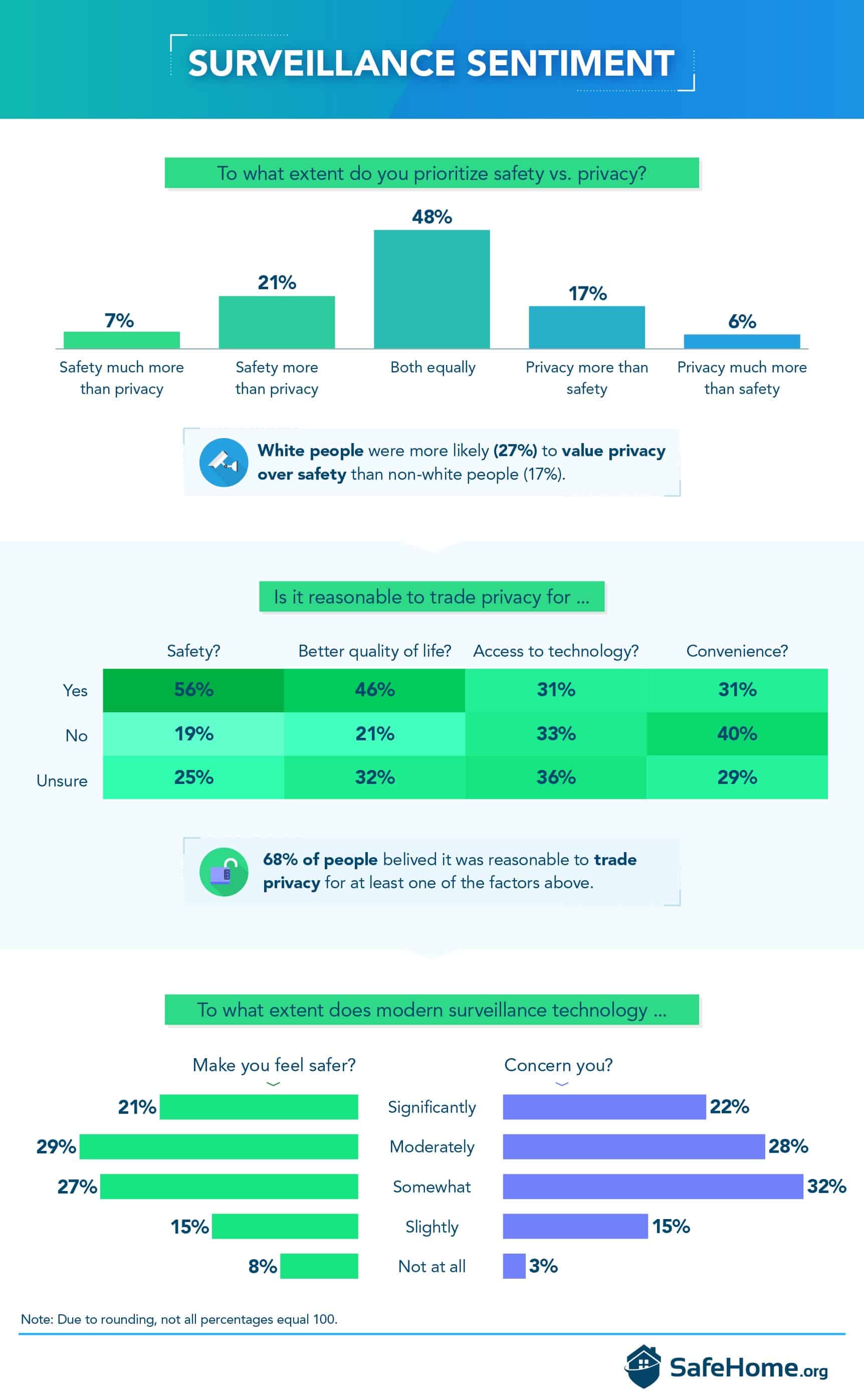
Our recent survey also took gender and political party affiliation into account when studying how people feel about safety and privacy concerns. It turns out that men (30%) were almost twice as likely as women (16%) to value privacy over safety. An additional study about safety confirms that women are more likely than men to feel unsafe, and they’re also more likely to use technology to stay safe.
Interestingly, 3 out of 4 Democrats agree that trading privacy for safety is reasonable. Independents were the most likely to value privacy over safety. Republicans were the most likely to say surveillance technology made them feel safer, however, they were also more likely to have a high level of concern about its usage.
Trust and Control Issues
We next took a look at five different types of surveillance to see if their usage made people feel safer or more concerned. We also measured trust levels people felt toward the various users of surveillance technology and the top reasons why people worry about its usage.
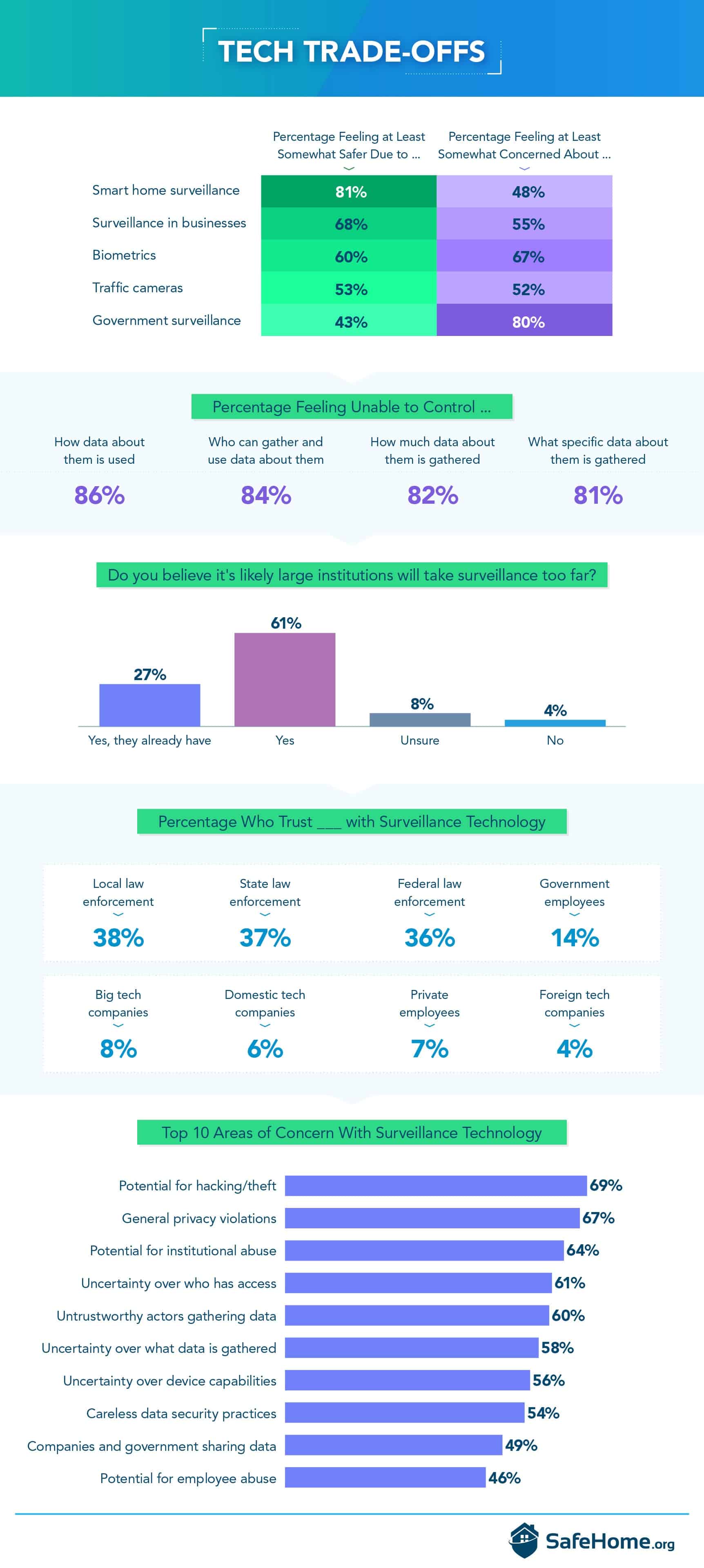
An overwhelming majority of people believed large institutions will take or have already taken surveillance measures too far. When it comes to political parties, 92% of Republicans believed surveillance has been or would be taken too far, followed by 88% of independents and 86% of Democrats. About 1 in 4 Americans felt surveillance had already been taken too far; of these, 37% were independents, 26% were Republicans, and 23% were Democrats.
Republicans were much less trusting of the federal government than state and local governments. On the other hand, Democrats were more trusting of the federal government and had less confidence in state and local governments. Our research also revealed that women (57%) were more likely than men (47%) to trust all levels of government with surveillance technology.
Technologically Advanced Law Enforcement
As leaders seek to arm their officers with new capabilities to protect and serve, advanced technology use in law enforcement has been on the rise in police departments.
Technologically advanced law enforcement is the use of computer programs and modern devices to police people. Some examples of surveillance technologies include:
- Artificial intelligence and predictive analytics
- Automatic license plate recognition
- Biometric identification systems
- Drones
- Enhanced body cameras
- Facial recognition software
- Autonomous security robots
- Gunshot detection systems
- Connected patrol vehicles with real-time data access
- Thermal imaging
Several law enforcement agencies have accelerated their adoption of surveillance technologies. Major U.S. cities, including New York and Chicago, use some form of predictive policing software. There’s a big push for the adoption of new information technology that includes gathering and storing a big collection of data. Some technologies have shown to be beneficial in reducing crime, like CCTV surveillance cameras. The efficacy of other methods, however, are still in question.
Facial recognition software is a powerful technology that compares faces to one another to help identify a person. Law enforcement wants to use this advanced tech to match suspects to photos in databases. Facial recognition accuracy continues to improve but there are still some significant disparities across demographic groups.
Inaccuracies also impact young Black and Asian women aged 18 to 30. If facial recognition continues its rapid adoption nationwide, the technology's imperfections could lead to wrongful arrests or misidentification of innocent individuals.
Conclusion
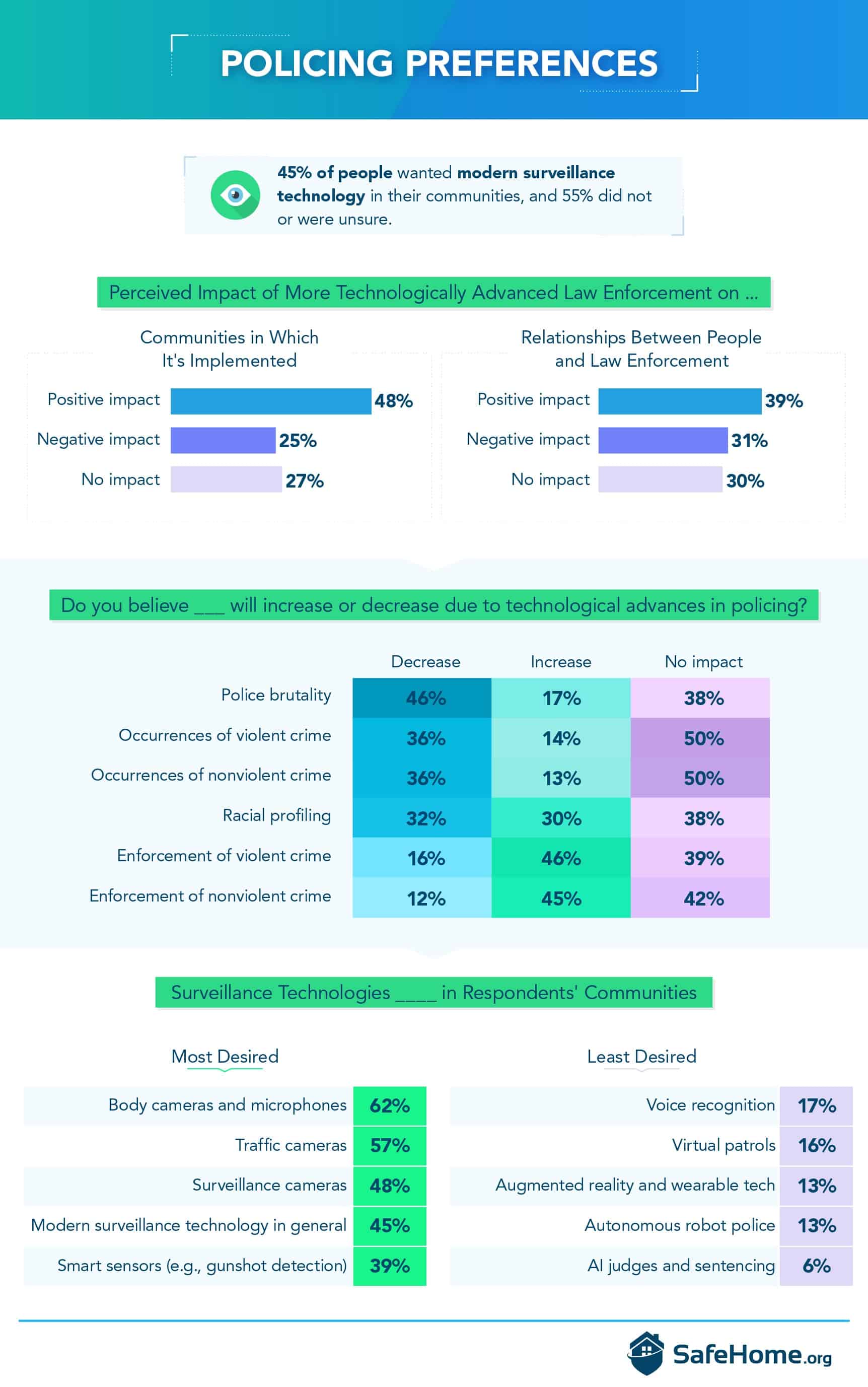
Americans are nearly split in half on whether or not they want more surveillance technology in their communities. Forty-five percent of the people we questioned said yes, while the other 55% either didn’t want it or weren’t sure. Women were also more likely than men to want modern technology in their community. Almost half of the group (48%) believes increased surveillance will have a positive impact, while 25% fear a negative impact, and 27% think it wouldn’t make a difference. Most people are also unconvinced that more advanced surveillance would result in a more positive relationship between the community and law enforcement.
The use of body cameras and microphones are what most people want to see increased in law enforcement, followed by more traffic and surveillance cameras. Women, non-white Americans, and Democrats are the most likely to desire more surveillance tech, while men, white Americans, Republicans, and Independents value privacy more. All agreed that the least desired technology implementations were artificial intelligence judges and robot police.
While some believe advanced surveillance technology can help reduce crime and improve public safety, many Americans remain skeptical about trading privacy for security. The widespread distrust in AI-powered policing tools suggests that society isn't ready for fully autonomous law enforcement systems. With data breaches affecting millions annually and concerns about algorithmic bias, people have reason to question whether those managing their personal information can be trusted to safeguard their privacy. Researchers agree that further evaluation is needed on the impact of artificial intelligence in policing to truly determine whether it’s worth sacrificing privacy for increased security.
Our Data
For this study, we surveyed 1,009 respondents using the Amazon MTurk platform. Among those respondents, 465 were female, 538 were male, and six identified as nonbinary. Our respondents ranged in age from 18 to 79 with an average age of 39.
In order to help gather accurate responses, all survey respondents were required to identify and correctly answer a decoyed attention-check question. In some cases, questions and answers have been rephrased or paraphrased for brevity or clarity. These data rely on self-reporting, and potential issues with self-reported data include, but are not limited to, telescoping, selective memory, and attribution errors.
Citations
- Grand View Research. (2025). Artificial Intelligence Market (2025 – 2033)
https://www.grandviewresearch.com/industry-analysis/artificial-intelligence-ai-market