Stalking Behavior: You Might be a Stalker if…
A package arrives in the mail. There’s no return address. You open it to find a bunch of old ’90s VHS tapes of the most iconic stalker movies of all time – films like “Psycho,” “Cape Fear,” and “Fatal Attraction.” It’s decision time. Do you call the police or rush out to the thrift store to snag an old VHS player and start watching?
The stalker archetype – the obsessed, jilted, and often-violent psychopath – captures and tantalizes the American imagination. But have you ever considered that YOU just might be the type of person so many of us love to fear?
Whether it’s peeking into someone else’s medicine cabinet, driving by the house of someone you’re crushing on, secretly sending a package, or perhaps going even further – most of us have been a bit too extreme in the name of love or just plain ol‘ curiosity.
We surveyed 2,000 Americans to uncover what types of boundary-pushing behaviors people admit to – and which actions cross the line from harmless curiosity into concerning territory. The results? More revealing than you might expect.
Here’s what we discovered.
Who Have You Stalked Lately?
Stalking is a pattern of ongoing and unwanted attention, harassment, contact, or other behaviors directed at someone causing them to be reasonably fearful.1 Looking up someone on social media isn't technically stalking unless your actions would make a reasonable person afraid. There's a crucial difference between being “stalky” – exhibiting some concerning behaviors – and being a stalker who commits criminal acts.
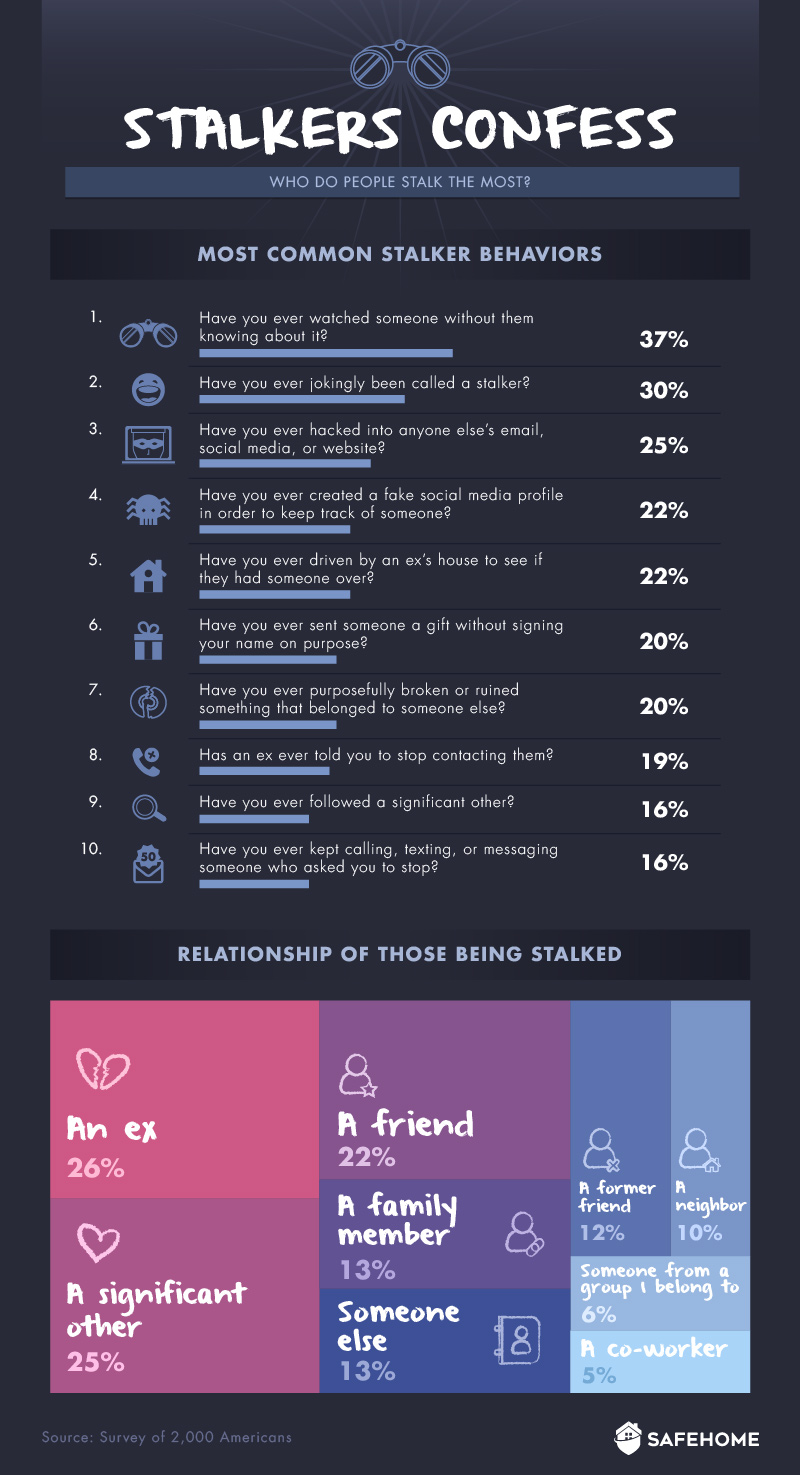
What percentage of the population admits to being stalky? More than a third of us have watched someone without their knowledge, and almost 30 percent of us have jokingly been called a stalker. Perhaps most surprisingly, a quarter of us have hacked into someone’s email, social media, or website. This finding coincides with recent data suggesting nearly half of Americans are concerned about the strength of their passwords.2
More than 20 percent of the people we surveyed also said they’ve created fake online profiles to keep track of somebody. The age old “flyby” of someone’s house to see what cars are in the driveway or what lights are on? That’s pretty common as well (more than 20 percent).
When it comes to targets, our survey revealed a clear hierarchy. Current romantic partners and exes topped the list, followed by current friends, family members, and then former friends. After that, neighbors, group members, and co-workers rounded out the most common subjects of stalky behavior.
Different Genders, Different Fears
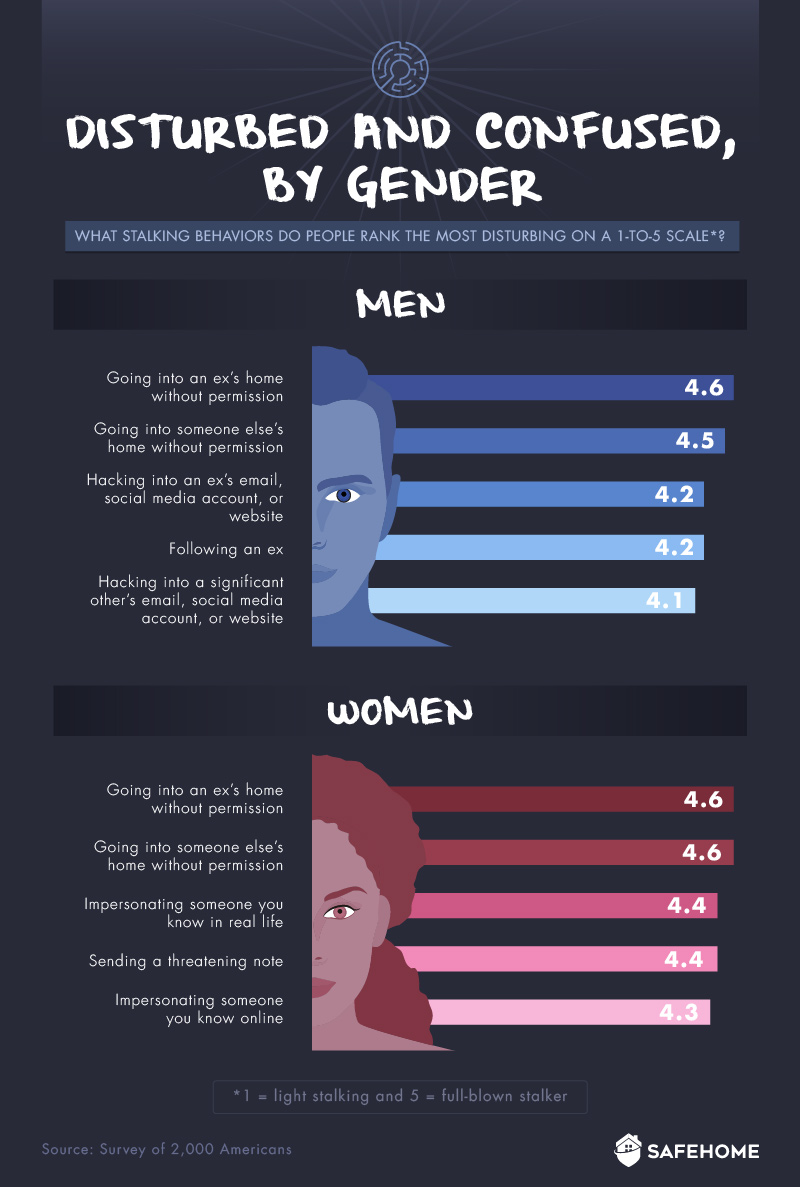
Gender plays a significant role in how we perceive stalking behaviors. Our data shows distinct differences between what men and women consider crossing the line. When it comes to the sexes and exes, men are more creeped out than women by the thought of a former partner hacking into their online life or following them in the real world. Meanwhile, impersonating someone in real life – or online – disturbed women more than men.
Interestingly, following an ex ranked fourth on the creepy-o-meter for men, but didn’t rank in the top five creepiest behaviors for women at all. Both sexes agreed that going into someone’s home without asking was the most stalkerish behavior of all.
Most Alarming Predatory Actions
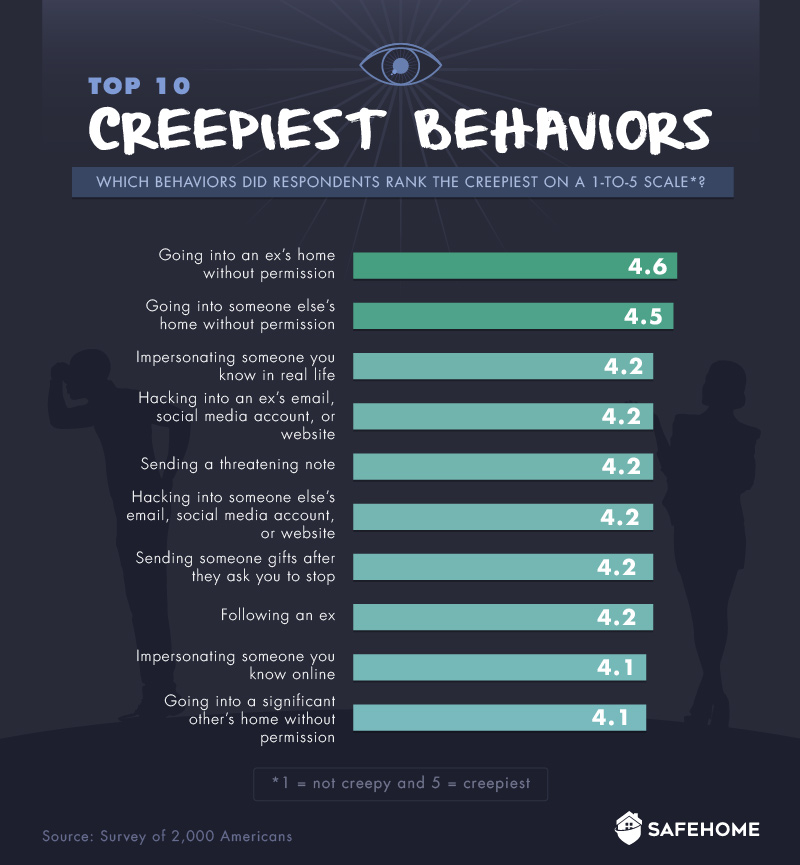
When it comes to creepy stalking behavior, going into the home of an ex-boyfriend or ex-girlfriend without their knowledge tops the list of deeds that people think are completely out of bounds.
The sanctity of our homes runs deep in the American psyche. Your home is your castle – a place where you should feel completely safe and free to be yourself. This explains why unauthorized entry consistently ranks as the most disturbing stalking behavior across all demographics we surveyed.
Impersonating someone in real life, hacking into an ex’s email, social media account, or website, and sending threatening notes were also considered among the most unnerving stalkerish actions.
The Object of My Affliction
One of the most memorable scenes in movie history takes place in the classic 1960 horror film “Psycho” as the character Norman Bates secretly watches the beautiful Marion Crane through a peephole while she showers. The scene taps into our fundamental fear of being watched when we believe we're alone. This fear has only intensified in our digital age.
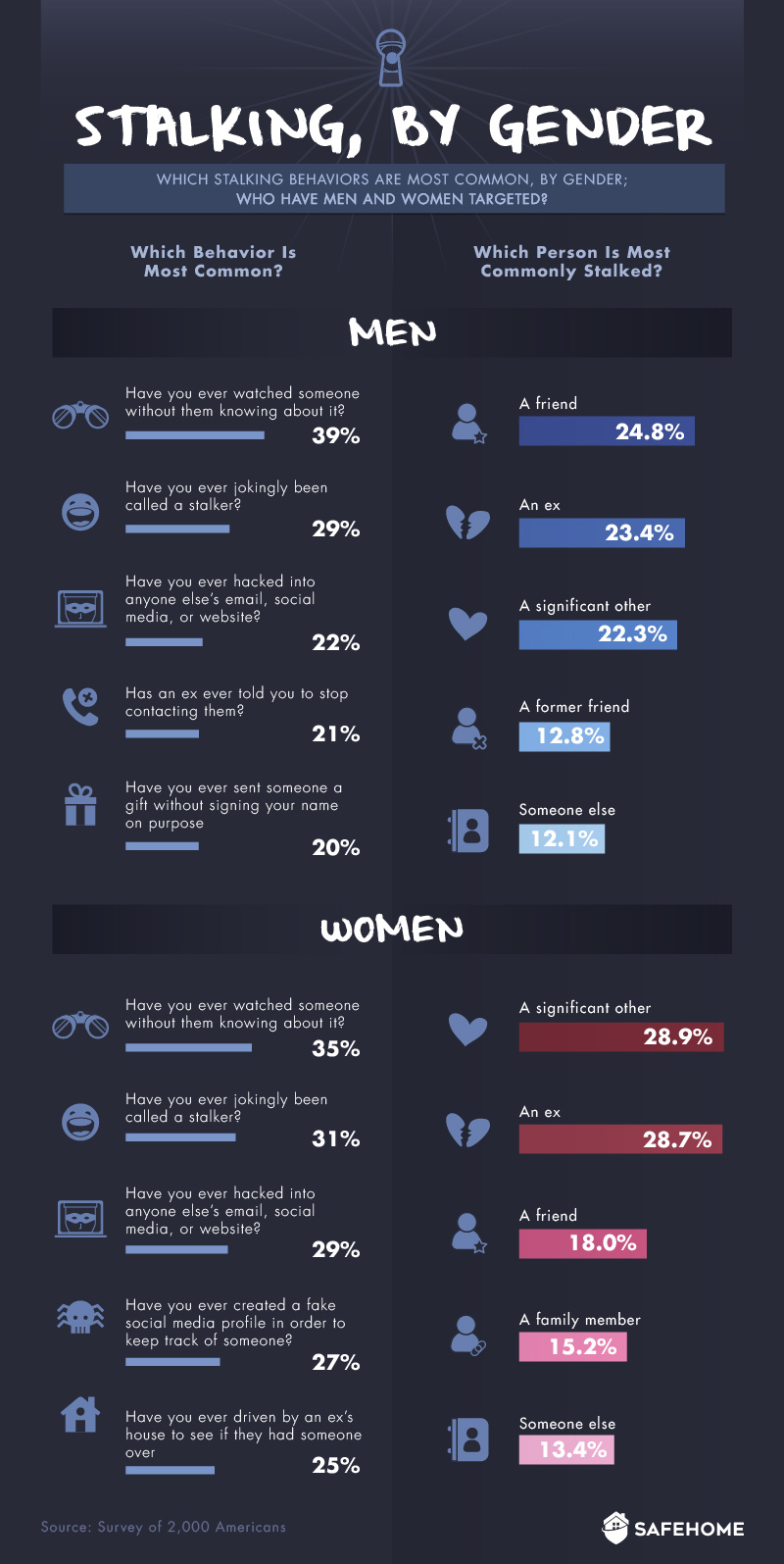
Of all the stalky behaviors we asked about, the one that men and women admitted to doing the most was watching someone without their knowledge. For men, 39 percent have done this before, while nearly 36 percent of women have done the same.
While secretly spying ranked as the No. 1 most common stalky action for both sexes, we found women were more likely than men to engage in online hacking by 7 percentage points. A whopping 26 percent of women have also created fake social media profiles to keep track of somebody. This behavior didn’t even place in the top five for men.
Despite our survey findings on stalky behavior, actual criminal stalking disproportionately impacts women. According to 2024 CDC data, approximately one in five women and one in ten men experience stalking at some point in their lifetime. 3 Women also experience higher rates of severe stalking behaviors.
The Age of Creepiness
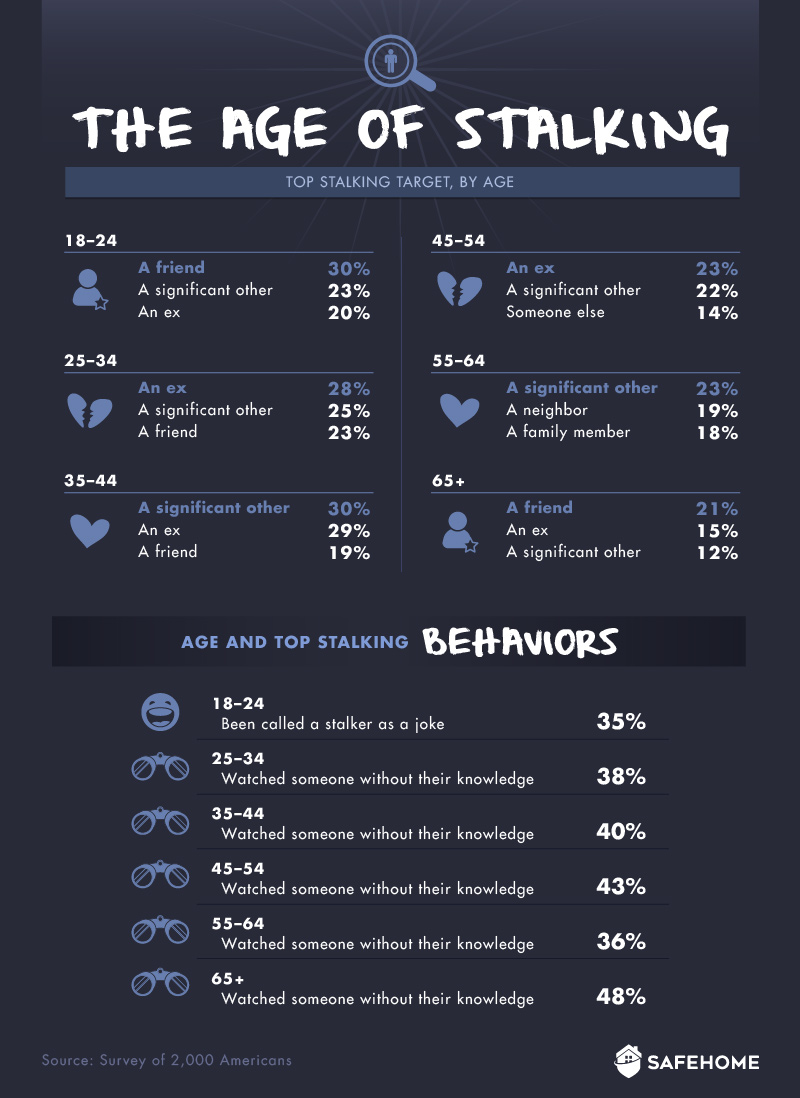
When we broke down stalking targets by age, the youngest group we surveyed (people aged 18 to 24 years old) said they stalked their friends more than any other group. Non-romantic friendships are especially important to college-aged adults as they strive to find their place in the larger social community. This aligns with research showing that young adults place exceptional importance on peer relationships and social validation.
Among those aged 25 to 64 years old, significant others and exes were most likely to be sneakily investigated. For those aged 65 and older, it was friends.
Stalkily Ever After?
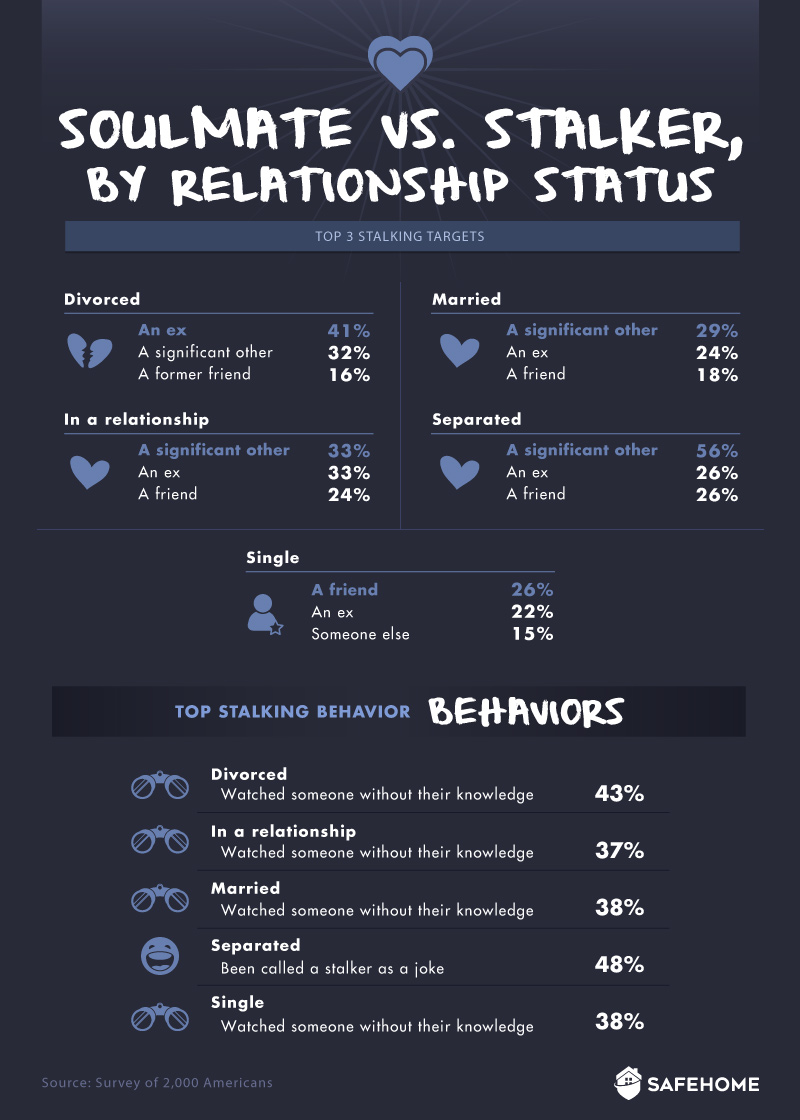
Relationship status dramatically influences who becomes the target of stalky behavior, revealing predictable but concerning patterns.
We found that single people were most likely to stalk a friend. People who were in a relationship or married were most likely to stalk their significant other. Divorced people were most likely to stalk their exes, while separated people were most likely to stalk their significant others – presumably their soon-to-be exes.
Notably, we found that people who were separated stalked their significant other the most (56 percent). They were also jokingly called a stalker nearly 48 percent of the time – more than any other group.
The separation period – that liminal space between together and apart – represents one of the most emotionally volatile times in a person's life. Research indicates that separation and divorce can trigger intense feelings of rejection, abandonment, and loss of control. These factors are all documented risk factors for escalating to stalking behaviors. It’s also a time when you’re at a higher risk of identity theft, which is why we recommend investing in one of the best identity theft protection services.
The State of Stalking
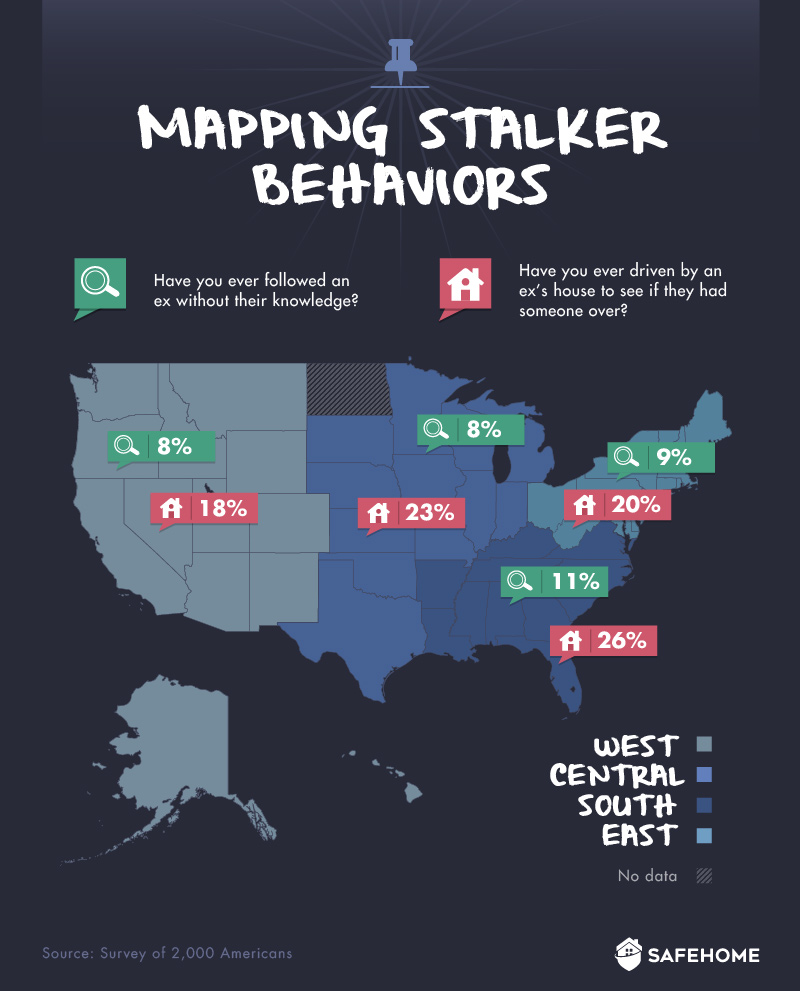
Does where we live in the U.S. influence our inclination to stalk? We found that it does. Those living in the West were the least likely to obsessively pursue their exes by following them or driving by their homes, while those living in the South were the most likely to do so. East Central U.S. fell in the middle.
These regional differences may reflect varying cultural attitudes about relationships and privacy. Recent psychological research confirms that regional personality differences exist. They’re shaped by historical migration patterns, cultural values, and social norms that have developed over generations.4
When Can We Expect Privacy?
The line between creepy and criminal isn't always obvious, but understanding it is crucial for protecting yourself and avoiding legal trouble.
Going into anyone’s home without his or her permission – unless, of course, you’re doing something good, like putting out a fire – is a criminal act.
It’s also a crime to harass someone. The crime of harassment can apply to a lot of the stalky behaviors we asked people about – from hacking into an online account, sending unwanted gifts, or following someone. Even driving by someone’s home to see who’s there could rise to harassment or criminal stalking if the behavior reasonably causes fear.
All 50 states have criminal stalking laws, with many states recently updating their statutes to include cyberstalking and digital harassment.5 Federal law also recognizes stalking as a serious crime, with penalties including up to 5 years in prison for interstate stalking violations.
Methodology
We surveyed 2,000 people in the U.S.
Fair Use Statement
It's safe to use the graphics above in your noncommercial content (we promise not to stalk you). But please link back to this page so the authors of this material secure proper credit.
Citations
- Office on Violence Against Women. (2023). Stalking.
https://www.justice.gov/ovw/stalking - Pew Research. (2023). How Americans View Data Privacy.
https://www.pewresearch.org/internet/2023/10/18/how-americans-view-data-privacy/ - Centers for Disease Control and Prevention. (2025). 2023/2024 Stalking Data Brief.
https://www.cdc.gov/nisvs/media/pdfs/stalking-brief.pdf - National Library of Medicine. (2022). Are Regional Differences in Psychological Characteristics and Their Correlates Robust? Applying Spatial-Analysis Techniques to Examine Regional Variation in Personality.
https://pubmed.ncbi.nlm.nih.gov/34699736/ - Stalking Prevention, Awareness, & Resource Center. (Retrieved 2025). U.S. Stalking Laws & Statutes.
https://www.stalkingawareness.org/map/