Home Heating Fire Risk Report
 |
December 3, 2025
|
December 3, 2025
Key findings
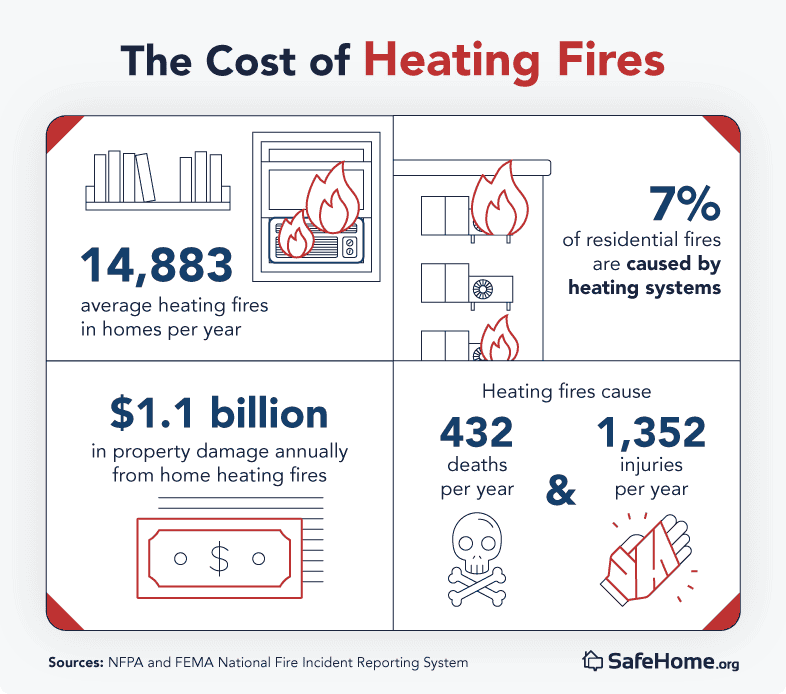
- On average, home heating systems cause 14,883 home fires each year in the U.S. That’s around 7% of all residential fires.
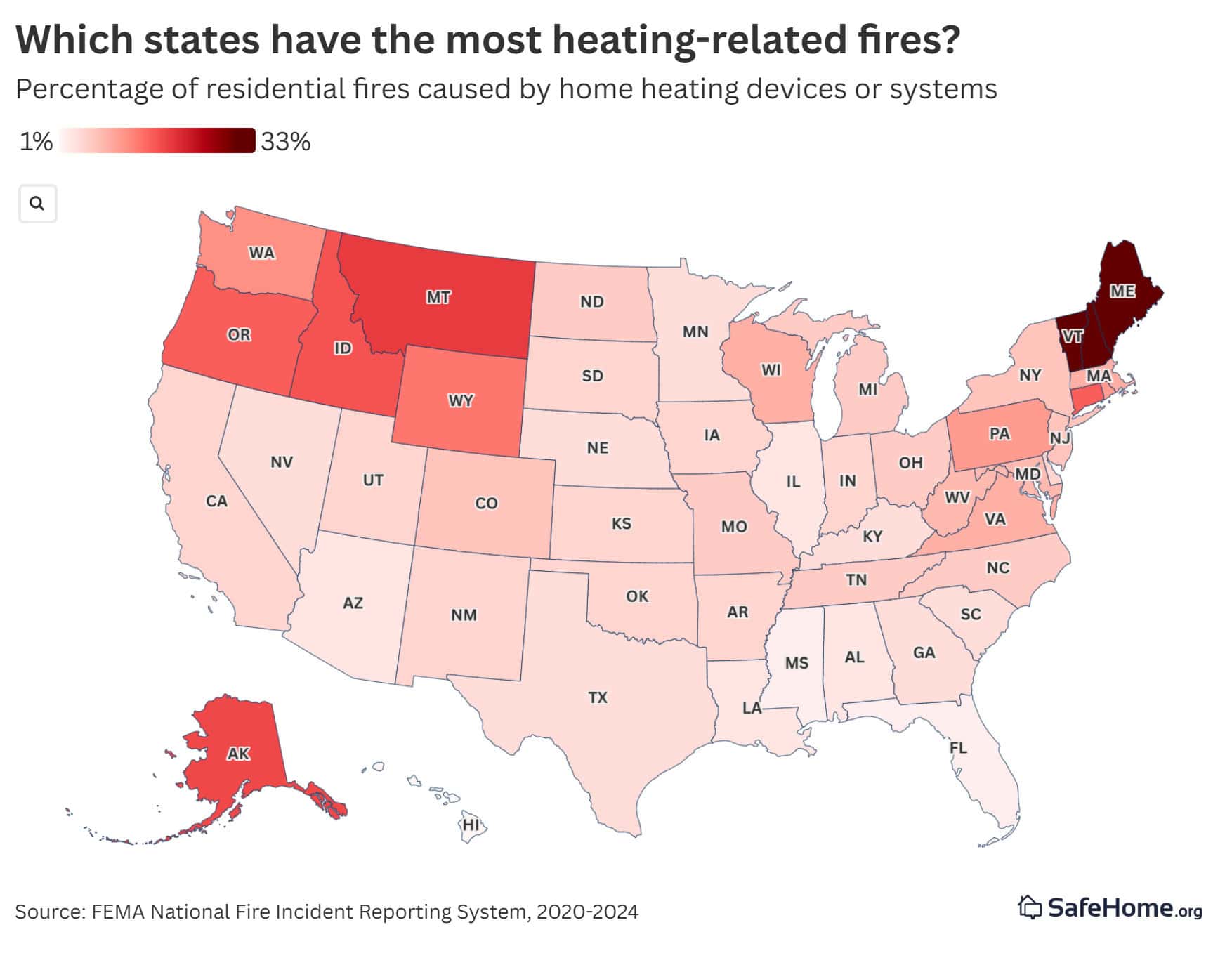
- In Vermont, New Hampshire, and Maine, approximately 1 in 3 residential fires are caused by heating systems or devices, which is significantly more than in any other state.
- Concord, NH, Torrington, CT, and Bangor, ME are the worst cities for home heating fires, with more than 30% of residential fires each year due to heating system malfunctions.
- 62% of Americans who use space heaters admit to leaving them on when they leave the room, fall asleep, or leave the house, and 50% plug space heaters into extension cords or power strips — a major fire hazard.
- Only a third of people with central heating systems or fireplaces at home have them inspected or cleaned annually.
- 27% of Americans say they do not have a carbon monoxide detector installed at home.
As colder weather settles over much of the United States, millions of households are turning on furnaces, plugging in space heaters, and lighting fireplaces. However, new data shows that many Americans are heating their homes in risky ways — particularly in the coldest regions of the country.
SafeHome.org analyzed data from the Federal Emergency Management Agency’s National Fire Incident Reporting System (NFIRS), which tracks reported residential fires nationwide. We then conducted a national survey of 1,986 U.S. adults to understand whether Americans use heating devices safely inside their homes.
States With the Highest Rates of Heating-Related Fires
According to the National Fire Protection Association (NFPA), heating-related fires result in 432 civilian deaths, 1,352 civilian injuries, and $1.1 billion in property damage annually in the U.S.
However, heating-related residential fire risks are not the same across the country. Heating equipment accounts for seven percent of all reported residential structure fires in the U.S., according to the National Fire Incident Reporting System (NFIRS). But some states—primarily those in New England and the Mountain West—have far higher rates of heating-related incidents than the national average.
States with Most Heating-Related Residential Fires
| STATE | Percent of residential structure fires caused by heating | Residential structure fires caused by heating (per 100k) | Annual residential structure fires caused by heating |
|---|---|---|---|
| Vermont | 33% | 30 | 188 |
| New Hampshire | 32% | 24 | 331 |
| Maine | 31% | 35 | 475 |
| Montana | 19% | 9 | 101 |
| Alaska | 18% | 20 | 148 |
| Idaho | 17% | 11 | 197 |
| Connecticut | 16% | 13 | 461 |
| Oregon | 16% | 7 | 304 |
| Wyoming | 14% | 10 | 60 |
| Washington | 12% | 8 | 619 |
Vermont, New Hampshire, and Maine—the three coldest states in the Northeast—experience heating-related fires at rates more than four times the national average. These states endure long, severe winters, and many residents heat their homes using fireplaces, wood stoves, pellet stoves, or older gas and oil furnaces. Vermont’s data also shows that fireplaces cause the largest share of reported heating-related fires (19 percent), reflecting a regional culture of wood-burning heat that, when poorly maintained, increases the chance of chimney fires and creosote buildup.
Smaller cities in these states see even sharper concentrations. In Barre and Bennington, Vermont, 50 percent and 47 percent of residential fires, respectively, are caused by heating devices. By contrast, states such as Hawaii, Mississippi, and Florida—where cold weather is rare—experience very few heating-related residential fires.
From Andrew Bozzo, Battalion Chief for Contra Costa County Fire Protection District
Metros Where Heating Fires Pose the Biggest Threat
The same pattern holds at the metro level, where mid-size cities across the Northeast, Mid-Atlantic, and Pacific Northwest show the highest concentrations of heating-related residential fires.
Metropolitan Areas with Most Heating-Related Residential Fires
| Metro | Percent of residential structure fires caused by heating | Annual residential structure fires caused by heating | Annual residential fires, all causes |
|---|---|---|---|
| Concord, NH | 34% | 42 | 125 |
| Torrington, CT | 33% | 29 | 88 |
| Bangor, ME | 31% | 53 | 172 |
| Manchester-Nashua, NH | 27% | 62 | 233 |
| Portland-South Portland, ME | 26% | 155 | 600 |
| Bremerton-Silverdale-Port Orchard, WA | 26% | 31 | 122 |
| East Stroudsburg, PA | 24% | 37 | 152 |
| Coeur d'Alene, ID | 22% | 25 | 110 |
| Kingston, NY | 21% | 31 | 150 |
| Barnstable Town, MA | 20% | 61 | 310 |
| Blacksburg-Christiansburg-Radford, VA | 20% | 13 | 63 |
| Chambersburg, PA | 19% | 18 | 96 |
| Traverse City, MI | 19% | 19 | 98 |
| Bridgeport-Stamford-Danbury, CT | 18% | 84 | 479 |
| State College, PA | 18% | 17 | 98 |
| Olympia-Lacey-Tumwater, WA | 17% | 32 | 189 |
| Lynchburg, VA | 17% | 28 | 166 |
| Bend, OR | 17% | 22 | 135 |
| Charlottesville, VA | 16% | 20 | 120 |
| Lancaster, PA | 16% | 53 | 325 |
| Burlington-South Burlington, VT | 16% | 26 | 163 |
| Hagerstown-Martinsburg, MD-WV | 16% | 39 | 249 |
| Hartford-West Hartford-East Hartford, CT | 15% | 139 | 919 |
| Salem, OR | 15% | 26 | 171 |
| Portland-Vancouver-Hillsboro, OR-WA | 15% | 141 | 936 |
| Idaho Falls, ID | 15% | 12 | 77 |
| Norwich-New London-Willimantic, CT | 15% | 37 | 247 |
Note: Only includes metros with populations of 150,000 or more
In New England cities such as Concord, Torrington, and Bangor, more than 30 percent of residential fires were caused by heating devices, underscoring how severe winters and higher reliance on wood-burning appliances shape local risk. In many of these metros, a significant number of people reside in older homes—properties that are more likely to have outdated chimneys, aging furnaces, or insufficient insulation, which can lead to the use of alternative heating sources.
In the Pacific Northwest, places such as Bremerton and Bend exhibit similarly high percentages of fires caused by heating devices. This region experiences frequent winter storms and power outages, which could lead residents to rely more heavily on fireplaces, wood stoves, and generators. Wood-burning heat remains a cultural norm across many rural and suburban communities in Washington and Oregon, and this can lead to an increase in chimney fires if annual maintenance is neglected.
Heating Fire Rates Among the 10 Largest Metros
| Population rank | Metro | Percent of residential structure fires caused by heating | Annual residential structure fires caused by heating | Annual residential fires, all causes |
|---|---|---|---|---|
| 1 | New York-Newark-Jersey City, NY-NJ | 6% | 1430 | 22227 |
| 2 | Los Angeles-Long Beach-Anaheim, CA | 3% | 122 | 4081 |
| 3 | Chicago-Naperville-Elgin, IL-IN | 3% | 219 | 7363 |
| 4 | Dallas-Fort Worth-Arlington, TX | 4% | 138 | 3091 |
| 5 | Houston-Pasadena-The Woodlands, TX | 2% | 78 | 3136 |
| 6 | Washington-Arlington-Alexandria, DC-VA-MD-WV | 6% | 191 | 3078 |
| 7 | Philadelphia-Camden-Wilmington, PA-NJ-DE-MD | 6% | 354 | 5733 |
| 8 | Miami-Fort Lauderdale-West Palm Beach, FL | 2% | 29 | 1889 |
| 9 | Atlanta-Sandy Springs-Roswell, GA | 4% | 141 | 3255 |
| 10 | Boston-Cambridge-Newton, MA-NH | 7% | 618 | 9049 |
Across the nation’s largest metropolitan areas, heating related fires were relatively uncommon. Howeverm annual residential fire totals varied widely, reflecting differences in climate, population, and housing. New York experiences by far the most residential fires each year—over 22,000—followed by Boston (9,049) and Chicago (7,363). In contrast, warmer metros like Miami (1,889) and Dallas–Fort Worth (3,091) experience far fewer residential fires overall, in part because homes in these areas rely less on heating systems that can spark wintertime incidents. These numbers show that even when heating accounts for a small percentage of fires, colder metros can experience dramatically higher numbers of home fires.
Risks of Common Home Heat Sources
Central Heating
Most households—78 percent, according to our survey—have central heating through a furnace or heat pump. But only 32 percent of users schedule recommended annual inspections.
Why is it important to regularly inspect and service central heating systems? Skipping routine furnace maintenance increases the likelihood of mechanical failure, electrical malfunction, carbon monoxide leaks, and ignition due to clogged filters or faulty components. During the first major cold snap of the year, HVAC companies frequently report spikes in emergency repair calls as systems that sat dormant for months suddenly fail. These problems are more common in regions with older homes or aging heating infrastructure.
| How often do you have your central heating system professionally inspected or cleaned? | Percent of people with central heating systems |
|---|---|
| Never | 13% |
| Less than once every 5 years | 13% |
| Every 3–5 years | 16% |
| Every 2 years | 12% |
| Once a year (recommended) | 26% |
| More than once a year | 6% |
| Unsure | 13% |
Source: Survey of 1,540 people with central heating systems
Lower-income households may be especially affected. Heating inspections typically cost between $100 and $300, and in regions where winter bills rise sharply, homeowners may choose to defer preventive services. Renters also have less control over maintenance schedules, and older multifamily buildings may have inconsistent inspection histories.
Space Heaters
While heating-related fires are more common in colder states, risky heating habits occur nationwide. According to the survey, 23 percent of Americans use a space heater—an appliance associated with a disproportionately high number of winter fire deaths—the specific behaviors many users admitted to reveal why.
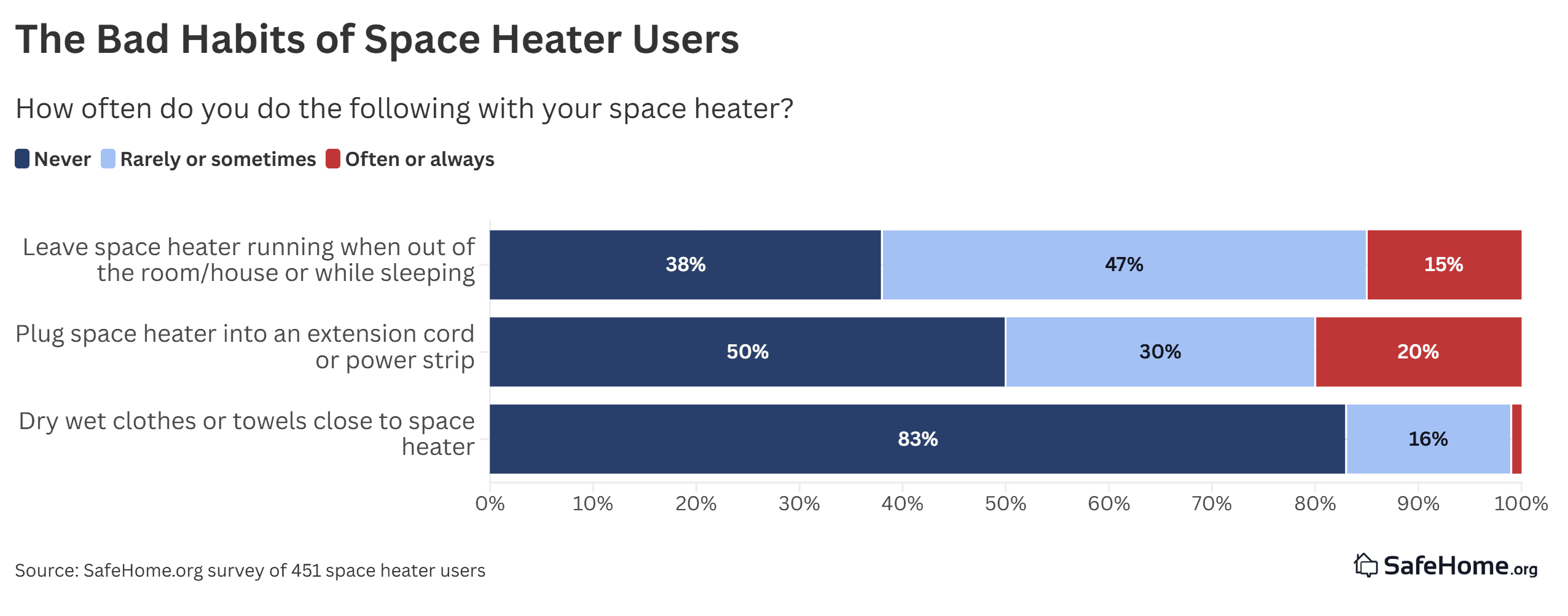
These behaviors mirror those most frequently identified by safety agencies as ignition sources. Leaving a heater running unattended is one of the leading contributors to fatal home heating fires. Plugging heaters into power strips rather than directly into a wall outlet can cause overheating, especially if multiple appliances share the same circuit. Drying clothes near a heater—a practice more common in small apartments or cold, damp climates—puts combustible materials within inches of a device designed to emit high heat.
In colder regions, energy bills can rise quickly in winter, so residents often turn to space heaters to warm individual rooms while keeping the household thermostat at a lower setting. These cost-saving strategies may be practical in the short term, but they can inadvertently increase the risk of fire. Fire departments across the country routinely warn that portable heaters draw more current than most power strips can handle, making these behaviors especially dangerous.
Real-world events underscore the seriousness of these risks. In January 2025, a Connecticut home was set ablaze by a space heater, displacing four people and injuring one. In October, two people were killed in a Missouri home fire that was likely ignited by a space heater.
From Andrew Bozzo, Battalion Chief for Contra Costa County Fire Protection District
Fireplaces
Fireplaces—wood-burning and gas alike— are wonderful to gather around in the winter months. Yet the survey found that a majority of fireplace users skip recommended maintenance or neglect basic safety practices. Sixty percent of fireplace users don't have their fireplace properly maintained, and 21 percent report that they never have it cleaned or inspected.
| How often do you have your fireplace or chimney professionally inspected or cleaned? | Percent of fireplace users |
|---|---|
| Never | 21% |
| Less than once every 5 years | 14% |
| Every 3–5 years | 14% |
| Every 2 years | 11% |
| Once a year (recommended) | 23% |
| More than once a year | 8% |
| I'm not sure | 9% |
Source: Survey of 158 people with fireplaces
Even people who clean and maintain their fireplaces can still increase their fire risk by leaving the fire unattended. In fact, 30 percent of fireplace owners report that they don't always completely extinguish their fireplace before going to sleep or leaving the house. Others admitted to drying wet clothes or towels close to their fireplace or improperly disposing of the ashes. Embers can stay hot for days, and placing them in cardboard boxes, plastic bins, or outdoor piles can lead to fast-spreading fires that start well after the fireplace has cooled.
Chimney and flue maintenance is essential for preventing creosote buildup, which is a primary cause of chimney fires. The Chimney Safety Institute of America recommends annual inspections and cleanings from certified chimney sweeps. Yet the survey shows that most Americans do not follow this guidance. In colder states like Vermont and Maine—where the NFIRS data shows fireplaces cause a significant share of heating-related fires—neglected chimneys may contribute to the elevated risk.
Home Heating and Carbon Monoxide Risks
Carbon monoxide (CO) incidents tend to spike in winter, when furnaces, space heaters, and fireplaces operate for more extended periods. Since modern homes are well-sealed and insulated for energy efficiency, there is less fresh air circulating, which increases the risk of CO poisoning.
Nearly 40 percent of Americans either don’t have a CO detector or are unsure whether one is installed in their home. This gap is especially concerning in older buildings and in states with long heating seasons. Because CO is colorless and odorless, detectors are the only reliable means of warning residents before symptoms appear.
How To Reduce Heating System Fire Risk This Winter
Heating systems and appliances are essential for navigating the winter months comfortably and safely, but when misused or neglected, they also pose fire risks. The NFIRS data and our survey both point toward clear, practical ways households can reduce their risk of heating-related fires:
- Turn off space heaters when leaving a room, going to sleep, or leaving the house.
- Plug heaters directly into wall outlets, never power strips or extension cords. Keep a three-foot clearance zone around all heating devices.
- Schedule annual inspections and cleanings for fireplaces and central heating systems to ensure optimal performance and safety.
- Fully extinguish fireplaces before leaving or going to bed and dispose of the ashes only in metal containers with lids.
- Install smoke alarms and carbon monoxide detectors on each floor and test them monthly to ensure they are functioning correctly.
The heating-related fire risk may increase as energy costs fluctuate and winter temperatures become more erratic. More households may rely on portable heaters to save money or turn to fireplaces during power outages. At the same time, smart thermostats, smart plugs, and improved safety standards for heaters offer promising pathways to reduce risk—if homeowners adopt them.
As cold weather returns, understanding how heating systems and habits intersect is key to preventing residential fires. With simple changes and greater awareness, many of the fires reflected in the data above can be prevented, helping families stay safe and cozy throughout the winter season.
Methodology
In November 2025, Safehome.org polled 1,986 American adults about their home heating devices and safety habits. The poll was conducted online. Participants’ responses were weighted to be representative of the age, sex, and ethnicity of the U.S. population according to the Census, as well as balancing by Census region.
We also analyzed National Fire Incident Reporting System (NFIRS) data from 2020 through 2024 and mapped each residential property fire to its corresponding metropolitan area using the U.S. Census Bureau’s Core-Based Statistical Areas (CBSAs). Following NFIRS documentation, we classified incidents into residential property, structure, and building fires, and identified heating-related fires using the standardized fire cause and equipment codes.
To contextualize fire activity across metro areas, we calculated average annual rates of residential heating fires and normalized these figures using 2022 American Community Survey (ACS) 5-year population estimates. In addition to incident rates, we examined contributing factors by analyzing the equipment associated with each fire and identifying the 15 most frequently involved equipment categories within each CBSA.
Because participation in NFIRS is voluntary, reporting completeness varies by state, department, and geography. As a result, NFIRS does not represent a full census of U.S. residential fires. To mitigate the impact of uneven reporting when comparing metro areas, we emphasized ratio-based metrics, such as the percentage of residential fires caused by home heating. These proportional comparisons are more resilient to participation variability than absolute incident counts or per-capita rates, as they rely on the relative distribution of causes within each metro’s reported fire sample rather than the total volume of reports.
Data Appendix
| STATE | Percent of Residential Structure Fires Caused by Heating | Residential Structure Fires Caused by Heating (per 100k) | Annual Residential Structure Fires Caused by Heating |
|---|---|---|---|
| United States | 7% | 5 | 14883 |
| Alaska | 18% | 20 | 148 |
| Alabama | 3% | 2 | 104 |
| Arkansas | 5% | 6 | 187 |
| Arizona | 3% | 1 | 65 |
| California | 5% | 2 | 754 |
| Colorado | 7% | 4 | 220 |
| Connecticut | 16% | 13 | 461 |
| Delaware | 5% | 6 | 59 |
| Florida | 2% | 1 | 188 |
| Georgia | 4% | 3 | 271 |
| Hawaii | 1% | 1 | 7 |
| Iowa | 5% | 2 | 78 |
| Idaho | 17% | 11 | 197 |
| Illinois | 3% | 3 | 364 |
| Indiana | 5% | 3 | 200 |
| Kansas | 5% | 4 | 104 |
| Kentucky | 4% | 3 | 128 |
| Louisiana | 3% | 2 | 117 |
| Massachusetts | 9% | 16 | 1090 |
| Maryland | 8% | 4 | 256 |
| Maine | 31% | 35 | 475 |
| Michigan | 6% | 5 | 536 |
| Minnesota | 4% | 3 | 180 |
| Missouri | 6% | 4 | 243 |
| Mississippi | 2% | 2 | 61 |
| Montana | 19% | 9 | 101 |
| North Carolina | 6% | 4 | 370 |
| North Dakota | 6% | 5 | 36 |
| Nebraska | 4% | 1 | 26 |
| New Hampshire | 32% | 24 | 331 |
| New Jersey | 7% | 5 | 401 |
| New Mexico | 5% | 5 | 95 |
| Nevada | 4% | 2 | 74 |
| New York | 7% | 8 | 1497 |
| Ohio | 6% | 6 | 648 |
| Oklahoma | 5% | 4 | 170 |
| Oregon | 16% | 7 | 304 |
| Pennsylvania | 11% | 10 | 1335 |
| Rhode Island | 11% | 11 | 114 |
| South Carolina | 4% | 4 | 209 |
| South Dakota | 5% | 2 | 19 |
| Tennessee | 6% | 5 | 354 |
| Texas | 4% | 2 | 491 |
| Utah | 5% | 2 | 59 |
| Virginia | 9% | 5 | 402 |
| Vermont | 33% | 30 | 188 |
| Washington | 12% | 8 | 619 |
| Wisconsin | 9% | 5 | 289 |
| West Virginia | 8% | 10 | 184 |
| Wyoming | 14% | 10 | 60 |