SafeHome.org’s
Report on Parenting in America
 |
December 8, 2025
|
December 8, 2025
Being a parent has always been challenging. During all eras of American history, parents have fretted about their kids’ health, safety, and well-being. But as our society evolves, parents’ biggest concerns have naturally shifted.
As part of our ongoing research about family safety and parenting, we asked thousands of U.S. parents more than 45 questions about raising children, including what keeps them up at night and what they consider appropriate for children.
Our research participants encompassed a diverse range of ages from 18 to 74 years and represented various racial backgrounds. This broad spectrum ensured that the collected insights reflect a rich tapestry of parental experiences. We distilled their experiences, opinions, and concerns into seven charts below.
1. The internet is parents’ primary safety concern for their children.
Real-world dangers like strangers, school violence, and traffic accidents remain significant threats, but the main concerns dominating parental anxiety are digital: the internet and social media. An overwhelming 70 percent of parents disclosed that social media and the internet are their foremost apprehensions. These are trailed by worries regarding safe sex for teenagers and the concept of body autonomy.
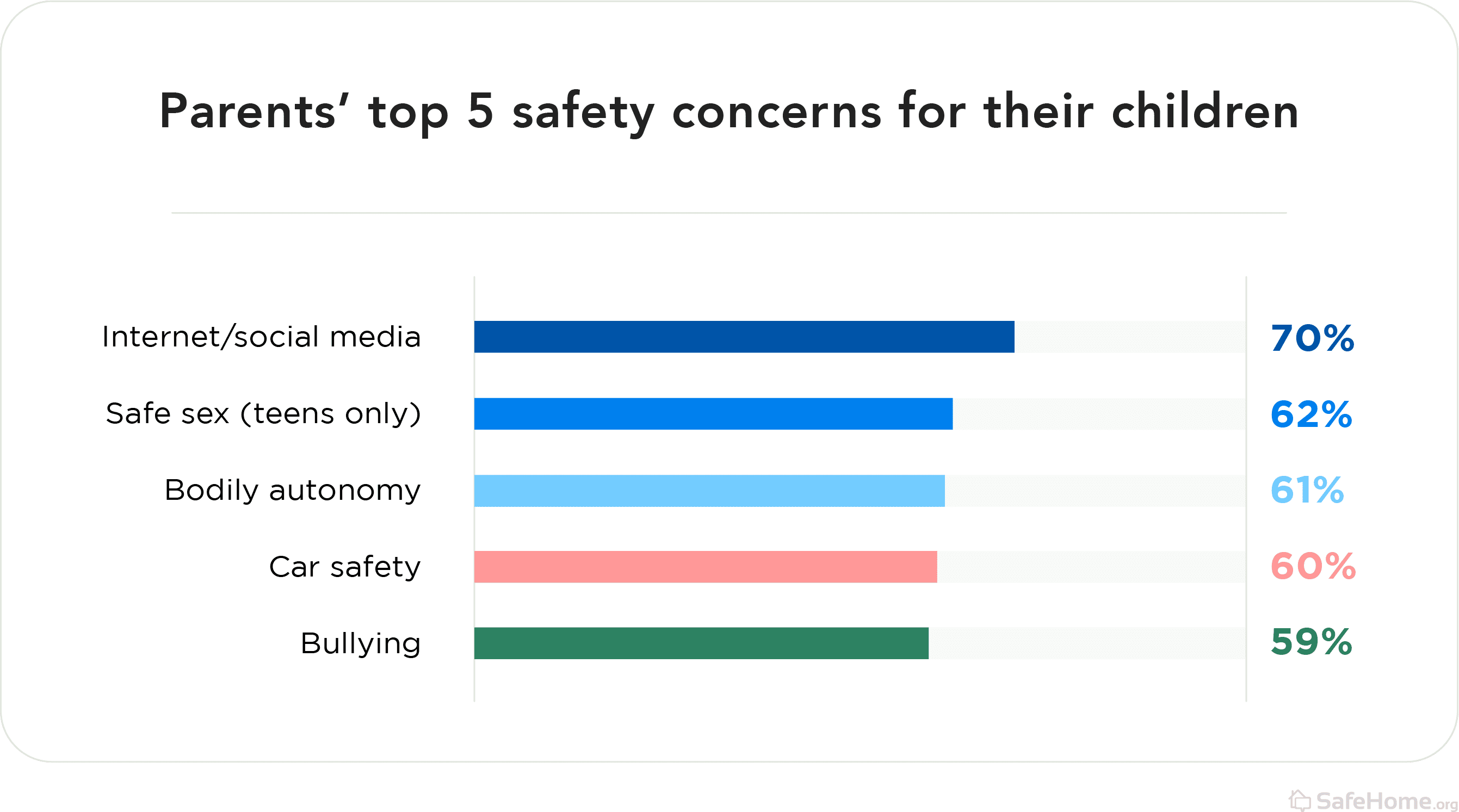
While issues like firearms (43 percent) and pools (50 percent) also evoke concern among parents, their prominence isn't as marked, possibly due to their less pervasive nature than the internet. According to the National Center for Education Statistics, 97 percent of children aged 3 to 18 have internet access at home.1 That makes digital safety an everyday concern for virtually all families.
2. Parents’ fears evolve as children grow up.
The internet presents multiple risks for young users: exposure to harmful content, contact with online predators, cyberbullying experiences, and personal data vulnerabilities. Consequently, parents across all age groups above three years old express concerns about the internet. Significantly, for parents with children aged seven to 15, the internet emerges as their primary worry.
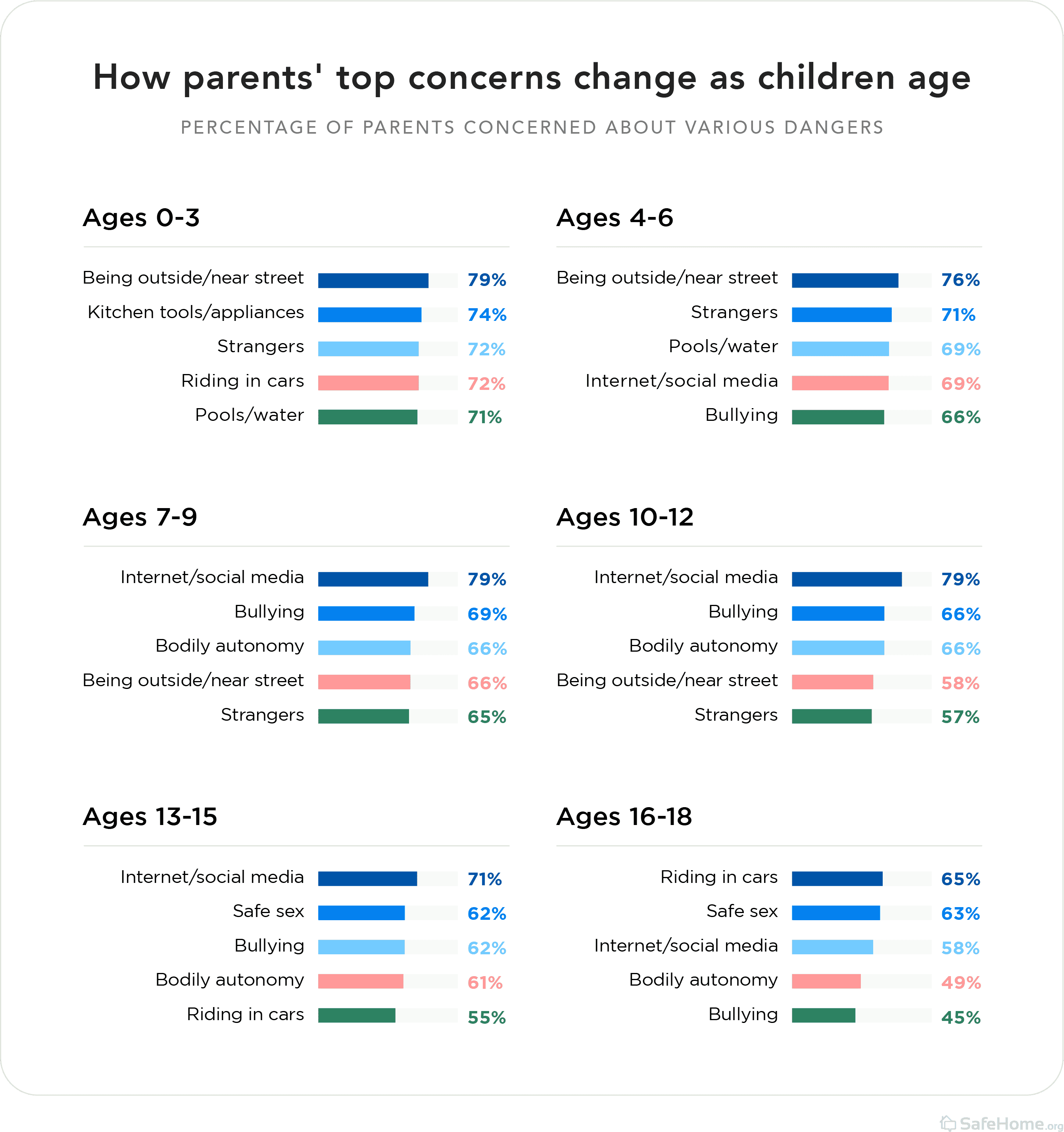
For parents with children under six, concerns about strangers loom large. While these fears recede as children grow into teenagers, apprehensions about strangers continue to linger for parents with children aged seven to 12.
Parents begin to show concern about bullying when their children are about four. This concern remains among the top five worries for parents across all age groups except the youngest (0-3), as bullying behaviors can start even during preschool years. Concerns about bullying peak among parents of elementary school kids, with a notable 69 percent expressing significant worry about this issue.
When it comes to driving safety, parents of teens with licenses understandably worry most. Their concern slightly exceeds their worries about safe sex for their teenagers. That makes sense given that motor vehicle crashes remain the leading cause of death for U.S. teens, according to the CDC.2
3. Despite significant concerns about the internet, many parents do not limit kids’ online access.
Although 70 percent of parents highlighted internet and social media as primary concerns, nearly 25 percent revealed not using parental controls to regulate their children's online activities. This disconnect between worry and action suggests parents feel overwhelmed by rapidly evolving technology or uncertain about which protective measures actually work.
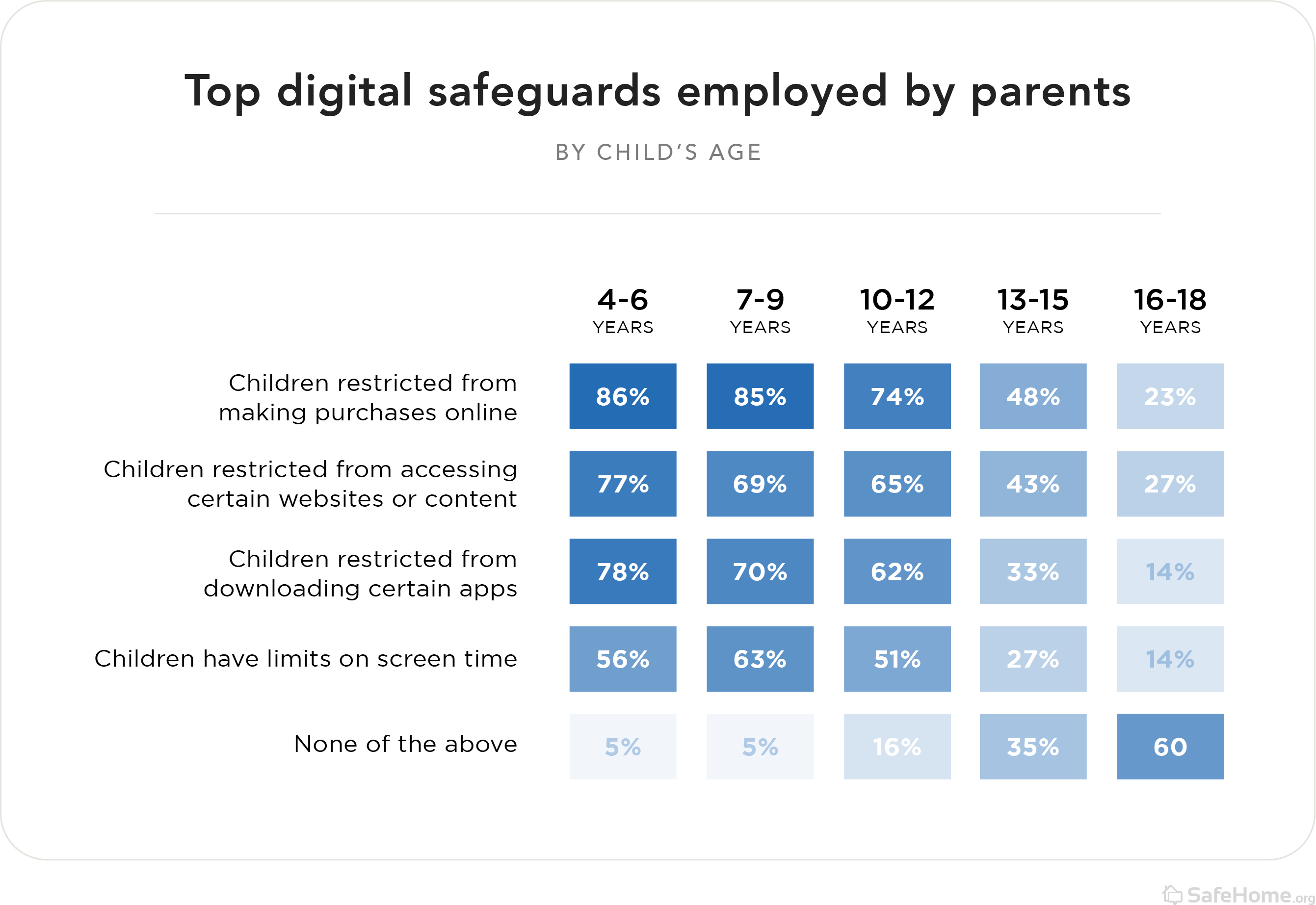
That said, parental controls are much more common among parents of younger children. By the age of four, one in three kids has access to a smartphone that can download apps and access the internet, and smartphone access becomes nearly universal by age 13.
Kids naturally seek more digital independence as they mature, and parents often struggle to balance protection with allowing age-appropriate freedom. Many parents assume their teenagers possess stronger digital literacy skills than they actually do, creating a false sense of security. Regardless of the cause, many parents of children aged four to 12 use some form of parental control. However, by the time their children reach 16, around 60 percent of parents have stopped using tools to restrict their teenagers' technology usage.
Similarly, as children age, parents tend to monitor their social media activities less. While over 60 percent of parents closely watch 10-12-year-olds' social media accounts, only 26 percent do the same for kids aged 16-18.
For parents who implement digital boundaries, few focus on limiting total screen time, despite this being a key recommendation from child development specialists. Although the American Academy of Pediatrics does not set specific screen time guidelines, they recommend limiting screen time to quality interactions.3
4. The majority of parents post photos of their kids on social media.
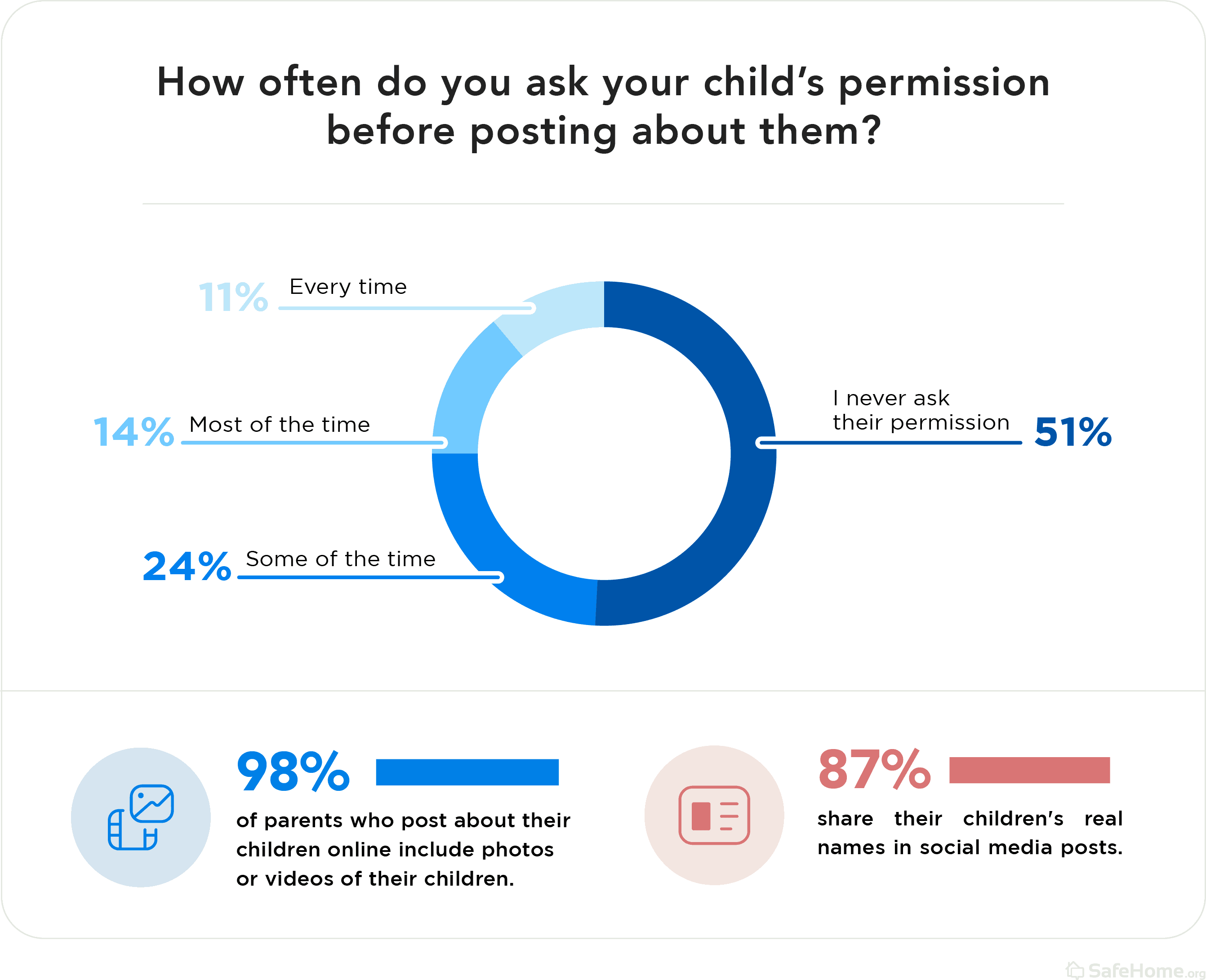
Despite concerns about children's exposure to social media, many parents post information about their kids online. Most parents reported posting about their children on social media, with 51 percent admitting they never sought their child's consent.
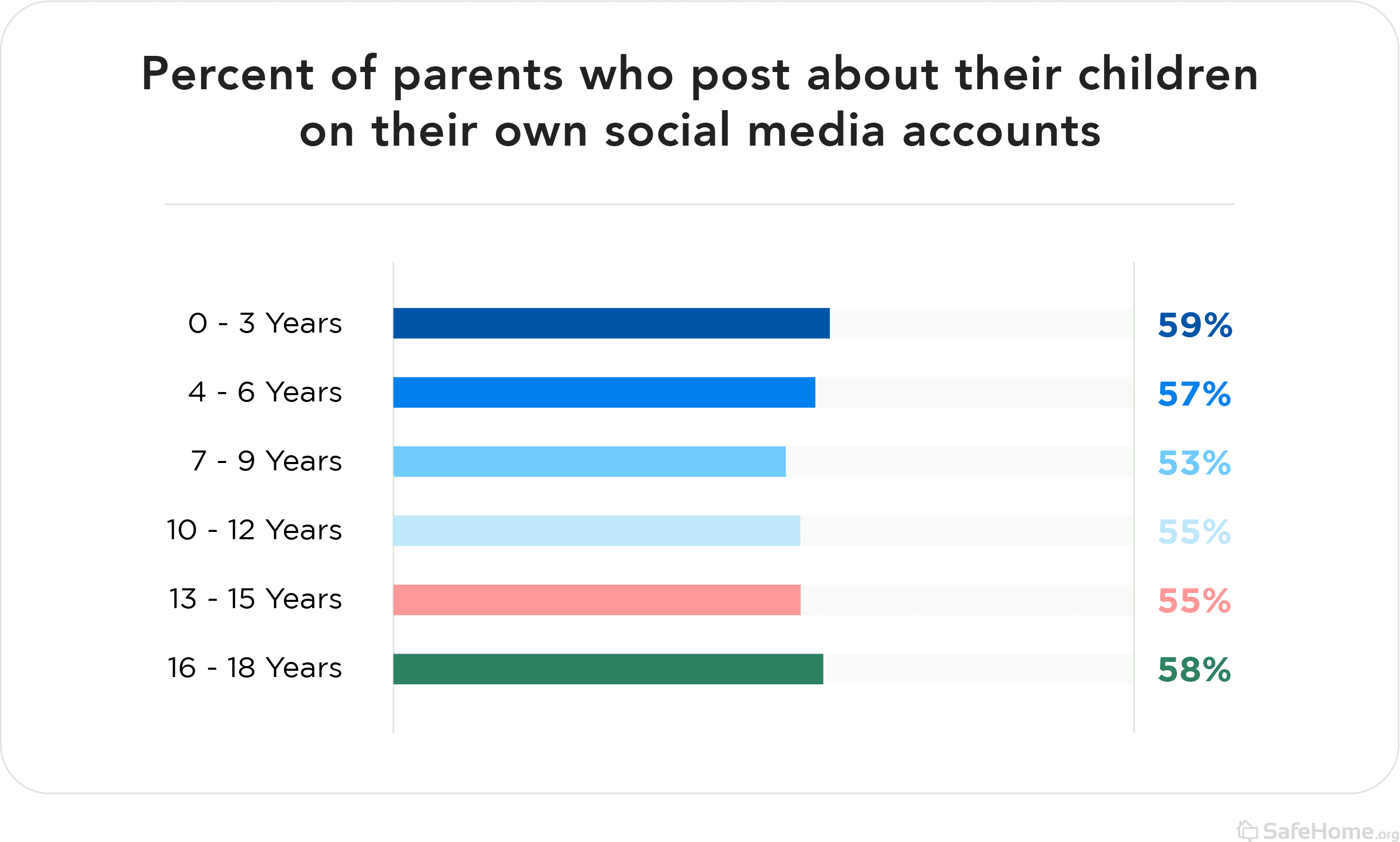
Nearly all parents who share content about their kids online post photographs. Security experts warn that this practice can expose children to identity theft risks, location tracking by bad actors, or cyber kidnapping. That last one is where predators steal children's photos to create fake profiles or inappropriate content.4
Parents who want to share their children's milestones online can use privacy settings to restrict viewing to trusted friends only. For further safety, avoid posting identifying information and turn off location tagging. Setting up Google Alerts for your child's name can also help you monitor if their information appears elsewhere online.
5. Nearly 1 in 3 parents regret allowing children to use social media.
While every child is different regarding when they’re mature enough for a mobile phone, about one in three parents had regrets about letting their children use social media too soon. Additionally, 25 percent felt their children had acquired mobile phones prematurely.
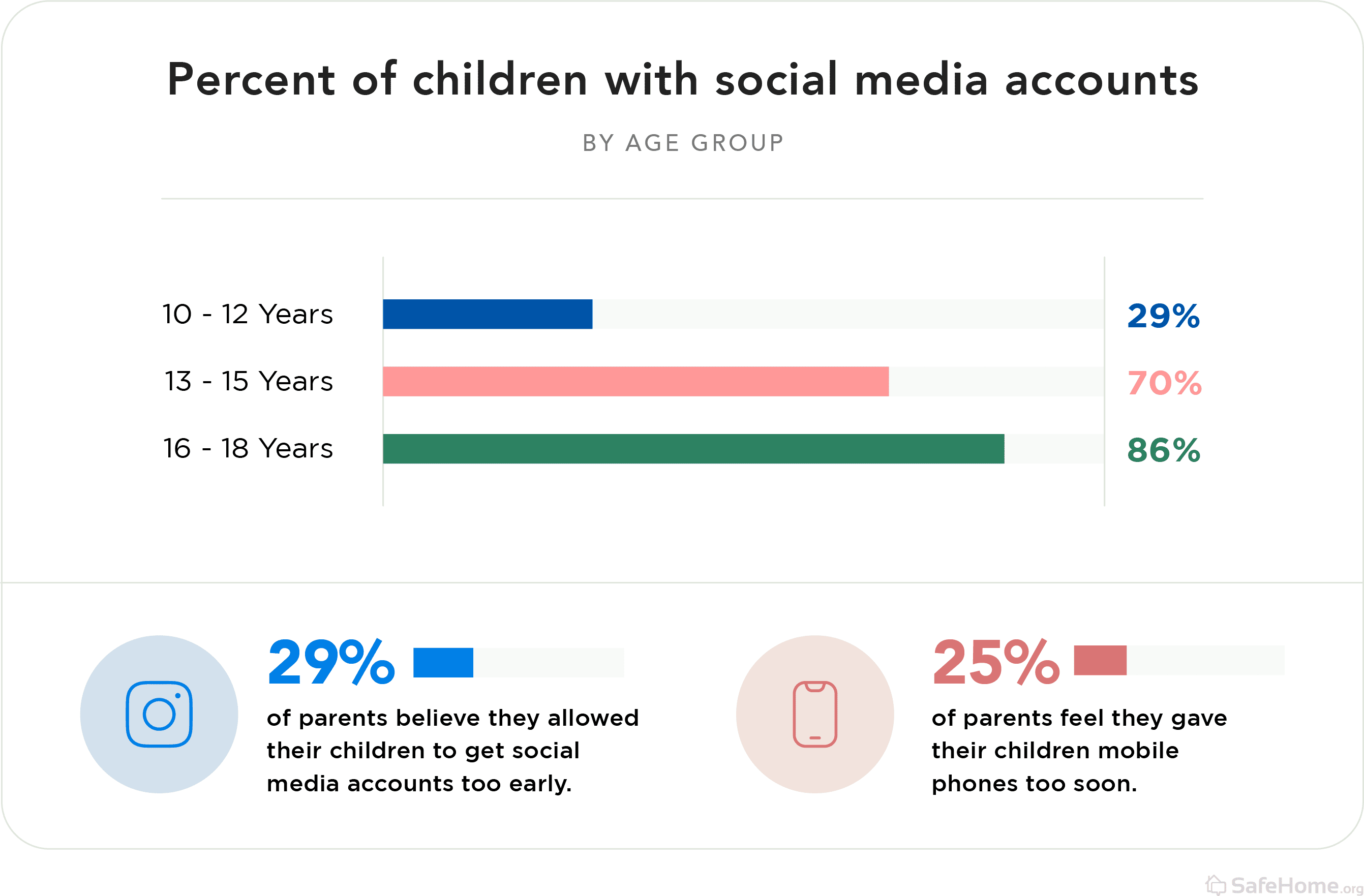
These regrets align with growing evidence about social media's impact on young people's mental health. The U.S. Surgeon General found that adolescents who spend more than 3 hours daily on social media face double the risk of mental health problems including depression and anxiety symptoms.5
The gap between parental confidence and reality is striking. While 75 percent of parents believe their child would tell them about cyberbullying, research shows only about one-third of kids actually report online harassment to their parents. This communication breakdown leaves many children dealing with digital problems alone.
6. The typical parent believes kids can have cell phones starting at age 12.
Beyond digital safety, we allowed parents to voice their perspectives on age-appropriate activities or topics for children. Their responses offer an intriguing glimpse into American parenting, where conformity to expert guidance sometimes aligns and sometimes diverges.
Technology
Of course, the internet is a key concern among parents, and it is difficult to know when children are mature enough to use it.
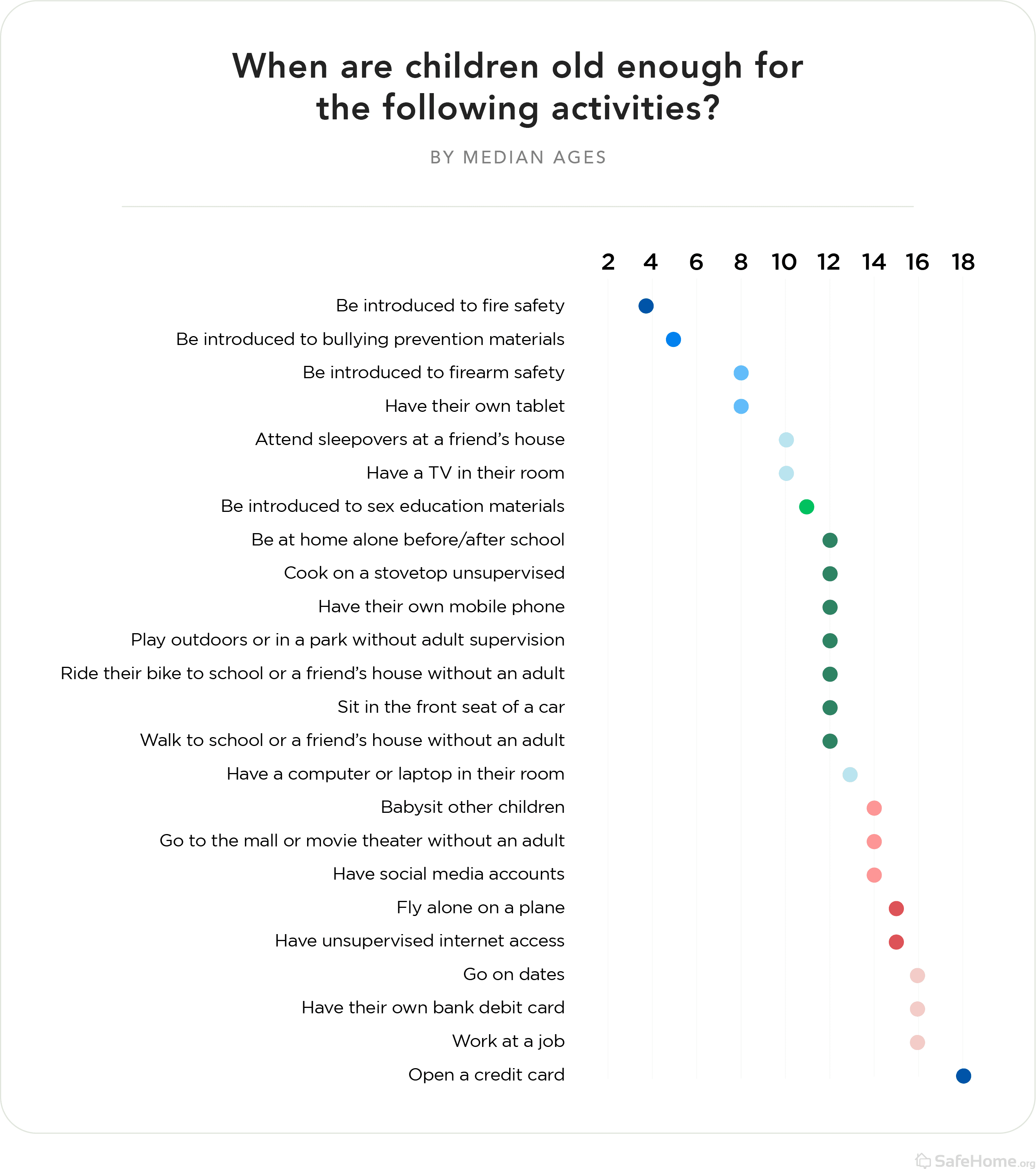
Parents in our study typically said 12 was the appropriate age for kids to have their own mobile phones. However, growing expert consensus suggests waiting longer. Most recommend delaying smartphones until at least high school (age 14).6
Parents showed more comfort with tablets than smartphones, believing 8-year-olds could appropriately have their own devices. This preference likely reflects tablets' widespread educational use. There’s also a perception that they're easier to control since many lack cellular data connections and rely solely on Wi-Fi.
The American Academy of Pediatrics continues to recommend keeping screens out of children's bedrooms, especially for those under 12. Yet parents typically felt 10-year-olds could have their own TV. This means they potentially underestimate how bedroom screens can disrupt sleep patterns and increase unsupervised content consumption.
Given the hazards that children (and adults) can encounter online, parents tend to be more conservative when it comes to when it’s appropriate for kids to have unsupervised internet access. Most parents chose 15 as the right age.
Most major social media platforms maintain a minimum age requirement of 13 in their terms of service. However, enforcement remains minimal and kids routinely circumvent these restrictions. Parents in our study selected a median age of 14 for social media access, with 84 percent agreeing it should be limited to teenagers, reflecting their awareness of these platforms' risks.
Fire safety
Fire safety education can begin surprisingly early. Experts recommend starting basic fire safety lessons with toddlers as young as two years old, using simple concepts like “hot” and “ouchie.” Many fire departments now offer interactive safety programs designed specifically for preschoolers. The most common answer among parents we talked to was 4 years of age, much higher than experts recommend.
Firearm safety
There is little consensus on when children should learn about firearm safety. The National Rifle Association, for example, suggests that children as young as six years old could learn about gun safety if they’ve demonstrated good safety behavior in other areas. However, the American Academy of Pediatrics points to studies that suggest skills-based gun safety programs do not reduce gun handling by children. Typically, parents felt age eight was appropriate for children to learn about gun safety. You can never start too early with firearm safety — even if you don’t have one in your home, that might not be true for your child’s friends or family.
Sleepovers
The research also revealed that parents generally endorsed children attending sleepovers at a friend's house around age 10. Child development experts emphasize there's no universal “right age” for sleepovers. The decision depends on the individual child's maturity, comfort with being away from home, and the parents' knowledge about the host family's supervision and safety practices.
Being alone at home
While experts agree that readiness to stay home alone varies by child maturity, some states set legal minimums. For example, Illinois requires children to be 14, Maryland sets the minimum at 8, and several other states provide guidelines rather than laws. Among our group of parents, the most common answer was 12.
Sex education
Parents typically believed introducing sex education around age 11 was appropriate. This aligns closely with puberty onset for many children. It also matches expert recommendations for comprehensive, age-appropriate sex education beginning in late elementary school.
Riding in the front passenger seat
Parents generally believed 12-year-olds could safely sit in the front seat. However, most traffic safety organizations recommend that all children under 13 ride in the back seat regardless of size, as front airbags can seriously injure smaller passengers. One in three parents we talked to said kids could sit in the front seat starting at age 12, while 16 percent said 13 and 20 percent said 10.
Going to malls or movies without parents
Around the ages of 14 to 15, parents commonly felt that their children could go to the mall or movie theater without an adult. However, many shopping centers have implemented stricter youth supervision policies, with some requiring anyone under 18 to be accompanied by an adult over 21 on weekends and evenings. Parents should check local mall policies before dropping off teens.
Teenage privileges
Most parents believed 15- and 16-year-olds were ready for significant independence milestones: flying solo on airlines, holding part-time jobs, managing debit cards, and dating. These ages align with when teens can legally work in most states and when many airlines allow unaccompanied minor travel without special supervision. Building these real-world skills during high school can help prepare teens for the greater independence of college and young adulthood.
7. Parents feel schools are the unsafest places for their children.
While most of the findings discussed in this analysis relate to digital or home safety, kids spend most of their waking days at school. Our research shows that parents’ positive feelings about how safe their kids are at school decline with child age.
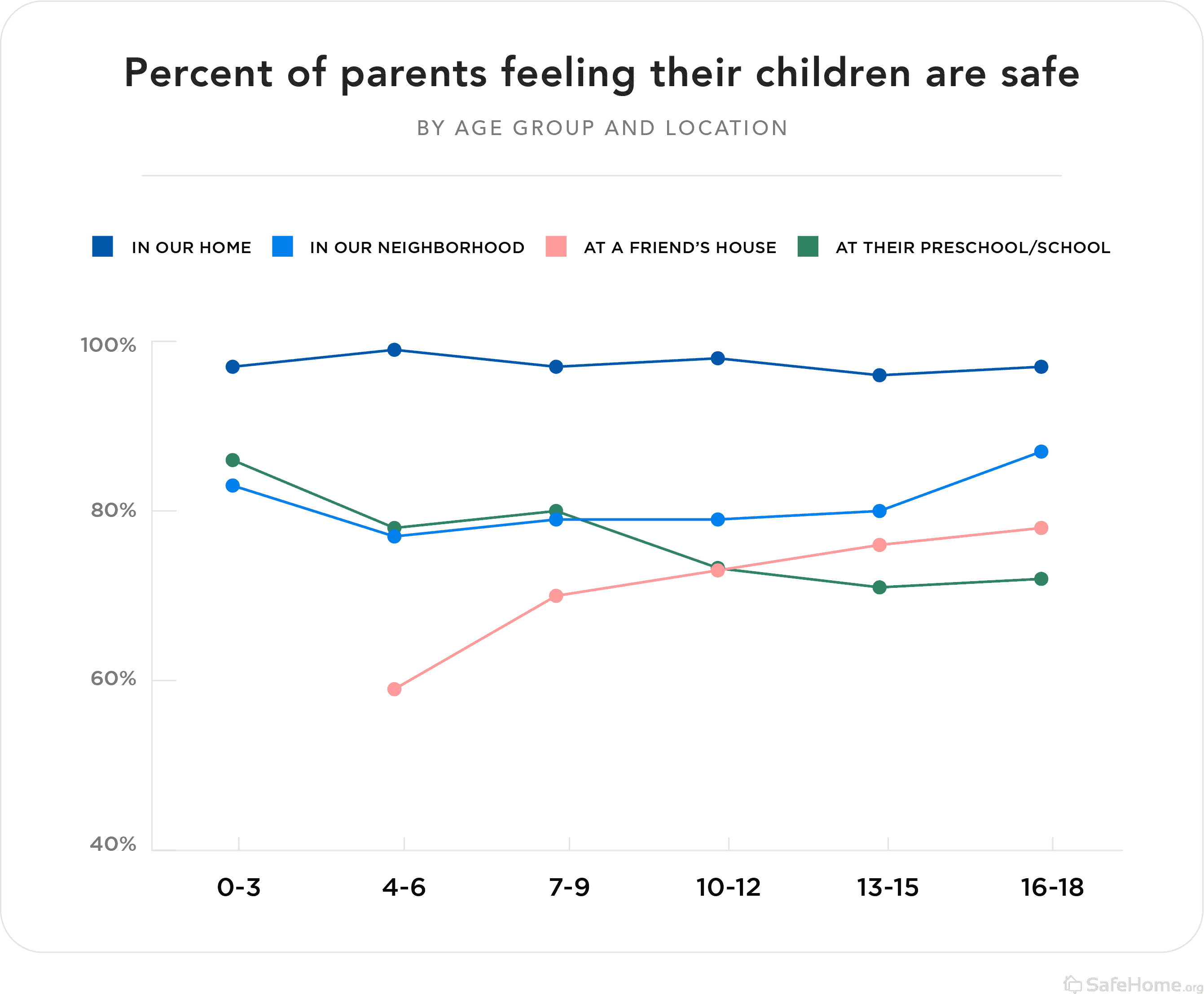
For parents of 16-18-year-olds, 72 percent say their kids are safe at school, and those parents are more likely to say their kids are safe at a friend’s house, in the neighborhood or at home. Across all age groups, the home is rated safest for children.
Parental concerns regarding school safety could stem from many issues, such as the rising number of school shootings, bullying, the implementation of metal detectors and active shooter drills, negative peer pressure, and children’s exposure to unfamiliar adults who may work in the schools.
Parents of LGBTQ+ youth face additional worries.7 Over 600 anti-LGBTQ+ bills were introduced across states according to the ACLU. Meanwhile, the student mental health crisis continues, with many schools lacking adequate counselors.
Conclusion
The average parent gets inundated with advice (or criticism) about their parenting choices on a near-daily basis, and while some of it is probably good advice, it’s hard to know when to take it to heart. This research shows that despite different parenting styles, the average American parent simply wants to do what is best for their child’s physical and emotional well-being — even if it goes against the grain.
Methodology
We surveyed over 2,500 Americans with at least one child about what they consider age-appropriate for children, what safety measures they take, and many other matters related to parenting. Our survey was conducted online.
Citations
- National Center for Education Statistics. (2023). Children’s Internet Access at Home.
https://nces.ed.gov/programs/coe/indicator/cch/home-internet-access - Centers for Disease Control and Prevention. (2025). Adolescent Health.
https://www.cdc.gov/nchs/fastats/adolescent-health.htm - American Academy of Pediatrics. (2025). Screen Time Guidelines.
https://www.aap.org/en/patient-care/media-and-children/center-of-excellence-on-social-media-and-youth-mental-health/qa-portal/qa-portal-library/qa-portal-library-questions/screen-time-guidelines/ - University of Colorado Boulder. (2024). Be aware of cyber kidnapping–and warn your family!.
https://www.colorado.edu/isss/2024/02/16/be-aware-cyber-kidnapping-and-warn-your-family - U.S. Department of Health and Human Services. (2025). Social Media and Youth Mental Health.
https://www.hhs.gov/surgeongeneral/reports-and-publications/youth-mental-health/social-media/index.html - After Babel. (2024). Yes, Social Media Really Is a Cause of the Epidemic of Teenage Mental Illness.
https://www.afterbabel.com/p/phone-based-childhood-cause-epidemic - American Civil Liberties Union. (Retrieved 2025). Mapping Attacks on LGBTQ Rights in U.S. State Legislatures in 2025.
https://www.aclu.org/legislative-attacks-on-lgbtq-rights-2025