2023 Childproofing Report: Biggest Risks and Best Practices for Parents
 |
November 23, 2025
|
November 23, 2025
Every parent’s primary concern is protecting their children from harm, a responsibility made increasingly difficult in a world fraught with myriad dangers. This challenge becomes even more daunting when one recognizes the many perils lurking within one’s home sweet home.
In an effort to help families make their homes as safe as possible, SafeHome.org conducted its latest annual study of more than 1,000 parents. Our research revealed their top childproofing tactics and home safety concerns, and here are some of the key findings:
- Parents of young children ranked the garage as the most dangerous room of the home, followed by the basement and kitchen.
- Though parents rated children’s bedrooms as the safest room in the home, injuries from beds or bedding sent nearly 200,000 young children to the emergency room last year.
- The top three childproofing measures among American parents are using safety gates around dangerous areas, locking cabinets and drawers, and installing outlet covers.
- Nearly 60 percent of children 10 and younger have experienced a household injury. According to parents, 55 percent of these household injuries could have been prevented with better childproofing measures.
- Many parents rely on smart home tech to protect their children, and they ranked smart smoke detectors and baby monitors as the most effective devices for safety.
Parents’ Rank Basement as Most Dangerous Room for Children
When asked which areas of the home were most and least dangerous, 95 percent cited children's bedrooms as a safe spot, and nearly two-thirds concurred that the garage is a highly hazardous spot for kids.
These perceptions often stem from personal experience: 59 percent of families have had at least one child injured at home. While it's helpful to understand which rooms pose greater risks, parents should remember that every area of the house could present dangers to kids.
As our survey revealed, garages present unique challenges. They're frequently cluttered and overlooked during childproofing efforts while housing sharp tools, hazardous chemicals, and moving vehicles. Basements can be equally concerning with their dim lighting and steep stairs.
More common rooms like kitchens also present a threat with sharp utensils, hot surfaces, and various whirring appliances. Bathrooms also host medications, cleaning products, and drowning risks. Even bedrooms harbor overlooked dangers, particularly beds and bedding.
For a clearer perception of wide-ranging threats found throughout the home, families should review the most dangerous products for youngsters. According to the Consumer Product Safety Commission, these household items and fixtures injured the most significant number of young children in recent data:
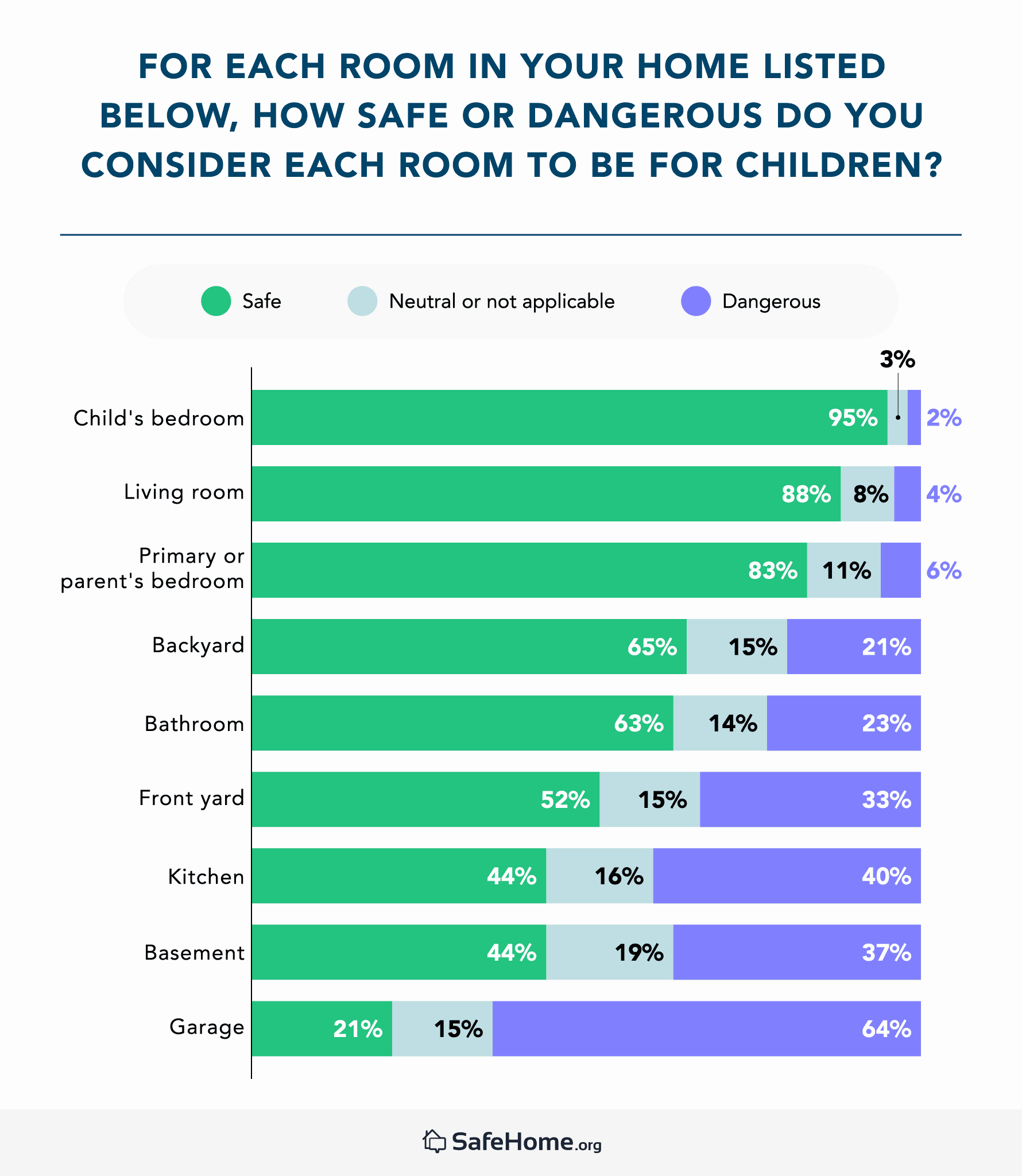
These assessments may have come from first-hand experience: 59 percent of families have had at least one child injured at home. Setting aside these relative room rankings, parents should remember that every area of the house could present risks to kids.

As noted by the parents in our study, garages pose a particular threat – they’re often treacherously messy and overlooked for childproofing while housing sharp tools, hazardous chemicals, and moving vehicles. Basements can be similarly scary due to their dark corners and steep stairs. Kitchens contain sharp implements, heated elements, and whirring appliances of various types. Bathrooms host prescriptions, cleaning agents, and open water fixtures. The front yard often opens on the road, and backyards may have pools or playground equipment. Even bedrooms contain threats that are often overlooked, such as beds and even bedding.
For a clearer perception of wide-ranging threats found throughout the home, families should review the most dangerous products for youngsters. According to the Consumer Products Safety Commission, these household items and fixtures injured the most significant number of young children in 2022:
| Annual emergency room visits caused by injuries from household products or fixtures Among children under 5 |
|
|---|---|
| Stairs, ramps, or landings | 309,321 |
| Beds or bedding | 190,080 |
| Chairs or sofas | 129,999 |
| Other home structures such as walls, counters, doors, floors, or windows | 126,921 |
| Tables | 83,360 |
| Nursery equipment | 75,897 |
| Toys | 74,028 |
| Drug poisoning | 48,573 |
| Other furnishings/fixtures
(Ladders, lamps, mirrors, misc.) |
38,377 |
| Carpets or rugs | 35,723 |
| Cans, bottles, or containers | 34,896 |
| Desks, cabinets, or shelves | 34,844 |
| Bathroom fixtures | 31,874 |
| Household chemicals | 25,597 |
| Appliances | 20,612 |
Note: Each reported injury could have up to three causes
Source: 2022 NEISS Data Highlights, U.S. Consumer Product and Safety Commission
These statistics help dispel common misconceptions about home safety. For instance, despite most parents viewing a child's bedroom as the safest room in the house, nearly 200,000 children under age five suffer injuries from beds and bedding each year. Understanding these realities helps parents create more effective safety strategies.
Most Popular Childproofing Methods Among Parents
American parents may differ on politics, education, and religion, yet the need to protectively childproof homes garners widespread support. We found near unanimous agreement that such safeguarding is essential, with 81 percent declaring such measures “very” or “extremely” important.
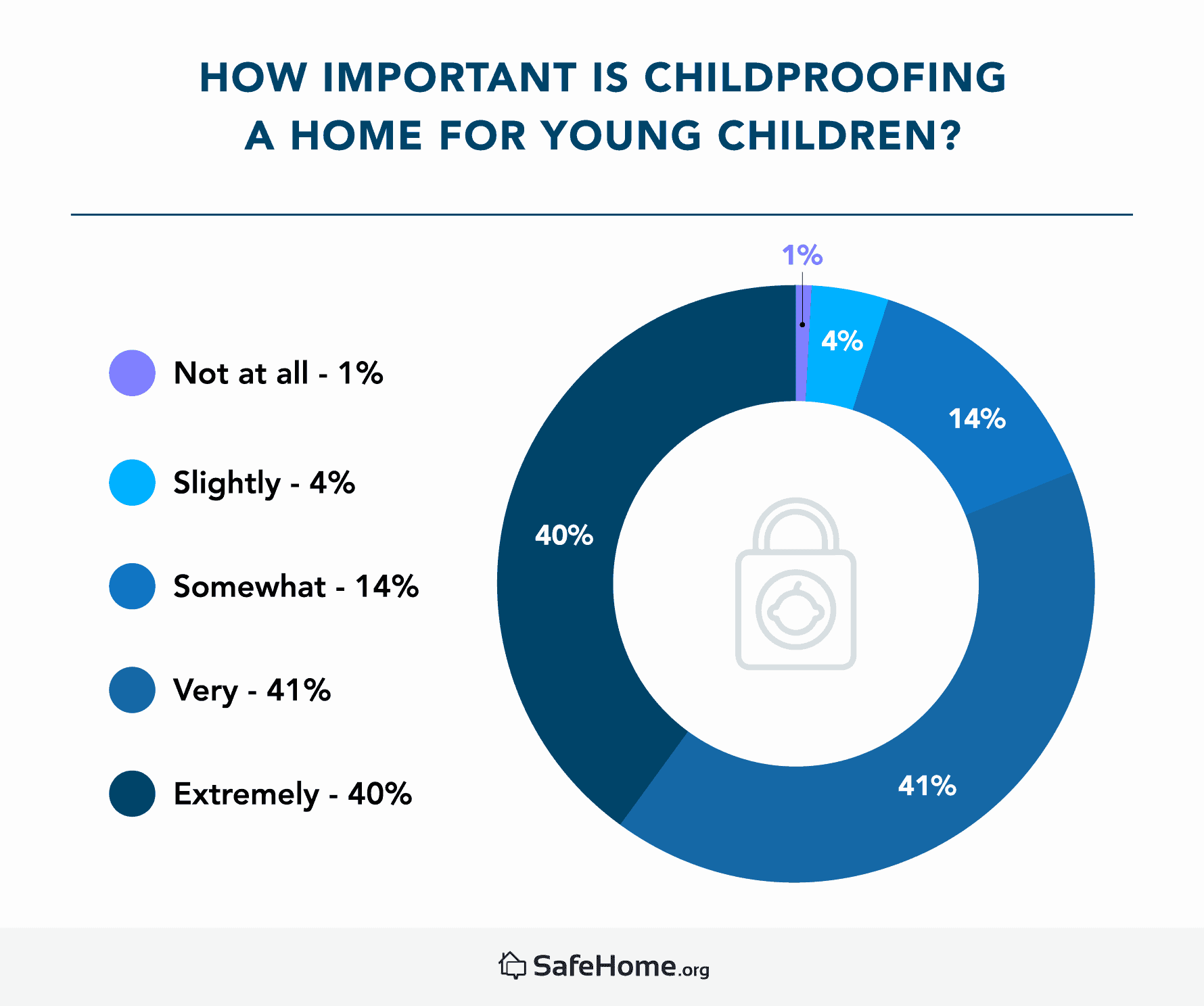
Mothers in our study felt even more strongly about safety: 85 percent of women rated childproofing as very or extremely important, compared to 76 percent of men.
While preventing every household accident remains impossible, proper childproofing makes a measurable difference. More than half of parents whose children experienced home injuries said that better safety practices could have prevented recent incidents.

To help families reduce home injuries, we asked parents to share their most insightful and hard-earned childproofing tips.
These were parents’ top five childproofing recommendations according to our analysis:
- Installing safety gates: Once children become mobile, they'll explore every accessible area. Safety gates restricting access to hazardous zones provide crucial protection when parents can't supervise directly. Parents most frequently mentioned gates securing staircases, but they can also block dangerous rooms, create safe play areas, or prevent access to outdoor hazards. Choose hardware-mounted gates over pressure or tension models, ensure proper measurements for complete coverage, and avoid designs with narrow openings where heads or limbs could become trapped.
- Locking cabinets and drawers: With wee ones about, most drawers and cabinets should be locked so that only adults can open them. Cleaning products, household chemicals, and prescription drugs are apparent dangers to keep out of reach of children. Still, even innocuous everyday items (batteries, pens, or plastic bags) can become hazardous in the wrong hands. Cabinet fasteners come in different styles, including external safety locks, internal latches, or magnetic latches requiring special keys. Whichever you install, ensure they prevent little fingers from accessing (or getting pinched), and keep an eye on clever kids who may decipher the releases.
- Installing outlet covers or plugs: Electrical outlets sit at perfect crawling height, presenting serious electrocution risks when curious children insert objects. Outlet plugs offer the simplest solution but can become choking hazards if removed. Better alternatives include sliding plate covers that automatically shield unused sockets, box-style covers enclosing the entire outlet or tamper-resistant outlets. Additionally, unplugging appliances when not in use prevents children from playing with cords, reducing strangulation or toppling risks.
- Securing furniture, rugs, and appliances: Children pulling cords, racing through rooms, or attempting to climb can become crushed beneath heavy objects. Installing wall anchors or floor brackets takes minutes but can save lives. For dressers and storage units, place heavier items in lower drawers for better stability. Mount televisions securely on walls rather than placing them on furniture. Also, secure area rugs with double-sided tape or non-slip pads to prevent trips and falls.
- Keeping dangerous items out of reach: Parents' simplest shortcut for keeping dangers at bay is using their height advantage. Gates, locks, anchors, and covers help secure hazardous items. Still, these dangerous items (especially when in use) should also rest well out of little ones' reach. Keeping knives, medicine, liquor, tiny items that present choking risks, cluttered handbags, or any other potentially harmful object away from reachable counters and up on high shelves provides an extra level of protection.
Parents also recommend installing rubber corner guards on furniture edges, selecting non-toxic cleaning products whenever possible, adding doorknob covers, securing toilet lids, choosing cordless window treatments, and having age-appropriate safety conversations with children rather than relying solely on physical barriers.
Beyond these traditional household precautions, parents mentioned positive experiences and high expectations for the next generation of technological safety equipment.
Smart Home Tech: The Future of Child Safety
As smart home technology evolves, parents gain powerful new tools for monitoring and protecting their children. This technological advancement is particularly welcome news for parents who naturally become more relaxed with subsequent children.
Most parents with multiple children admit to being less cautious with younger offspring than with firstborns. Of course, this likely indicates the relaxation of initial over-protective instincts rather than rising neglect.

Regardless of parental vigilance levels, modern technology simplifies child monitoring and protection. GPS tracking, smartphone connectivity, affordable home surveillance, and the expanding Internet of Things create a digital safety net that makes traditional methods seem outdated.
Consider baby monitors. Early models were essentially one-way radios placed near cribs. Today's versions feature high-definition video, motion alerts, breathing monitoring, room temperature tracking, and smartphone apps enabling monitoring from anywhere. However, parents should remain aware of potential security vulnerabilities with connected devices.
Many other safety tools have received similar upgrades. Smart locks, environmental sensors, and connected appliances enable remote supervision and control. Affordable security cameras and motion detectors allow parents to monitor children from any room or location. GPS devices ensure children can be located in crowded spaces or emergencies. And once children are old enough for smartphones, they're always just a message away.
When asked how effective next-gen home devices are at keeping children safe, parents showed the most support for smart smoke detectors and baby monitors. Less than half were impressed by smart plugs and motion sensors.
| Rate each of the following home devices based on how effective you believe they are at keeping children safe. | Percentage of parents believing each device is highly effective |
|---|---|
| Smart smoke detectors | 77% |
| Baby monitors | 69% |
| Security cameras | 61% |
| Smart door locks | 59% |
| Video doorbells | 59% |
| GPS trackers for kids | 57% |
| Smart plugs (for controlling appliances) | 47% |
| Motion sensors | 46% |
Before investing heavily in smart home security, parents should consider potential drawbacks. Connected devices can be vulnerable to hacking and often raise privacy concerns. Additionally, over-reliance on technology can lead to complacency. There's no digital substitute for attentive parental supervision.
Conclusion
Parents naturally worry about external threats to their children and work hard to make homes safe havens. Unfortunately, statistics show that dangers persist even in the most loving, carefully maintained households.
Despite the fact that 80 percent of American parents consider childproofing very important, nearly 60 percent saw a child hurt at home. More than half of those injuries were viewed as preventable.
The most effective approach combines traditional safety measures, modern technology, and awareness of household hazards to create comprehensive protection for youngsters.
Parents who implement a multi-layered approach transform home safety from reactive to proactive. Leveraging all the tools you have including physical safeguards and smart devices, while maintaining awareness that every room contains potential dangers, creates the strongest defense against preventable injuries.
Our Data
In October 2023, SafeHome.org conducted an online survey of 1,005 American adults with children aged ten and younger. Researchers asked a series of questions to assess their emphasis on home childproofing practices, their experience with injuries in the home, their assessment of various safety threats, and their opinions regarding commercially available protective devices. The team also solicited open-ended responses seeking suggestions for other parents looking to safeguard their homes and used a text analysis program to discover which safety measures were most popular among parents. Our respondent pool was evenly divided between men and women. 14 percent of parents were 18-29 years old, 67 percent were 30-44 years old, and 19% were 45 or older. 75 percent of parents in the study were white, 11 percent were Black, 7 percent were of multiple ethnicities, 4 percent were Asian, and 3 percent preferred not to answer or were of another ethnicity. 55 percent of parents had just one child, and 45 percent had multiple children.