Sex Offender Registry Statistics: 2024 Data for All 50 States
 |
December 4, 2025
|
December 4, 2025
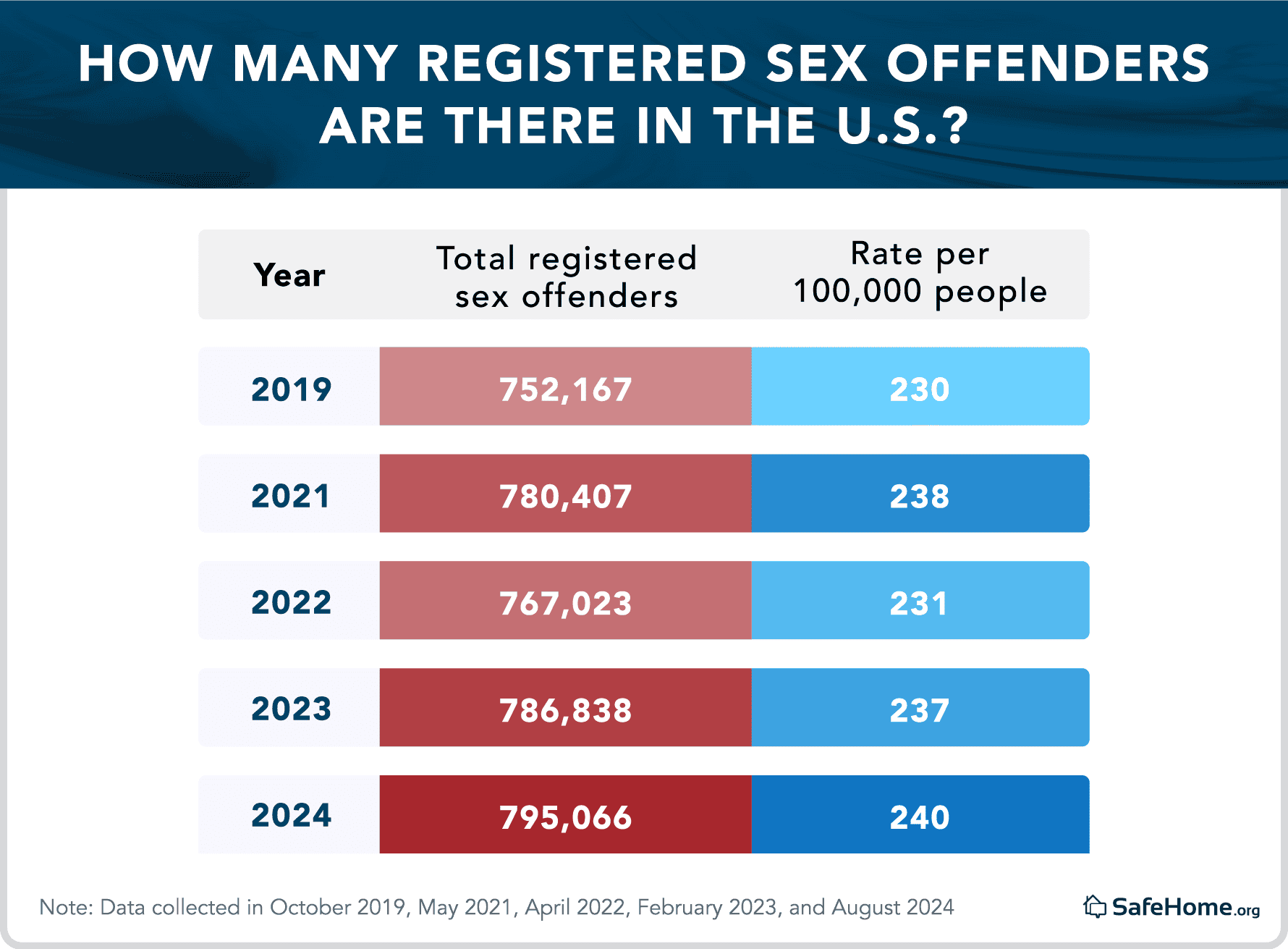
Every year, we examine sex offender registry data from all 50 states. We identify which regions maintain the largest registries and track how rates of sex-related offenses shift throughout the country. In 2024, the total number of registered sex offenders approached 800,000 nationwide, with the population-adjusted rate of registrants climbing by about two percent from the previous year.
Beyond analyzing each state's sex offender database, we also evaluated publicly accessible crime and child abuse statistics. That allowed us to identify regional patterns regarding sexual violence across America.
Here are some of our key findings:
- More than 795,000 people were listed on state sex offender registries as of August 2024. This is about 8,000 more people than in 2023.
- Since 2019, the number of registered sex offenders in the U.S. has risen by nearly 43,000, or around six percent.
- On a population-adjusted basis, Oregon, Arkansas, and Alaska have the highest rates of convicted sex offenders in the nation.
- Texas has the highest total number of registered sex offenders (over 75,000), accounting for nearly 10 percent of all registered sex offenders nationally. California had the second-highest number of total registrants at around 60,600.
- Massachusetts, Maryland, and Connecticut have the nation’s lowest population-adjusted rates of registered sex offenders.
- Only Arkansas ranked in the ten worst states in three categories: child abuse, rape, and registered sex offenders.
Total Number of Registered Offenders Continues to Climb
Our analysis reveals that 795,066 people appeared on sex offender registries throughout the United States in 2024. This represents approximately 8,000 more offenders than in 2023.
These figures naturally fluctuate as individuals are added to and removed from registries throughout the year. Since we initiated this research in 2019, this marks the highest count of individuals on state registries. Typically, at least 750,000 people remain on the registries at any given time.
Explore the map below and our data appendix at the end of this article to discover each state's total number of registrants and population-adjusted rates.
| States with the most registered sex offenders | States with the most registered sex offenders per 100,000 residents | ||
|---|---|---|---|
| Texas | 75,710 | Oregon | 790 |
| California | 60,615 | Arkansas | 640 |
| New York | 42,985 | Alaska | 473 |
| Michigan | 40,391 | South Dakota | 471 |
| Illinois | 34,056 | Wisconsin | 459 |
| Oregon | 33,421 | Missouri | 427 |
| Florida | 32,460 | Delaware | 427 |
| Virginia | 29,202 | Wyoming | 421 |
| North Carolina | 27,864 | Michigan | 402 |
| Wisconsin | 26,972 | Tennessee | 386 |
Texas continues to maintain the nation's largest sex offender registry, with nearly 76,000 individuals listed. California holds the second-largest registry, containing over 60,000 offenders. The District of Columbia's sex offender registry includes just over 1,000 people, making it the smallest nationally. Vermont lists around 1,200 registrants, while North Dakota has approximately 2,100.
Although the three most populous states (Texas, California, and New York) dominate in raw numbers of registered sex offenders, the landscape shifts dramatically when adjusting for population differences. Oregon, ranking sixth for total sex offenders, claims the top position for sex offenders per 100,000 residents.
Oregon’s high rate of registered sex offenders is partly due to its practice of publishing the total number of all offenders, even though it only maps the most severe cases. The state also requires lifetime registration for some offenses, and over 25 different crimes can lead to registration. Oregon's elevated rate of registered offenders might also suggest that residents frequently report sex offenses. Alternatively, their justice system may successfully prosecute offenders at a higher rate.
Despite Arkansas' public registry limiting listings to the highest-risk offenders, it still recorded the nation's third-highest rate of registered sex offenders. Alaska followed closely behind, reporting 454 registered sex offenders per capita. Arkansas additionally appeared among the top 10 states for both rape rates and child sex abuse incidents.
Meanwhile, Massachusetts, which had the 16th-smallest registry, recorded the lowest population-adjusted rate of sex offenders nationally. Maryland, Connecticut, and Arizona also demonstrated notably low population-adjusted rates of registered sex offenders.
States with Least Registered Sex Offenders Per 100,000 Residents:
| State | Sex offender rate |
|---|---|
| Massachusetts | 79 |
| Maryland | 117 |
| Connecticut | 124 |
| Arizona | 143 |
| Florida | 150 |
| California | 154 |
| District of Columbia | 163 |
| Indiana | 165 |
| Ohio | 181 |
| Pennsylvania | 182 |
Why do some states have more offenders than others?
The map clearly shows that sex offender rates differ substantially, even among neighboring states. These variations are largely due to interconnected legal, social, and demographic elements. States implement different laws concerning which offenses mandate registration, the duration offenders must stay on the registry, and enforcement severity levels.
States with more comprehensive laws often show elevated numbers of registered offenders because of expanded offense categories and extended registration periods. Meanwhile, other states might provide easier removal processes or alternative sentencing options that bypass registration requirements. Enforcement practices also vary, with certain states allocating greater resources to compliance monitoring, potentially increasing registrant numbers.
Knowing this, some offenders strategically relocate to states with more lenient registration requirements or where they can more easily avoid detection. Still, states with robust crime reporting and conviction rates, or those emphasizing punitive justice approaches, typically maintain larger registries.
Yearly Trends
Since we started tracking this data in 2019, registered sex offenders have increased by several thousand annually, with rates fluctuating based on population shifts. Over the past five years, the sex offender count has grown by approximately six percent. Between 2023 and 2024, the rate of registered sex offenders per 100,000 Americans rose from 237 to 241, representing about a one percent increase.
Sexual Assault Rates
Various forms of sexual misconduct, including indecent exposure, possession of explicit materials involving minors, or human trafficking, can result in placement on a state's offender registry. While regulations differ across states, rape and sexual assault consistently trigger sex offender registration requirements nationwide. Although rape rates decreased nationally between 2021 and 2022 according to FBI data, significant state-by-state variations persist.1
States with the highest rates of reported rapes
Per 100,000 residents
| State | Rate Per 100K residents |
|---|---|
| Alaska | 134 |
| Arkansas | 76 |
| Michigan | 65 |
| Colorado | 63 |
| Wyoming | 63 |
| Utah | 59 |
| Nevada | 59 |
| Oklahoma | 58 |
| North Dakota | 57 |
| South Dakota | 56 |
The most recent state-level data from the Federal Bureau of Investigation (FBI) comes from 2022, which prevents perfect comparison with the latest sex offender registry information.
Nevertheless, we observe that several states with the highest sex offender rates also show the highest population-adjusted rape rates: Alaska, Arkansas, South Dakota, Wyoming, and Michigan.
Child Maltreatment Rates
While the FBI doesn't specifically track child sexual abuse statistics, this offense typically results in sex offender registration. The U.S. Department of Health and Human Services (HHS) publishes annual statistics about child mistreatment, including sexual abuse.2
Nationally, nearly 11 percent of all child maltreatment victims (HHS's official terminology) experienced sexual abuse. This makes child sex abuse the third most prevalent form of child abuse, following neglect and physical abuse.
Throughout all states and Puerto Rico, more than 59,000 children were documented as sex abuse victims in 2022, similar to the number in 2021. The population-adjusted rate of child sex abuse also remained largely the same between 2021 and 2022 with about 82 victims per 100,000 children nationwide.
States with the highest rates of minor sexual abuse victims
Per 100,000 children under 18
| State | Rate per 100,000 children |
|---|---|
| Arkansas | 267 |
| Vermont | 231 |
| Mississippi | 192 |
| Alabama | 183 |
| Utah | 181 |
| Ohio | 161 |
| Tennessee | 160 |
| Maryland | 147 |
| Indiana | 146 |
| Oregon | 144 |
Child sex abuse was reported in Arkansas at a rate of 267 per 100,000 children in 2022, the highest rate in the nation. This figure is more than three times the overall national rate. North Dakota had the lowest rate, and 30 other states also had rates lower than the national average.
When looking at all three lists in this report, only Arkansas ranked in the top 10 for the highest rates of sexual offenders, rape, and child sexual abuse. This indicates that this state, in particular, has significant challenges with sexual violence and the rehabilitation of offenders.
Conclusion
The growing number of registered sex offenders and ongoing sexual violence crimes underscore the continued need for community awareness and vigilance. When used appropriately, sex offender registries serve as an important resource for improving neighborhood and home security. You can search for offenders in your area at the National Sex Offender Public Website.3
Although sex offender registries offer valuable information, building truly safe communities demands a comprehensive strategy including education, prevention programs, and survivor support services. Through staying informed and implementing proactive measures, we can collectively work to reduce sexual crimes and create safer environments for all residents.
If you or a loved one has experienced sexual assault or abuse and needs support, call RAINN’s 24/7 national hotline at 1-800-656-HOPE for free assistance.4
Methodology
We individually searched each state’s online sex offender registry to calculate the number of people listed as of August 2024. In several states, the number of registrants was unavailable on state registry websites. In these cases, we contacted law enforcement public information officers and other state officials who provided us with the most updated numbers for their states by email or phone. Updated figures from New Jersey were unavailable at the time of our 2024 report, so our report uses figures from 2023.
The child sex abuse data referenced in our report was from the U.S. Department of Health & Human Services 2022 Child Maltreatment Report. To determine the number of cases per 100,000 residents under 18, we compared the data with population estimates from the U.S. Census Bureau.
The rape data was collected from Table 5 of the 2022 Crime in the U.S. Report from the Federal Bureau of Investigation. To determine the number of cases per 100,000 residents, we compared the data with the 2022 population estimates from the U.S. Census Bureau.
Limitations
Please note these are not lists of every person who has ever committed, been arrested for, or convicted of a sex offense.
These figures change on an ongoing basis as states have varying requirements regarding who has to register and how long their names must remain on the registry. Illinois, Minnesota, and Montana’s public registries contain sex offenders and others convicted of violent and/or drug-related crimes. For Kansas and Montana, our figures only include sex offenders. In Minnesota, the count includes individuals who are considered predatory offenders.
It’s also important to note that each state decides which offenders are listed on its public registries based on the severity of their crimes and their risks for re-offending. Due to the sensitive nature of these crimes, many go unreported, and the actual figures could be much higher.
Each state has unique requirements for sex offender registration and different policies regarding which types of offenders are listed on their public registries. Similarly, states have various requirements for the length of time offenders must be listed publicly.
Data appendix
| State | Total registered sex offenders as of January 2025 | Number of registered sex offenders per 100,000 residents, 2025 |
| Alabama | 9,730 | 194 |
| Alaska | 3,527 | 478 |
| Arizona | 10,380 | 144 |
| Arkansas | 19,523 | 645 |
| California | 61,015 | 155 |
| Colorado | 19,532 | 337 |
| Connecticut | 4,542 | 125 |
| Delaware | 4,289 | 429 |
| District of Columbia | 1,106 | 164 |
| Florida | 32,760 | 151 |
| Georgia | 24,980 | 233 |
| Hawaii | 3,037 | 209 |
| Idaho | 5,286 | 284 |
| Illinois | 34,356 | 269 |
| Indiana | 11,326 | 166 |
| Iowa | 6,781 | 213 |
| Kansas | 11,183 | 379 |
| Kentucky | 9,816 | 218 |
| Louisiana | 10,443 | 225 |
| Maine | 2,919 | 213 |
| Maryland | 7,236 | 118 |
| Massachusetts | 5,594 | 80 |
| Michigan | 40,691 | 405 |
| Minnesota | 19,027 | 333 |
| Mississippi | 8,188 | 277 |
| Missouri | 26,494 | 430 |
| Montana | 3,077 | 281 |
| Nebraska | 5,487 | 280 |
| Nevada | 7,496 | 242 |
| New Hampshire | 2,611 | 189 |
| New Jersey* | 4,695 | 51 |
| New Mexico | 2,752 | 130 |
| New York | 43,285 | 217 |
| North Carolina | 28,164 | 268 |
| North Dakota | 2,151 | 276 |
| Ohio | 21,465 | 182 |
| Oklahoma | 8,292 | 209 |
| Oregon | 33,721 | 795 |
| Pennsylvania | 23,848 | 183 |
| Rhode Island | 2,244 | 204 |
| South Carolina | 17,632 | 342 |
| South Dakota | 4,234 | 475 |
| Tennessee | 26,949 | 389 |
| Texas | 76,210 | 261 |
| Utah | 9,102 | 277 |
| Vermont | 1,267 | 196 |
| Virginia | 29,502 | 341 |
| Washington | 17,676 | 230 |
| West Virginia | 6,402 | 356 |
| Wisconsin | 27,272 | 463 |
| Wyoming | 2,451 | 424 |
| Total | 802,066 | 242 |
*Figures from 2024
Citations:
- Federal Bureau of Investigation. (Retrieved 2025). Crime Data Explorer.
https://cde.ucr.cjis.gov/LATEST/webapp/#/pages/explorer/crime/crime-trend - U.S. Department of Health & Human Services. (2024). Child Maltreatment 2022.
https://acf.gov/cb/report/child-maltreatment-2022 - National Sex Offender Public Website. (Retrieved 2025). Search NSOPW.
https://www.nsopw.gov/ - Rape, Abuse & Incest National Network. (Retrieved 2025). Homepage.
https://rainn.org/